


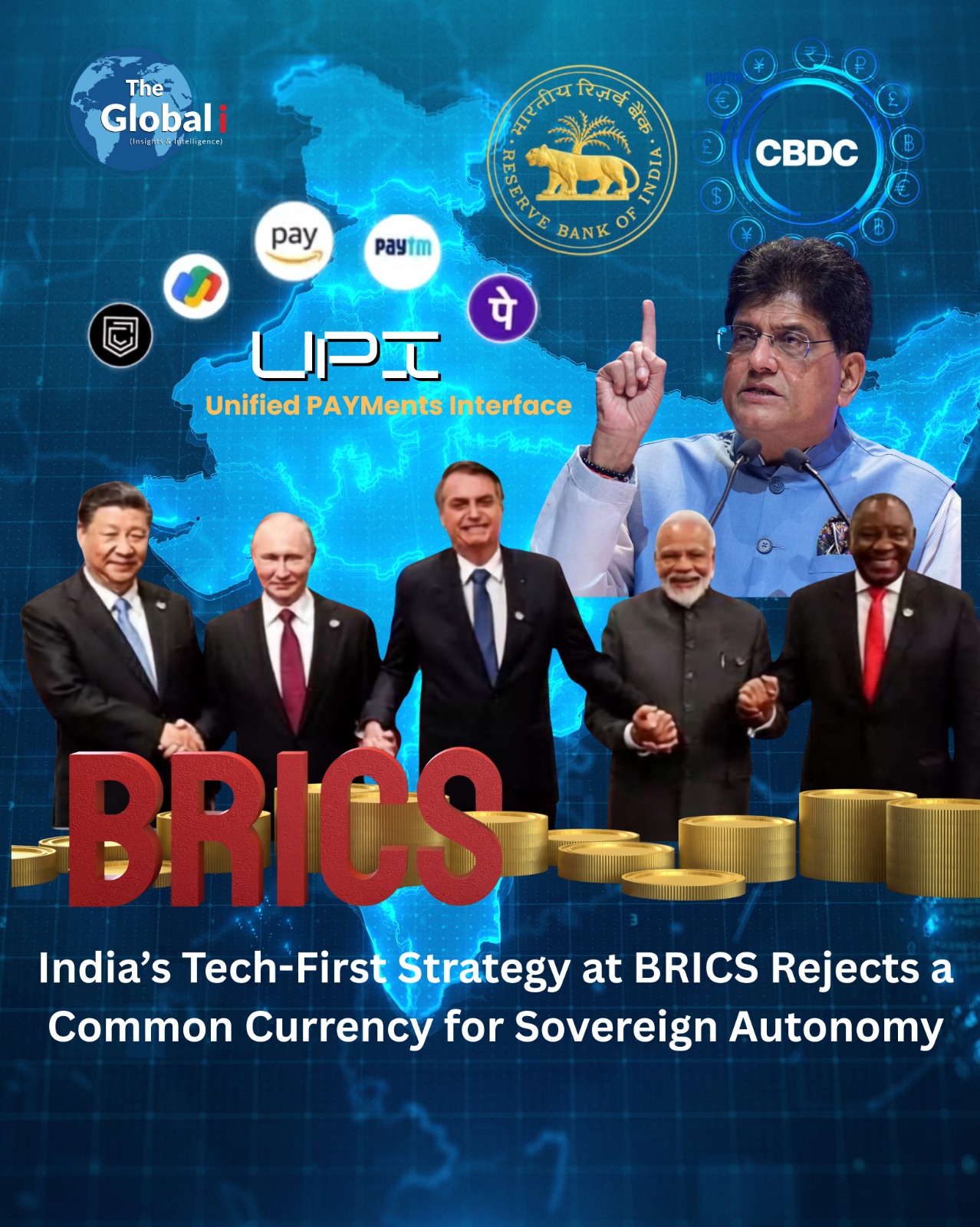
India’s Tech-First Strategy at BRICS Rejects a Common Currency for Sovereign Autonomy
By: Mahima Kansal
As India hosts the BRICS Summit, a distinct ideological divide has emerged regarding the future of global finance. While members like Russia and China frequently nudge the bloc toward aggressive de-dollarisation through a unified multilateral currency, India has firmly drawn a red line. India’s strategy is not to replace one monolithic currency with another, but to pioneer a decentralized, tech-driven alternative rooted in its own Unified Payments Interface (UPI) and Central Bank Digital Currencies (CBDCs). This posture reflects a calculated macroeconomic doctrine: protecting sovereign monetary autonomy while simultaneously dismantling the high transaction costs of legacy cross-border commerce. Rather than supporting a shared currency bloc that could compromise its fiscal independence, India is championing a plug-and-play network of bilateral local currency settlements.
The Goyal Doctrine: Payment Linkage Over Currency Alignment
Speaking at the opening session of the BRICS Business Forum in New Delhi, Union Commerce and Industry Minister Piyush Goyal clearly articulated India's vision. Rather than subscribing to the regulatory and political friction of a shared multilateral currency, Goyal focused heavily on technological interoperability and bilateral trade settlements.
"I would urge the BRICS member countries and partner countries to link our payment systems, trade in each other's local currencies, make digital trade global and build together for the future emerging technologies," Goyal stated.
Minister Goyal explicitly anchored this vision in India's highly successful Digital Public Infrastructure (DPI), highlighting that India's UPI now processes more than 250 billion transactions annually, accounting for over half of global transaction volumes. By inviting BRICS partners to integrate directly with this architecture, India offers a realistic alternative for swift, cheap, and secure international payments without requiring members to yield domestic monetary control.
Why a Shared Currency is a Macroeconomic Red Line
From an analytical perspective, India’s resistance to a unified BRICS currency is highly pragmatic. A shared currency requires a deeply aligned fiscal policy and a unified central bank, which is an impossible feat for a bloc composed of vastly disparate economic systems, ranging from democratic consumer markets like India to heavily state-directed economies like China. Furthermore, Indian policymakers recognize that a common BRICS currency would structurally favor the Chinese Yuan, effectively swapping reliance on the US Dollar for dependency on Beijing. By championing local currency trade backed by digital rails, India ensures its economic destiny remains dictated from Mumbai and New Delhi, not foreign capitals.
The Interoperable Future: UPI and CBDCs
India’s alternative blueprint relies on two domestic financial milestones:
The Global Expansion of UPI: India has already integrated its instant payment system with 11 countries, including fellow BRICS member the United Arab Emirates (UAE) via its Aani network.
The Integration of CBDCs: The Reserve Bank of India (RBI) has proactively proposed connecting official digital currencies across the bloc. Connecting the digital versions of existing national currencies allows trade and tourism settlements to bypass the traditional SWIFT network entirely.
Ultimately, India is playing a sophisticated dual game. It acknowledges the Global South’s valid frustration with weaponized Western financial architecture, but rejects the simplistic solution of creating an anti-Western currency bloc. By offering a middle path focused on digital infrastructure, India positions itself as the technological bridge of the multi-polar world, proving that the future of international trade isn't a new global currency, but the smart networking of national ones.