
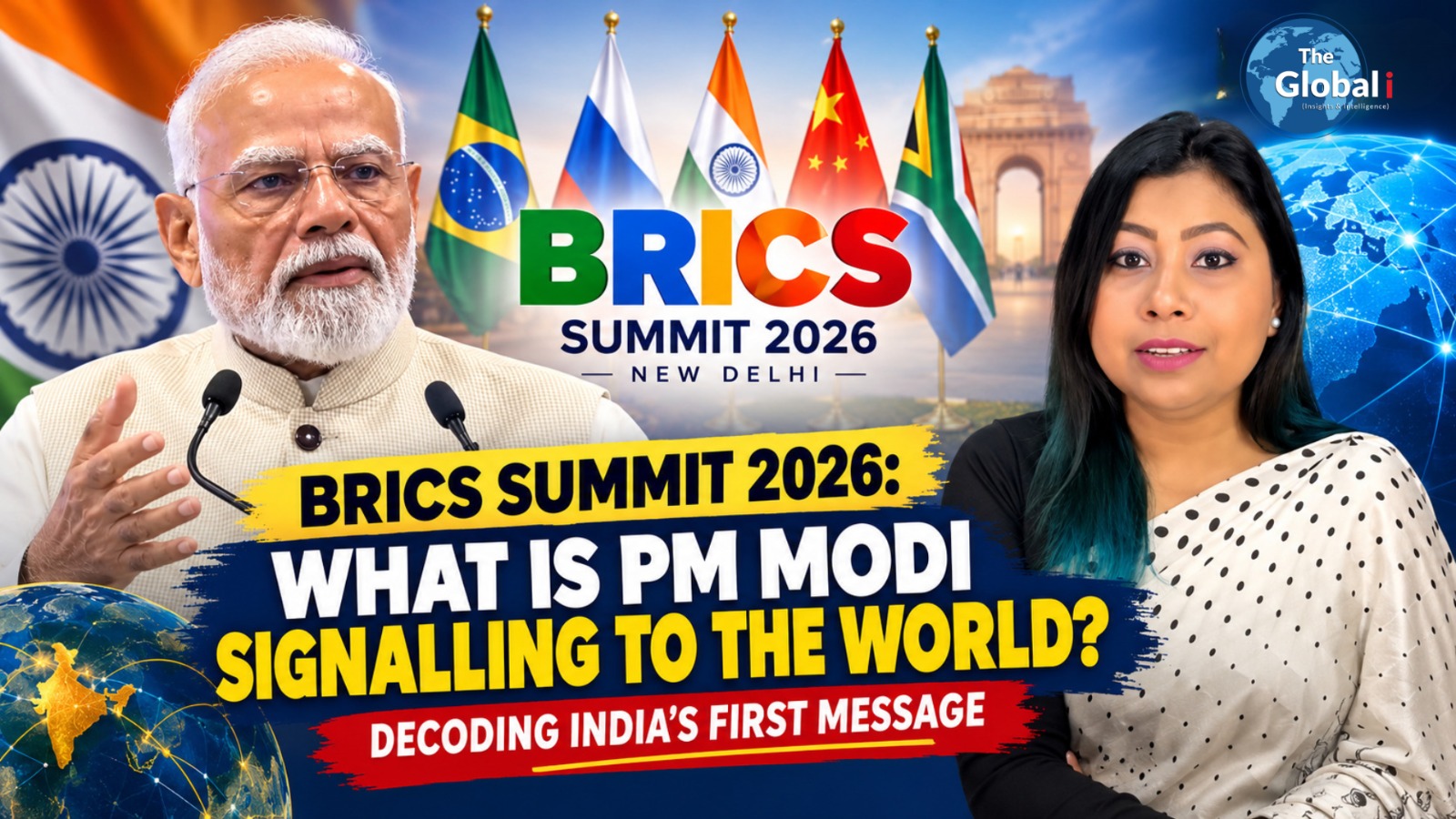
BRICS Summit 2026: What Is PM Modi Signalling to the World? Decoding India’s First Message
BRICS is no longer just a summit; It is becoming a contest over who gets to shape the rules of the global economy. And, at the heart of that contest there is one crucial question: what is India trying to achieve?”
This is not just another international summit. Behind the photographs, the bilateral meetings and the diplomatic statements, there is a much bigger question: Is the world economy slowly moving away from a Western-dominated system towards a more multipolar global order?
And, perhaps more importantly, “What role does India want to play in that new world? ”
WHAT IS BRICS TODAY?
When BRICS was originally created, it was a group of emerging economies. Today, it has become much bigger. The BRICS family, now includes 11 full members, along with partner countries, creating a much wider network of emerging and developing economies. And collectively, this grouping represents roughly half of the world's population and around 40% of global GDP on a purchasing-power-parity basis. Now, don't look at these numbers merely as statistics.Think about what they mean. Half of humanity is represented within this larger BRICS family.
That means enormous markets, consumers, labour forces, natural resources, manufacturing capacity, technological capabilities, energy resources, investment potential.
BRICS has become an important economic force.
WHY DOES BRICS SUMMIT 2026 FEEL DIFFERENT?
BRICS can no longer be dismissed as simply a meeting of developing countries. The world around BRICS has changed. We are witnessing trade wars, tariff battles, sanctions, supply-chain disruptions, conflicts, energy insecurity, and growing competition between major powers.
The United States and China are competing for economic and technological influence. Russia is facing Western sanctions. Iran remains in confrontation with the United States and its allies. And countries across Asia, Africa, the Middle East and Latin America increasingly want greater freedom in deciding their economic partnerships. Thus, BRICS is meeting at a very different moment.
The central question is no longer: “Can emerging economies grow?”
The question is: “Can these economies collectively create more influence over the rules of the global economy?”
DECODING MODI'S FIRST MESSAGE AT BRICS 2026: BRICS MUST MOVE FROM TALK TO ACTION
Prime Minister Narendra Modi's address at the BRICS Business Forum becomes particularly important. Modi's message was very clear.
BRICS already has the size, population, and economic weight. Now it needs greater economic integration.
In simple words, "Don't just make BRICS bigger. Make BRICS work." And this is why , Modi spoke about removing trade barriers, connecting businesses, scaling startups and expanding technological cooperation.
WHAT DOES “REMOVE TRADE BARRIERS” ACTUALLY MEAN?
Suppose an Indian company wants to sell its product in Brazil or a Brazilian company wants to enter India.
Or an Indian startup wants to expand into the UAE or Saudi Arabia.
There can be tariffs, customs restrictions, different regulations, certification requirements, payment difficulties, logistics problems, & complicated procedures, collectively known as Trade barriers.
So, PM Modi emphasized on , Identify the biggest obstacles and start removing them. He has challenged the BRICS Business Council to identify and work towards eliminating the top ten trade friction points.
That sounds technical. But the simple message is: Make it easier for a company in one BRICS country to do business in another BRICS country.
THE STARTUP IDEA — WHY IS MODI TALKING ABOUT 100 STARTUPS?
This is another extremely interesting part of the Prime Minister's roadmap. India has one of the world's largest startup ecosystems. But , a startup cannot remain successful if it has access to only one market.
So Modi wants BRICS countries to help 100 high-growth startups every year scale across BRICS markets.
Imagine an Indian startup developing: AI technology, healthcare technology, fintech, agricultural technology, clean-energy solutions, education technology, or logistics technology. Instead of thinking only about the Indian market, it could potentially enter into Brazil, South Africa, UAE, Saudi Arabia, Indonesia, Egypt, and other emerging markets as well. It wonderfully expands the opportunity.
So when Modi talks about startups, he is actually talking about something much bigger: Creating a common innovation ecosystem.
THE 1,000 BUSINESS PARTNERSHIPS
The third part of the roadmap is to create thousands of enterprise partnerships across BRICS economies, with a target of around 1,000 new business partnerships.
Why does this matter?
Because global economic power is not created only by governments. It is created by companies, entrepreneurs, investors, technology partnerships, joint ventures, and supply chains.
Modi is effectively saying: Let governments create the framework, but let businesses create the economic integration. This is a very important shift.
UPI: INDIAS BLUEPRINT FOR FUTURE INTEROPERABILITY ACROSS BRICS
Modi highlighted India's digital payment ecosystem and said that, UPI now powers around half of the world's real-time digital payment transactions. UPI demonstrates something very significant.
India can build technology infrastructure at population scale. Hundreds of millions of people can make digital payments within seconds. And now India is asking:"Why can't similar digital payment systems become interoperable across countries?"
Imagine someone in India being able to make a payment in another BRICS country almost as easily as making a domestic digital payment. That could dramatically reduce transaction friction.
Does this means India wants to replace the dollar?
Not, exactly. The distinction is extremely important.
UPI does not mean the dollar disappears. What it potentially means is: Fewer transactions may need to depend exclusively on dollar-based financial channels.
Suppose, India and another country are able to settle more trade directly in their own currencies. Then, there may be less need to convert every transaction into dollars.
So,the real objective is not necessarily: “Destroy the dollar, but create alternatives.”
And that is a much more realistic way of understanding BRICS' financial ambitions.
ABOUT THE DE-Dollarisation
There is growing interest among BRICS countries in:
- local-currency trade,
- alternative payment mechanisms,
- cross-border digital payments,
- central-bank digital currencies,
- and financial systems,
that reduce excessive dependence on any single currency. This is what we broadly call de-dollarisation.
But let's be very clear. De-dollarisation does not necessarily mean: “The dollar will disappear tomorrow.”
That is extremely unlikely. The dollar remains deeply embedded in global trade, finance, investment and central-bank reserves. Instead, what may happen is something more gradual. The world could move from: One dominant currency towards: A more diversified financial system.
The dollar could remain extremely important while the yuan, rupee and other currencies play a larger role in regional and bilateral transactions. So this is not necessarily the end of the dollar. It could be the beginning of a less dollar-dependent world.
DOES INDIA REALLY WANT DE-DOLLARISATION?
India's position is different from Russia's.
Russia has a very strong reason to reduce its dependence on Western financial systems because of sanctions. India has a very different relationship with the United States.
India has:
- major trade with America,
- technology partnerships,
- defence cooperation,
- investment relationships,
- and strategic cooperation in the Indo-Pacific.
Therefore, India is unlikely to say, “We want to destroy the dollar.”
India's approach is much closer to, “We want more options.” And that is what Indian foreign policy has increasingly called strategic autonomy.
India wants the freedom to conduct business with America, Russia, China, Europe, the Gulf, Iran, Africa,and the wider Global South.India does not want to be economically dependent on one power centre.
INDIA'S STRATEGY FOR SOVEREIGN AUTONOMY
This is the most important point for understanding India's BRICS strategy.
India does not want, "BRICS OR America". It wants "BRICS AND America."
India wants, "Russia AND the West"
India wants, China as an economic partner, while managing China as a strategic competitor. India wants Gulf energy and investment, while maintaining independent foreign policy.
This is difficult. But it is precisely what strategic autonomy means.
WHAT DOES BRICS MEAN FOR INDIA'S ECONOMY?
Potentially, a lot.
Global market: Indian companies could access more emerging markets.
More investment: BRICS and partner countries contain enormous pools of capital.
More technology cooperation: AI, fintech, healthcare, clean energy and digital infrastructure.
More manufacturing opportunities: India can become a larger manufacturing hub.
More energy choices: Greater diversification of energy suppliers.
More payment alternatives: Potentially lower dependence on intermediary financial systems.
More diplomatic bargaining power: India has a larger platform from which to negotiate global economic rules.
WHAT DOES IT MEAN FOR THE COMMON INDIAN?
It could affect:
- Jobs, If trade and investment increase.
- Startups, If Indian startups get access to larger markets.
- Manufacturing, If companies build new factories in India.
- Digital payments If cross-border payment systems become easier.
- Energy prices If India gets greater flexibility in energy sourcing.
- Exports If Indian companies gain access to more markets.
Thus, BRICS is not just a foreign-policy story. It can eventually become an economic story for ordinary Indians.
WHAT MODI IS REALLY TRYING TO DO?
If you listen carefully to the Prime Minister's Business Forum message, the strategy becomes clear.
He is not saying: “Let's create an anti-American bloc.”Instead he is saying: “Let's create stronger economic connections among emerging economies.”
That is a very different proposition. And that is why he focused on:
- trade barriers,
- startups,
- UPI,
- innovation,
- investment,
- women entrepreneurs,
- MSMEs,
- technology,
- business partnerships.
WHO BENEFITS IF BRICS SUCCEED?
The biggest winner can be India.
India is sitting in a unique position. It has a large population, market, technology, startup ecosystem, geopolitical importance. It shared great relations with the West and Russia including, an expanding relationship with the Global South.
If India can use BRICS to expand its economic footprint without becoming trapped inside a particular geopolitical camp that could be a major strategic victory.
The BRICS Summit 2026, is therefore much bigger than a gathering of presidents and prime ministers. It represents a world undergoing a structural transition. For decades, the global economic system was largely shaped by Western institutions and led by the United States.
Today, emerging economies are asking for a greater role. BRICS is one expression of that demand.
But the real question is not whether BRICS can defeat America.
The real question is whether BRICS can build enough economic strength, financial alternatives, technological cooperation and trade connectivity to ensure that no single power can dominate the global system as easily as before.
And that is where India becomes crucial.
Prime Minister Narendra Modi, is trying to position India not as a country forced to choose one camp, but as a country capable of engaging with every major power centre:
Russia for defence and energy. America for technology and investment. Europe for trade and advanced industries.
The Gulf for energy and capital. China for economic engagement, even while managing strategic competition, and BRICS for a larger voice for the Global South.
So, perhaps the biggest message from New Delhi is not: BRICS versus America. It is not: Dollar versus BRICS currency. It is not even: East versus West.
The bigger story is this: The world is becoming multi-polar. And,India is attempting to make sure that in this new multi-polar world; India is not merely acts as a participant, rather a leading nation to shape rules.