


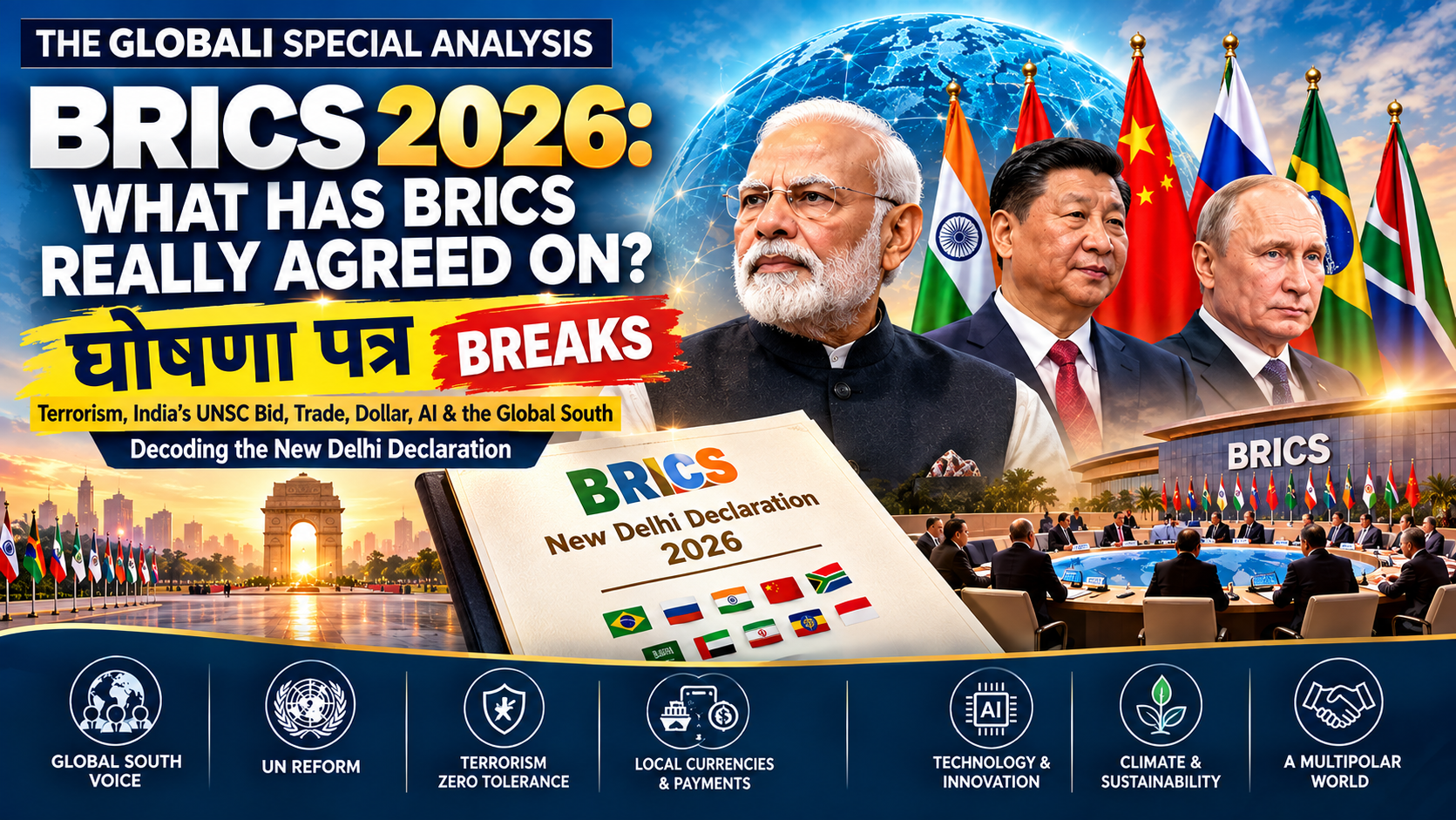
BRICS GHOSHNA PATRA 2026: What Has BRICS Really Agreed On?
What happens when countries with very different political interests, economic priorities and geopolitical relationships sit around one table, and still manage to agree on a common document?
China and India have strategic differences. Russia remains in confrontation with the West. Iran faces major geopolitical tensions. The Gulf countries pursue their own strategic calculations. India, meanwhile, maintains important relationships with both the United States and Russia.
Yet, at the 18th BRICS Summit in New Delhi, the member countries adopted the New Delhi Declaration 2026 by consensus. The declaration is a 45-page document containing 140 paragraphs and covering issues ranging from trade and terrorism to artificial intelligence, energy, global governance and sustainable development.
So the real question is not simply: What has BRICS signed?
The bigger question is: What does the New Delhi Declaration tell us about the world that is emerging?
Is BRICS becoming a meaningful force in a multi-polar world? Is India helping the Global South move from being merely a “voice” to becoming a “rule-shaper”? And does the declaration challenge the existing global order—or does it simply demand a larger seat at the table?
What Exactly Is the BRICS Ghoshna Patra?
The New Delhi Declaration 2026 is the collective political and policy statement adopted by BRICS leaders at the New Delhi Summit.
Its most important feature may be a single word: consensus.
BRICS has expanded far beyond its original grouping and now brings together countries with significantly different political systems, economic priorities and foreign-policy interests. Reaching a common declaration under these circumstances is itself a diplomatic achievement.
But consensus does not mean complete agreement.
The members have found common ground on a wide range of issues, but their bilateral disputes and strategic differences have not disappeared. In fact, the declaration’s language often reflects this reality: where members agree, the language is stronger; where their interests diverge, diplomacy and carefully negotiated wording become essential.
The Bigger Message: The Global South Wants a Greater Voice
If the declaration can be reduced to one central idea, it is this:
The Global South wants greater influence over the rules of the international system.
BRICS is calling for greater representation of developing and emerging economies in global institutions, including the United Nations and international financial institutions such as the IMF and World Bank.
The argument is straightforward.
The global economic balance has changed dramatically. Emerging economies have become increasingly important to global growth, trade, investment and production. Yet many of the institutions governing the international system were designed in a very different geopolitical era.
The question BRICS is therefore raising is fundamental:
If the economic balance of the world has changed, should the political and institutional balance remain unchanged?
That demand for greater representation is at the heart of the declaration.
India’s Big Moment: Reform of the United Nations Security Council
For India, one of the most significant aspects of the declaration is its support for reform of the United Nations and the Security Council.
India has long sought permanent membership of the UN Security Council. The declaration, however, does not automatically give India a permanent seat. Any such change would require a much broader institutional and political process.
But politically, support from a grouping as diverse as BRICS strengthens India’s case for greater representation.
More importantly, India is increasingly positioning itself not merely as a country demanding reform, but as a country capable of helping shape the debate around what a reformed global governance system should look like.
That represents a significant shift in diplomatic posture.
Terrorism: A Particularly Important Issue for India
Terrorism occupies an important place in the declaration and has particular significance for India.
The document takes a strong position against terrorism, terrorist financing, safe havens and the movement of terrorists across borders. It also condemns the April 2025 terrorist attack in Jammu and Kashmir that killed 26 people and calls for stronger international cooperation against terrorism.
For India, the larger principle is clear:
There cannot be one standard for terrorism in one part of the world and another standard elsewhere.
The challenge, however, lies in translating common diplomatic language into coordinated action.
That raises an important question:
Can BRICS turn consensus on terrorism into genuine collective action?
That will be much harder than reaching agreement on a declaration.
West Asia: Consensus Through Diplomatic Balancing
The declaration also addresses the highly sensitive situation in West Asia.
BRICS called for restraint, protection of civilians and civilian infrastructure, continued humanitarian and economic flows, and diplomatic efforts aimed at lasting peace. It also reiterated support for Palestinian statehood and a two-state solution.
The significance lies partly in the fact that BRICS itself contains countries with very different relationships with the parties involved.
Iran is a BRICS member. The UAE is also a member while maintaining close relations with the United States.
Reaching common language under such circumstances demonstrates both the potential and the limitations of the grouping.
BRICS is becoming less about everyone agreeing on everything—and more about finding enough common ground to speak collectively.
Is BRICS Against America?
This is perhaps where headlines can become misleading.
Is the declaration saying “BRICS versus America”?
No.
Is it declaring an economic war against the United States?
No.
Is it announcing the end of the dollar?
No.
The broader message is more nuanced.
BRICS is pushing for a more representative and multi-polar international system in which global decision-making is not concentrated around a single centre of power.
That is fundamentally different from calling for America’s removal from the global system.
And this distinction matters.
Trade: A Pushback Against Protectionism
The declaration expresses concern about unilateral tariffs, non-tariff barriers and protectionist measures, arguing that such policies can distort trade and disrupt global supply chains.
This connects closely with India’s economic priorities.
During the BRICS Business Forum, India pushed ideas aimed at making the grouping more economically productive, including identifying major trade barriers, helping high-growth BRICS startups expand internationally and increasing business partnerships.
The larger objective is clear:
BRICS should not remain merely a diplomatic platform. It should become economically useful.
The declaration provides the political framework; business and trade initiatives can provide the practical mechanism.
The Dollar Question: Is BRICS Really Trying to End Dollar Dominance?
Few issues surrounding BRICS generate as many headlines as de-dollarisation.
But the reality is more complicated.
The more accurate question is not:“Will the dollar disappear?”
It is: “Can countries create more alternatives to using the dollar for every international transaction?”
The direction being explored involves greater use of national currencies, improved cross-border payment mechanisms and alternative settlement arrangements.
The 2026 declaration does not create a common BRICS currency. Nor does it establish a monetary union. Current reporting also indicates that the declaration does not propose a shared currency or integration of members’ central-bank digital currencies.
The more realistic path is therefore gradual:
- Local currencies,
- Payment interoperability,
- Alternative settlement systems,
- Greater financial choice.
That is very different from declaring the end of the dollar.
India’s Digital Advantage
This is where India’s digital public infrastructure becomes strategically significant.
India has demonstrated the ability to operate digital payments at enormous scale. The larger opportunity is whether elements of this experience can contribute to greater payment connectivity among emerging economies.
Imagine, a future in which cross-border payments between India and other BRICS economies become faster, cheaper and less dependent on multiple intermediaries.
If that happens, India’s technological capabilities could translate into geopolitical influence.
India would not simply be exporting a payment system.
It could be contributing to a broader model of digital economic infrastructure.
No, BRICS Is Not Creating a Common Currency
Financial cooperation should not be confused with monetary integration.
A common currency would require extraordinary levels of monetary coordination, financial integration, currency convertibility, fiscal discipline, institutional trust and shared governance.
BRICS is nowhere close to such an arrangement.
The more realistic ambition is to expand financial choices without necessarily attempting to replace the existing global monetary system overnight.
IMF and World Bank: Who Gets to Make the Rules?
Another major theme is reform of the Bretton Woods institutions.
Emerging economies argue that their economic importance has grown substantially, while their representation and influence in global financial institutions have not kept pace.
This brings us to one of the fundamental questions behind BRICS:
Who gets to make the rules of the global economy?
BRICS clearly wants emerging economies to have a larger role in answering that question.
The objective is not necessarily to abolish existing institutions. It is to make their governance more representative of the world economy as it exists today.
The New Development Bank: Creating More Choices
The New Development Bank is another important part of the BRICS architecture.
Developing countries require enormous financing for infrastructure, energy, transport, urban development, digital infrastructure and sustainable development.
The existence of BRICS-led financial institutions gives developing economies another potential source of financing.
This does not mean replacing the World Bank.
It means creating more choices.
And “choice” may be one of the most important words for understanding the larger BRICS project.
Artificial Intelligence and the Technology Race
The declaration also moves beyond traditional geopolitics.
Artificial intelligence, digital transformation, cybersecurity, misinformation and deepfakes, digital financial security, Industry 4.0, startups and technology cooperation all feature in the broader agenda.
This reflects a fundamental change in the nature of global power.
The next major competition may not be fought only over territory.
It will also be fought over:
- Data,
- Artificial intelligence,
- Semiconductors,
- Digital infrastructure,
- Critical technologies,
The question for India is therefore not simply whether it can consume technologies developed elsewhere.
It is whether India can help shape the technologies, standards and institutions that will define the next global economy.
Energy, Food and Supply-Chain Security
Recent global crises have demonstrated how interconnected the world has become.
A conflict in one region can affect food prices thousands of kilometres away.
A disruption in a major shipping route can affect factories across continents.
Financial sanctions can influence energy and commodity markets far beyond the countries directly involved.
BRICS therefore places considerable emphasis on energy security, food security, infrastructure and supply-chain resilience.
For India, these priorities fit naturally with its broader effort to build diversified and reliable supply chains.
Climate Change and Sustainable Development
BRICS is also attempting to balance economic development with sustainability.
Developing economies need growth, jobs and industrialisation. At the same time, they face growing pressure to reduce emissions and transition towards cleaner energy systems.
This creates a difficult question:
If developing countries are expected to make a green transition, where will the affordable technology and financing required for that transition come from?
BRICS wants developing countries to have a stronger collective voice in answering that question.
What the Declaration Does NOT Create
Sometimes, what a diplomatic document does not create is just as important as what it does.
The New Delhi Declaration does not create:
- A BRICS military alliance
- A common foreign policy
- A common currency
- A BRICS government
- An anti-American treaty
BRICS is therefore not becoming another NATO.
Nor is it becoming another European Union.
It is something different:
A platform.
A platform where emerging powers can coordinate positions, develop economic mechanisms and seek greater influence over global governance.
Is BRICS Really United?
Not completely.
And that is precisely what makes the declaration interesting.
India and China remain strategic competitors.
Russia’s relationship with the West remains deeply adversarial.
Iran has major tensions with the United States and Israel.
The Gulf countries maintain strong relationships with Washington while participating in BRICS.
India itself maintains deep strategic and economic relationships with the United States.
So BRICS is not united by ideology.
It is united selectively—where interests overlap.
Perhaps this represents an important feature of 21st-century diplomacy:
Not permanent alliances, but issue-based partnerships.
What Does the New Delhi Declaration Really Tell Us?
The declaration points towards a changing international system in which countries are increasingly seeking:
- More representation.
- More economic choices.
- More financial alternatives.
- More Global South participation.
- More technological cooperation.
- Stronger action against terrorism.
- Greater resilience in trade and supply chains.
Together, these demands point towards a multi-polar world.
Not necessarily a world without America.
Not necessarily a world dominated by China.
But a world with multiple centres of influence.
Where Does India Stand?
This may be the most important question for Indian readers.
India is not abandoning the West.
It is not abandoning Russia.
It is not becoming an ally of China.
And it is not declaring war on the dollar.
India is attempting something more strategic: expanding its options.
With the United States, India seeks technology, investment, defence and strategic cooperation.
With Russia, it maintains relationships in areas including energy, defence and strategic cooperation.
With Europe, it seeks deeper trade, technology and advanced-industry partnerships.
With the Gulf, the focus includes energy, investment and connectivity.
With China, India seeks economic engagement while managing strategic competition.
And through BRICS, India is seeking a larger voice for the Global South.
This is what strategic autonomy can look like in the 21st century.
The Biggest Achievement May Not Be Any Single Clause
The New Delhi Declaration covers an extraordinary range of subjects—from trade and terrorism to finance, AI, energy, climate, West Asia, payments and development.
So which element is the most important?
Perhaps the fact that the members managed to reach consensus despite their differences.
That does not mean BRICS has solved its contradictions.
It means that, under India’s chairship, the grouping managed to keep the table together despite those contradictions.
That itself is a diplomatic achievement.
But the Real Test Begins After the Summit
A declaration can look impressive on paper.
History, however, will judge BRICS by what happens after the cameras leave New Delhi.
Will trade barriers actually fall?
Will business partnerships materialise?
Will payment systems become more interoperable?
Will local-currency trade expand?
Will the New Development Bank finance more projects?
Will cooperation against terrorism become more effective?
Will developing countries receive greater representation in global institutions?
And will the demand for UN reform translate into actual political change?
These are the questions that matter now.
Because, a declaration can change the language of diplomacy. Only implementation can change the world.
The Bigger Outcome for India
For India, the summit has provided an opportunity to demonstrate its ability to bring countries with divergent interests around a common table.
It has placed terrorism prominently on the BRICS agenda, pushed for reform of global institutions, highlighted digital and financial cooperation, promoted trade and business connectivity, and continued to advocate a larger role for the Global South.
India’s broader BRICS strategy can perhaps be summed up in one thought:
India does not want to choose which power should dominate the world. India wants a world where no single power can dominate alone.
That is a very different proposition.
The Global i Analysis
So, what has BRICS really agreed on?
The New Delhi Declaration 2026 is not announcing the collapse of the American-led international system. It is not creating a BRICS superstate. It is not announcing the death of the dollar.
Instead, it signals something more gradual—and potentially more consequential.
Emerging economies want more choices.
More choices in trade.
More choices in finance.
More choices in technology.
More choices in development.
And, above all, more influence over the rules of the international system.
For India, the opportunity is not simply to be one of the countries sitting around the BRICS table.
It is to become a bridge between different worlds—between the Global South and developed economies, between East and West, between traditional and digital finance, between economic growth and sustainable development, and between geopolitical competition and practical cooperation.
The question, therefore, is no longer simply:
Can BRICS challenge America?
The more important question is:
Can BRICS build enough economic, technological and financial strength to give the Global South a genuine alternative?
And perhaps the biggest question of all is this:
If the old world order was built by the powers of the 20th century, who will write the rules of the 21st century?
That is the real story behind the BRICS New Delhi Declaration 2026.