


UPI MDR: The Price of Going Cashless — Could a New Fee Push India Back Towards Cash?
NPCI’s new MDR framework seeks to make India’s digital-payment giant financially sustainable. But as merchants begin paying for some high-value UPI transactions, a bigger question is emerging: could the cost of digital payments revive the parallel cash economy?
By Mahima Kansal
For millions of Indians, the QR code has become the new cash counter.
A cup of tea, a grocery bill, a cab ride, school fees or a payment to a neighbourhood shopkeeper can now be completed in seconds, without opening a wallet or counting currency notes. UPI has turned digital payment from a financial service into an everyday habit.
But, India’s remarkable digital-payment story is now entering a new chapter.
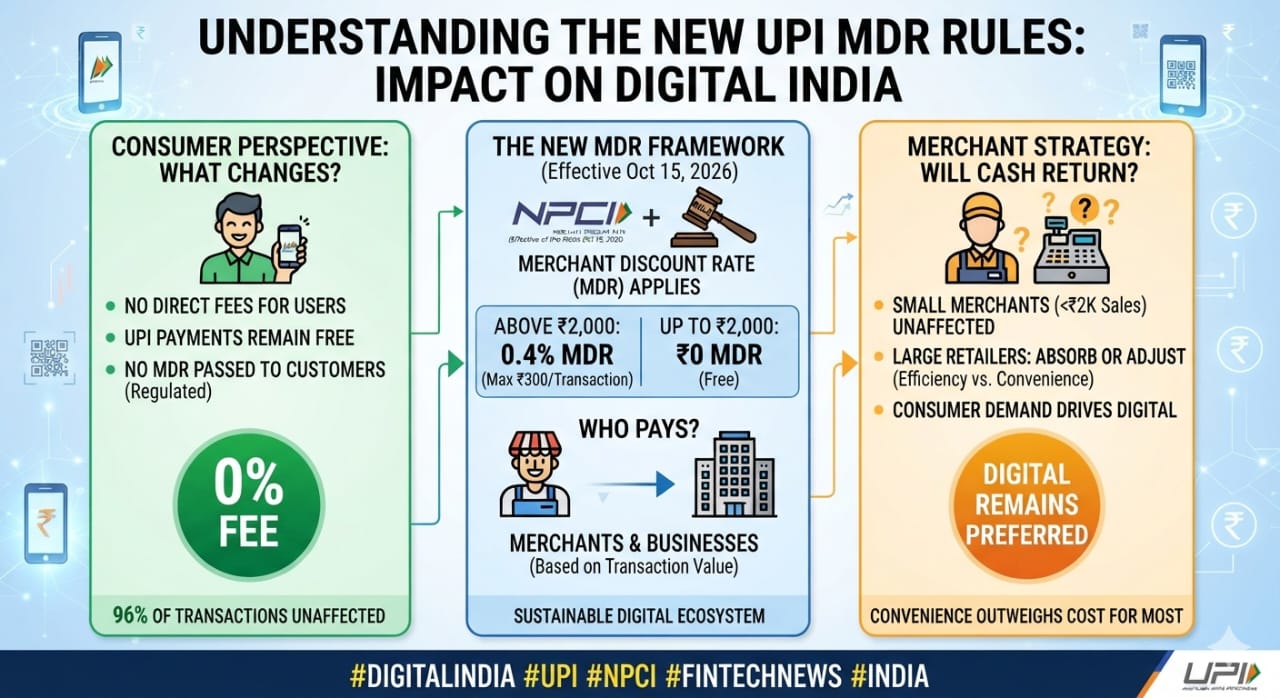
The National Payments Corporation of India (NPCI) has introduced a Merchant Discount Rate (MDR) framework for specified UPI merchant transactions above ?2,000. Under the framework, a 0.4% MDR will apply to eligible Person-to-Merchant (P2M) transactions above ?2,000, while transactions of ?75,000 and above will have a maximum MDR of ?300. The framework is scheduled to take effect from 15 October 2026.
The government, however, has made one point clear: UPI is not becoming a paid service for ordinary users. Person-to-person transactions will remain free, and payments to merchants up to ?2,000 will remain free. According to the Ministry of Finance, around 96% of P2M transactions will remain unaffected.
Yet, the significance of the decision extends far beyond the 0.4% figure.
It touches the future of India’s digital economy, the survival of small merchants, the economics of payment infrastructure, and perhaps most importantly, the relationship between India’s formal digital economy and its enormous cash-based parallel economy.
Why has NPCI introduced MDR now?
UPI’s success has created a paradox.
The more successful the system becomes, the more expensive it is to operate at scale.
In August 2026 alone, UPI processed nearly 24.51 billion transactions worth ?29.82 lakh crore.
Behind every apparently effortless “payment successful” notification lies a complex infrastructure involving banks, payment-service providers, applications, servers, cybersecurity systems, fraud monitoring and telecommunications networks.
NPCI says the MDR revenue will remain within the payment ecosystem and support areas such as infrastructure resilience, innovation, cybersecurity and customer service.
The framework, therefore represents a shift from a largely subsidy-supported model towards a more commercially sustainable model for selected transactions.
The question is no longer simply how to increase UPI adoption.
It is, how to pay for the infrastructure supporting that adoption.
What will actually be charged?
The new structure is selective rather than universal.
For eligible P2M transactions:
- Up to ?2,000: No MDR.
- Above ?2,000: 0.4% MDR.
- ?75,000 and above: Maximum ?300 per transaction.
- Selected essential sectors: ?5 flat MDR on transactions above ?2,000.
- Capital-market transactions: 0.02%, capped at ?300.
- Eligible small P2PM merchants: Zero MDR.
This means a ?3,000 eligible merchant transaction would carry an MDR of ?12, while a ?50,000 transaction would carry ?200. A ?1 lakh transaction would not attract ?400; the maximum would remain ?300.
The customer, officially, does not pay this fee.
The common man’s UPI remains free — but the merchant equation changes
For an individual, the immediate impact is limited.
Sending ?10,000 to a family member will remain free. Paying a friend back will remain free. Transferring money between one’s own accounts will remain free.
Even merchant payments up to ?2,000 will remain outside the MDR framework. The government has also said UPI applications cannot impose separate platform fees or hidden charges on users.
So why should an ordinary consumer care?
Because the customer may not pay MDR directly, but the merchant’s economics can eventually influence how a transaction takes place.
A merchant operates on margins.
For a large retailer, a few rupees in payment-processing cost may simply become another operating expense. But for a small trader selling low-margin goods, every deduction can matter.
This is where the policy’s treatment of small merchants becomes critical.
Small merchants: The firewall against a cash comeback
The framework provides zero-MDR protection to eligible small merchants under the P2PM category, including street vendors and neighbourhood businesses receiving up to ?1 lac per month through UPI QR codes.
The government has also proposed a dedicated fund aimed at expanding digital-payment infrastructure and merchant on-boarding in smaller towns, rural areas and specified regions.
This is significant.
India’s digital revolution did not happen only in shopping malls and corporate stores. It happened at the roadside tea stall, the vegetable cart, the local grocery and the neighbourhood pharmacy.
If these merchants continue to find digital payments inexpensive and convenient, UPI’s penetration can continue.
But if the economics of accepting digital payments become unattractive for certain businesses, the story could change.
And that leads to the bigger question.
Could MDR push some transactions back into cash?
There is no official evidence yet that the new MDR framework will cause a large-scale return to cash.
But economically, the possibility deserves attention.
Suppose a customer wants to purchase a product worth ?10,000.
For the customer, paying by UPI is convenient.
For the merchant, however, an eligible transaction could involve a 0.4% MDR i.e.,?40 in this example.
The amount is small in absolute terms.
But consider a merchant processing hundreds of such transactions. The cumulative cost becomes more visible.
A merchant might therefore have an incentive to prefer:
cash ? no digital processing cost
over
UPI ? payment-processing cost
That does not mean every merchant will make such a choice. Digital payments also bring advantages: speed, transaction records, reduced cash handling, easier reconciliation and potentially greater customer convenience.
But where profit margins are thin, even small costs can influence behaviour.
This is particularly relevant for businesses where customers are willing and able to pay cash.
The parallel economy question
India has spent years trying to move economic activity from an opaque cash environment towards a more transparent digital ecosystem.
Every digital transaction leaves a trail.
Cash does not.
That distinction matters.
Digital payments can help businesses establish transaction histories, demonstrate cash flows and participate more easily in formal financial systems. They can also make certain forms of economic activity more visible to regulators and financial institutions.
Cash, by contrast, can operate outside formal digital records.
This does not mean that every cash transaction belongs to the “parallel economy”. Cash is a perfectly legitimate form of payment and remains essential to millions of people.
But a large cash-dependent economy can provide greater room for unreported or under-reported transactions, particularly where tax compliance and documentation are weak.
This is why a possible shift from digital payments to cash would have implications beyond payment convenience.
If even a section of merchants begins encouraging cash for higher-value transactions to avoid payment-processing costs, the country could face an unintended tension:
the policy designed to make UPI financially sustainable could, at the margin, make cash relatively more attractive.
That would be an important development to monitor.
The paradox of India’s cashless revolution
There is an interesting paradox at the heart of the MDR debate.
India wants UPI to become financially self-sustaining.
But UPI’s greatest strength has been its simplicity and low cost.
The more expensive digital acceptance becomes for businesses, the greater the need to ensure that the cost does not undermine the very behaviour the digital-payment ecosystem spent years encouraging.
This is why the 0.4% figure may matter less than merchant behaviour.
If businesses absorb the cost because digital payments generate higher sales, reduce cash-management expenses and improve efficiency, the effect could remain limited.
If businesses begin displaying signs such as:
“Cash preferred”
or
“UPI extra”
then the policy’s practical consequences could become much more visible.
The government has explicitly stated that merchants should not pass MDR charges to customers.
The real test, therefore, will be implementation and compliance.
A sustainable UPI — without creating a cash incentive
There is another side to the debate.
UPI cannot remain technologically static.
Cybersecurity threats evolve. Fraud techniques become more sophisticated. Transaction volumes keep rising. Banks and payment platforms need investment in servers, software, authentication and fraud detection.
NPCI estimates that maintaining UPI operations, including server bandwidth, fraud prevention and banking technical support, costs around ?20,000 crore annually.
A sustainable payment infrastructure requires sustainable financing.
The challenge is therefore not whether digital payments should have an economic model.
The challenge is how that model is designed without weakening digital adoption.
The new MDR framework attempts to address this through thresholds, exemptions, caps and special treatment for small merchants.
Whether that balance works will depend on what happens beyond the policy document — in the actual marketplace.
The real test begins at the QR code
The success of India’s digital-payment revolution was never simply about technology.
It was about behaviour.
People stopped carrying cash because UPI was easier.
Small businesses started displaying QR codes because customers wanted to scan them.
The technology became successful because it disappeared into everyday life.
That is why MDR deserves to be watched not merely as a financial-policy change but as a behavioural-economic experiment.
Will merchants absorb the cost?
Will customers continue choosing UPI?
Will small businesses remain protected?
Will digital transaction records continue expanding the formal economy?
Or will some higher-value transactions quietly move back to cash?
Nobody can answer that with certainty today.
But the possibility creates an important policy tension.
Conclusion: The QR Code Is More Than a Payment Tool
India’s UPI revolution has done something remarkable: it has made a complex financial transaction feel almost invisible.
A person scans a QR code.
The phone vibrates.
Payment successful.
But behind those few seconds lies one of the world’s largest digital financial infrastructures.
The new MDR framework is an attempt to put an economic value on maintaining that infrastructure.
The government has protected the common user by keeping P2P payments free and most merchant transactions outside MDR. It has also created safeguards for small merchants.
But the deeper story begins where the policy ends.
India’s battle is no longer simply between cash and digital payments. It is between two economic systems — one increasingly transparent, traceable and technology-driven, and another where cash can still operate with far less visibility.
If MDR remains a small, manageable business expense, UPI could become not only India’s most successful payment platform but also a financially sustainable piece of national infrastructure.
But if payment costs begin changing merchant behaviour, the country could witness an unexpected counter-current: the gradual return of cash in precisely those transactions where digital payments were beginning to dominate.
And, that would make the MDR debate much larger than a 0.4% fee.
It would become a question about, what kind of economy India wants to build: one where every QR code strengthens the formal digital economy, or one where the cash drawer quietly begins competing with the smartphone again.
The next chapter of India’s cashless revolution may therefore not be decided inside a bank, a fintech company or an NPCI office. It may be decided at the neighbourhood shop: when a customer asks, “UPI chalega?” and the shopkeeper decides what to say.
#NPCI #UPI #MDR #Businessnews