


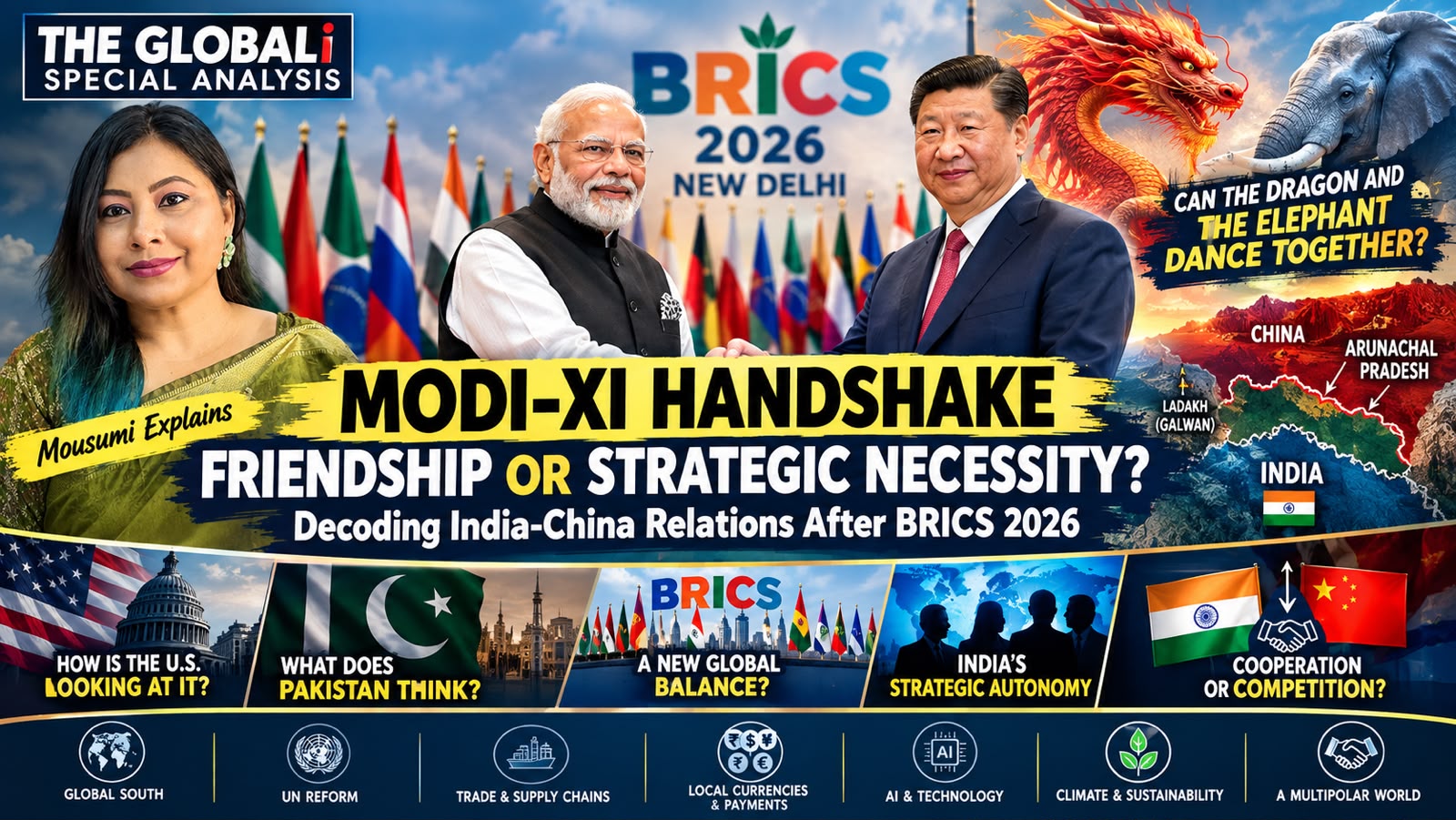
MODI–XI HANDSHAKE: FRIENDSHIP OR STRATEGIC NECESSITY?
Can the Dragon and the Elephant Dance Together? Decoding the Message Behind the BRICS 2026 Handshake.
A handshake lasts only a few seconds. In international politics, however, a handshake between two leaders can carry the weight of an entire diplomatic message.
At the BRICS Summit in New Delhi, Prime Minister Narendra Modi and Chinese President Xi Jinping shook hands, exchanged smiles and held a bilateral meeting lasting more than 50 minutes. The images quickly travelled across the world, prompting a familiar question: Is India and China finally turning a corner?
Is this the beginning of a new friendship, or is something more strategic unfolding beneath the symbolism?
Perhaps the more important question is not whether India and China can become friends, but whether two major powers can learn to cooperate while remaining strategic competitors.
That is what makes the Modi–Xi handshake significant.
THE HANDSHAKE THAT MADE HEADLINES
Xi Jinping's visit to India was significant in itself. It marked his first visit to the country in nearly seven years. The public image of Modi and Xi shaking hands at the BRICS Summit immediately created an impression of an India-China thaw.
Yet, diplomacy demands caution.
The handshake should not necessarily be read as friendship. It should be read as diplomacy.
The border dispute remains unresolved. Strategic trust has not been completely restored. Trade continues to be heavily imbalanced. China's relationship with Pakistan remains a major concern for India, while New Delhi and Beijing continue to compete for influence across Asia and the Global South.
What, then, are we witnessing?
Perhaps not friendship, but something more pragmatic: managed competition.
FROM GALWAN TO NEW DELHI: THE BORDER STORY IS NOT OVER
To understand the significance of the Modi–Xi engagement, one must look back to the transformation in India-China relations following the 2020 Galwan Valley clash.
For years, India and China had maintained a difficult but functioning relationship despite their unresolved boundary dispute. Galwan dramatically altered that equation.
Lives were lost. Military tensions escalated. Trust deteriorated. The relationship entered a prolonged period of strategic suspicion.
But Galwan is only one part of the border story.
India's concerns also extend to Arunachal Pradesh, which China continues to claim as part of what it calls southern Tibet. Beijing has repeatedly attempted to reinforce that claim by assigning Chinese names to places in Arunachal Pradesh, moves that India has firmly rejected.
The India-China border issue is therefore not limited to a single flashpoint. It represents a broader and unresolved territorial question stretching across the Himalayas.
And that is precisely why the Modi–Xi handshake must be interpreted carefully.
A handshake cannot erase a boundary dispute.
Since Galwan, both countries have gradually sought to stabilize the relationship. The 2024 disengagement process helped reduce immediate military tensions in parts of the western sector, while diplomatic engagement has increased once again. Yet substantial strategic mistrust remains.
Now, in September 2026, Xi Jinping is back in India. Modi is shaking hands with Xi. The two leaders are discussing ways to move the relationship forward.
But the difficult questions remain:
What happens on the border?
What happens in Arunachal Pradesh?
How will India address China's strategic relationship with Pakistan?
And perhaps most importantly:
Can diplomatic engagement continue even when the territorial dispute remains unresolved?
That is the real test of the Modi–Xi moment.
India may be willing to engage, but engagement does not mean abandoning its territorial concerns. Cooperation does not mean surrendering its position.
The handshake may signal a thaw in diplomacy, but the map tells a far more complicated story.
WHAT DID MODI ACTUALLY TELL XI?
The substance of the meeting is more important than the symbolism of the handshake.
India's position has consistently emphasized the importance of mutual respect, mutual sensitivity and mutual interest. One particularly significant principle is that differences should not be allowed to become disputes.
At the same time, India has emphasized that peace and tranquillity along the border remain essential for the development of bilateral relations.
The message is therefore clear: India is prepared to engage, cooperate and expand economic and people-to-people ties, but the border cannot simply be pushed aside.
That is not surrender.
That is diplomacy.
AND WHAT IS CHINA SAYING?
China, too, has adopted a more conciliatory tone.
Xi Jinping has described India and China as partners rather than rivals, arguing that the development of one country should be viewed as an opportunity rather than a threat to the other.
Beijing has also emphasized cooperation in trade, connectivity, people-to-people exchanges and multilateral institutions.
But why does China have an interest in improving relations with New Delhi?
The answer lies partly in the larger geopolitical environment.
WHY DOES CHINA NEED INDIA?
China does not necessarily want another permanently hostile relationship on its western and southern strategic periphery.
Beijing is already operating in an increasingly complex geopolitical environment, particularly amid strategic competition with the United States and its allies. A continuously confrontational relationship with India would add another major challenge.
India is no longer a marginal regional player.
It is one of the world's largest economies, possesses significant military capabilities, has an expanding technology sector and has emerged as an important voice of the Global South.
India has also developed increasingly close strategic relationships with the United States, Japan, Australia and Europe.
From Beijing's perspective, therefore, keeping India permanently aligned against China would carry strategic costs.
THE GLOBAL SOUTH AND THE BRICS EQUATION
There is another important factor: BRICS.
China wants BRICS to emerge as an important pillar of a more multi-polar international system. But the grouping influence is difficult to separate from the relationship between its two major Asian members—India and China.
India brings something that China alone cannot easily provide: broad credibility and diplomatic reach across the Global South.
India maintains relationships with Western powers, the Gulf, Europe, Japan and Australia while retaining an independent diplomatic identity.
China may not need India as an ally.
But it certainly needs India as a major partner within the multi-polar framework it seeks to strengthen.
BUT INDIA NEEDS CHINA TOO
The equation works both ways.
It is easy to ask why China needs India. The more difficult question is why India needs China.
Not as an ally.
Not necessarily as a strategic partner.
But as a neighbour, a major economic power and a permanent member of the UN Security Council.
China is too large to ignore.
India imports significant quantities of industrial goods, components and critical inputs from China. Chinese manufacturing capabilities are deeply embedded in several global supply chains.
If India wants to become a major manufacturing power, it can reduce excessive dependence on China and diversify its supply chains—but completely ignoring the Chinese economic ecosystem would be difficult.
India therefore faces a complex balancing act.
It can compete with China.
It can reduce strategic and economic vulnerabilities.
It can strengthen alternative supply chains and deepen partnerships with the United States, Japan, Europe and other countries.
But at the same time, it must continue talking to China.
That is strategic realism.
CAN THE DRAGON AND THE ELEPHANT DANCE TOGETHER?
Perhaps; but not in the conventional sense of friendship.
India and China may instead learn to walk parallel paths while competing for influence.
They can cooperate on climate change, global health, BRICS and selected multilateral issues. They can expand trade and people-to-people exchanges.
At the same time, they can continue competing in the Indo-Pacific, disagreeing over the border and competing economically and strategically.
There is no inherent contradiction in this.
That is how modern diplomacy often works.
Countries do not have to agree on everything to cooperate on something.
MODI, XI AND PUTIN: THE LARGER PICTURE
The Modi–Xi handshake was only one part of the broader diplomatic imagery emerging from BRICS 2026.
Another significant image was that of Modi alongside Xi Jinping and Vladimir Putin.
The picture captures the complexity of India's foreign policy.
India maintains a historic strategic relationship with Russia. It is rebuilding dialogue with China. At the same time, it maintains deepening relationships with the United States, Japan, Europe, Australia and the Gulf.
This is the practical expression of strategic autonomy.
India's message is essentially straightforward:
Talk to everyone.
Cooperate where interests converge.
Disagree where interests diverge.
And do not allow any single relationship to define India's foreign policy.
WHAT ABOUT AMERICA?
Washington will inevitably watch the India-China engagement closely.
However, India's dialogue with Beijing does not automatically indicate a retreat from its relationship with the United States.
India can cooperate with the United States through the Quad while simultaneously expanding defence, technology and economic cooperation with Western partners. At the same time, it can engage China through BRICS, the SCO and bilateral diplomacy.
This makes India's foreign policy increasingly difficult to fit into a simple geopolitical binary.
India does not want its foreign policy to be defined by choosing Washington over Beijing—or Beijing over Washington.
It seeks strategic space to engage with both according to its national interests.
The Modi–Xi handshake, therefore, should not automatically be interpreted as the emergence of an India-China strategic alliance.
It is more accurately understood as a signal that India wants competition with China to be managed rather than allowed to become permanent confrontation.
AND WHAT ABOUT PAKISTAN?
Islamabad will also be watching the India-China equation carefully.
China remains one of Pakistan's closest strategic partners, while India continues to have serious concerns regarding China's strategic and defence relationship with Pakistan.
Does improved India-China engagement automatically mean that Beijing will distance itself from Islamabad?
Not necessarily.
China can improve relations with India while maintaining its relationship with Pakistan.
Both Beijing and New Delhi understand this reality.
The more realistic diplomatic question is therefore not whether China will stop being Pakistan's partner, but whether India and China can prevent their Pakistan-related differences from poisoning the broader bilateral relationship.
That will remain a difficult challenge.
BRICS IS THE BIGGER STAGE
The BRICS platform provides an important setting for this balancing act.
India does not want BRICS to become simply a China-Russia platform positioned against the United States and the West.
New Delhi has consistently sought to preserve BRICS as a platform where countries of the Global South can cooperate, negotiate and increase their collective influence without transforming the grouping into an anti-Western military or geopolitical bloc.
This explains why the Modi–Xi engagement matters.
India can cooperate with China within BRICS without accepting Chinese leadership over India's foreign policy.
It can work with Russia without becoming part of a Russia-China bloc.
And it can work with the United States without becoming part of an American bloc.
That is strategic autonomy.
WHAT DOES XI WANT FROM INDIA?
At its core, Beijing's message may be relatively straightforward.
China wants stability.
It wants trade.
It wants access to markets.
It wants BRICS to become more influential.
It wants greater cooperation among emerging economies.
And it has little strategic interest in seeing India become an unquestioning member of an anti-China coalition.
India's interests are equally clear:
Peace at the border.
Predictability in economic relations.
Greater market access.
Strategic space.
And the ability to compete without permanent confrontation.
There is therefore a zone where the interests of both countries overlap.
Diplomacy begins precisely there.
BUT TRUST REMAINS THE BIG QUESTION
A handshake can last seconds.
Trust can take years to build.
That is why the most important test of the Modi–Xi moment will not be the photograph. It will be what follows.
Will the border remain peaceful?
Will existing agreements be respected?
Will trade become more balanced?
Will market access improve?
Will business and travel links genuinely expand?
Will India and China be able to manage disagreements without allowing them to escalate into crises?
And most importantly:
Will actions match the new diplomatic language?
If they do not, the handshake will remain just a photograph.
THE REAL INDIA–CHINA FORMULA
Perhaps India-China relations should no longer be viewed through the simplistic lens of friends or enemies.
International relations rarely operate in such binary terms.
India and China can be competitors and still cooperate.
They can disagree and still maintain dialogue.
They can compete economically and continue trading.
They can have a border dispute and still pursue diplomatic engagement.
They can have different visions of the international order and still find common ground.
The emerging formula may therefore be:
Cooperate where possible.
Compete where necessary.
Protect national interests at all times.
THE GLOBALI'S FINAL ANALYSIS
So, is the Modi–Xi handshake a sign of friendship?
Not yet.
Is it meaningless symbolism?
Certainly not.
It is diplomacy.
It is a signal that India and China may have recognized a fundamental reality: permanent confrontation serves neither side.
The elephant does not have to become the dragon's friend.
The dragon does not have to become the elephant's ally.
But both may have concluded that they have too much at stake to allow rivalry to become uncontrollable.
And perhaps that is the real meaning of the handshake.
India is not abandoning America.
It is not abandoning Russia.
It is not surrendering its position on the border.
It is not forgetting Pakistan.
And it is certainly not handing over its strategic autonomy to China.
Instead, New Delhi appears to be pursuing a more complicated but increasingly important diplomatic proposition:
India can cooperate with China without becoming China's partner in everything.
India can compete with China without becoming China's permanent enemy.
That may be the deeper lesson of BRICS 2026.
Because in the emerging world order, countries may not have permanent friends.
They have permanent interests.
And perhaps the most powerful form of diplomacy is not the ability to turn a rival into a friend, but the ability to sit across the table from that rival, shake his hand, maintain dialogue—and still protect one's own interests.
So the question is no longer simply:
Can the dragon and the elephant become friends?
The bigger question is:
Can, the dragon and the elephant learn to dance without stepping on each other's toes?