


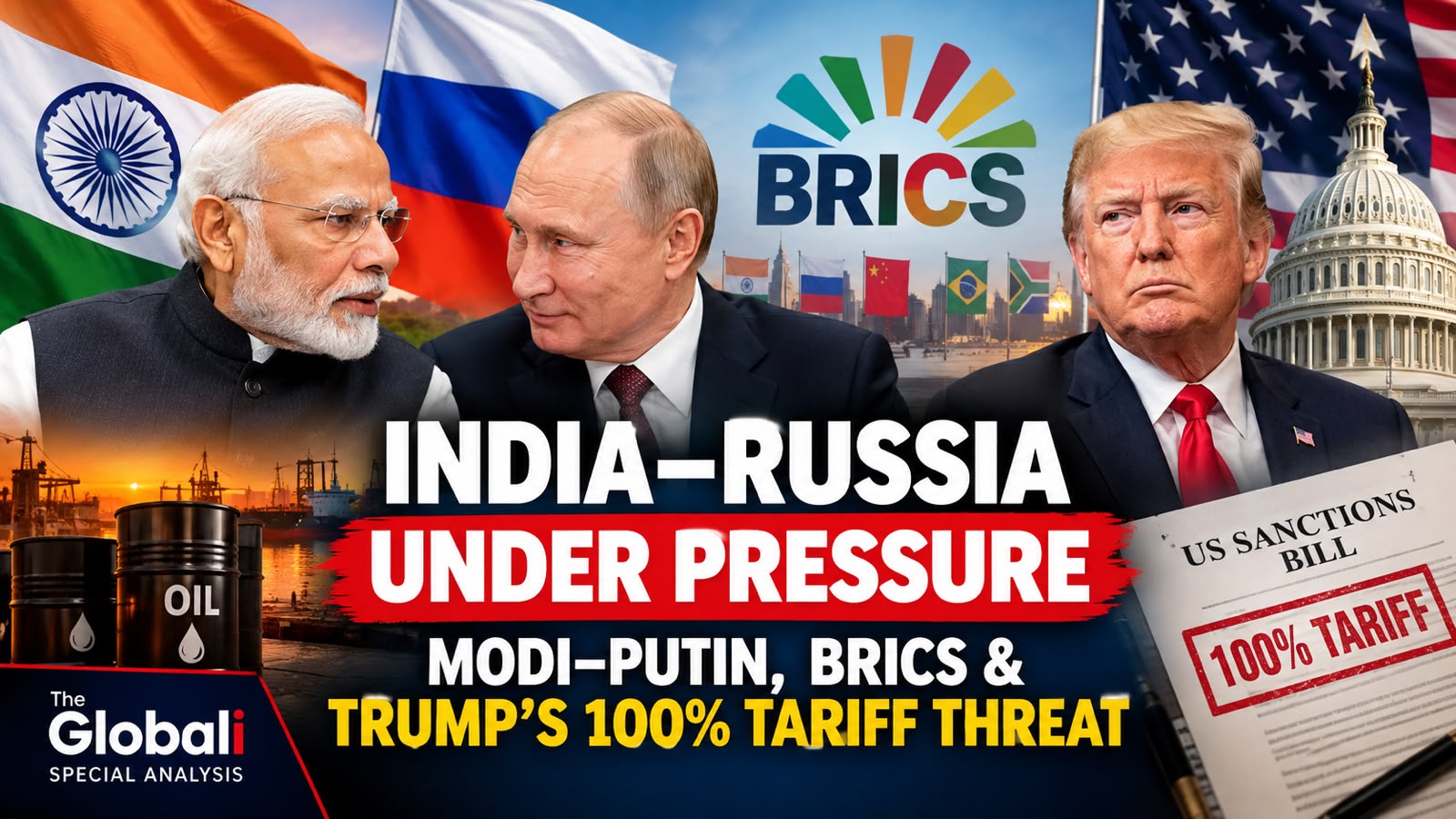
India-Russia Ties Under Pressure: Can Strategic Autonomy Survive the New Tariff Battle?
Modi-Putin meeting, BRICS diplomacy and proposed U.S. tariffs put India's balancing strategy under the spotlight.
India's relationship with Russia is entering a more complicated phase as proposed U.S. secondary tariffs raise fresh questions about energy security, trade and strategic autonomy.
THE MODI-PUTIN MEETING: MORE THAN A BILATERAL CONVERSATION
Russian President Vladimir Putin's arrival in New Delhi ahead of the BRICS Summit placed India-Russia relations at the centre of a larger geopolitical conversation. His bilateral meeting with Prime Minister Narendra Modi covered political, economic, defence, energy, space, skill mobility and people-to-people cooperation. The two leaders also discussed conflicts in West Asia and the Black Sea region, including their implications for maritime trade and the safety of Indian seafarers.
Putin's invitation to Modi for the "24th India-Russia Annual Summit", which Modi accepted, added another signal of continuity. India officially describes the relationship as a “Special and Privileged Strategic Partnership” that has remained resilient despite geopolitical uncertainties.
The timing, however, makes the meeting particularly significant. The BRICS Summit brought India, Russia, China, Iran and other emerging powers together around discussions on local currencies, cross-border payment mechanisms and reforms to global institutions. At the same time, Washington was advancing legislation that could increase economic pressure on countries continuing to purchase Russian energy.
FROM DEFENCE TO ENERGY, TRADE AND TECHNOLOGY
India-Russia relations are no longer confined to defence cooperation. The relationship increasingly encompasses energy, nuclear cooperation, industrial production, critical minerals, technology, trade and payment mechanisms.
The two countries have discussed increasing bilateral trade towards $100 billion by 2030, while exploring cooperation in infrastructure, energy and nuclear power.
That wider relationship matters because pressure on Russian oil purchases could have implications beyond the energy sector. The central question for New Delhi is whether it can continue expanding its relationship with Moscow while maintaining a major strategic and economic relationship with Washington.
THE LINDSEY GRAHAM BILL AND THE 100% TARIFF QUESTION
The proposed U.S. legislation has brought that question into sharper focus.
According to the supplied source, the U.S. Senate passed the Lindsey O. Graham Sanctioning Russia and Iran Act of 2026 on August 7 by an 86–11 vote. The legislation is broader than Russian oil, covering sanctions against Russian individuals and entities, the energy sector and vessels associated with sanctions evasion, including the network commonly described as the “shadow fleet”. It also contains provisions concerning Iran.
The Senate version includes the possibility of tariffs of up to 100 percent on certain countries that are among the biggest purchasers of Russian oil and natural gas, as well as certain facilitators of sanctions evasion. It also provides for tariffs of up to 500 percent on Russian-origin goods, subject to specified exceptions, and extends the Iran Sanctions Act from 2026 to 2031.
The important point is that this is not simply an oil measure. It is designed as a wider economic pressure mechanism around Russia.
INDIA IS EXPLICITLY NAMED IN A PROPOSED HOUSE AMENDMENT
The political message became more direct as the legislation moved through the House.
A proposed amendment introduced by Democratic Representative Steny Hoyer would specifically identify 10 countries as eligible for duties of up to 100 percent: China, India, Türkiye, Azerbaijan, Hungary, Slovakia, the United Arab Emirates, Singapore, Kazakhstan and Kyrgyzstan.
However, the source also notes that another House amendment, proposed by Representative Gregory Meeks, seeks to remove the provision granting the President broad authority to impose these secondary tariffs.
That distinction is crucial. Saying that India “will face a 100 percent tariff” would be premature. The more precise formulation is that India has been explicitly named among countries that could become eligible for tariffs of up to 100 percent if the legislation becomes law in its current form and the authority is subsequently used.
THE HOUSE VOTE AND THE QUESTION OF PRESIDENTIAL POWER
On September 15/16, the House took a major procedural step, with the measure advancing by a narrow 214–211 vote. According to the source, the final House vote was still pending in the latest reporting, after which the legislation would have to complete the remaining congressional process before reaching President Donald Trump.
The proposed framework therefore raises a second question alongside the tariff issue: how much discretion would the President ultimately have over whether and how such measures are imposed?
That makes the legislation both an economic and diplomatic instrument. It could influence not only purchases of Russian energy but also the wider relationship between Washington and countries that maintain significant economic ties with Moscow.
WHY INDIA MATTERS IN THE RUSSIAN ENERGY EQUATION
India's role in the debate is closely connected to the transformation of its energy imports after the Ukraine war. Discounted Russian crude became an important component of India's energy imports.
For New Delhi, the stated considerations are energy security, affordability and national interest. From Washington's perspective, the argument is different: revenue from Russian energy exports supports Russia's ability to sustain its war effort in Ukraine, making major purchases by other economies an important part of the sanctions debate.
This creates a fundamental clash of priorities.
Washington's question is how Russia can be economically pressured if major economies continue purchasing its oil. India's question is how it can protect energy security while pursuing its own national interests in a geopolitical conflict.
WHY THE TIMING AFTER BRICS MATTERS — BUT REQUIRES CAUTION
The sequence of events has naturally generated geopolitical speculation. At the BRICS Summit, India, Russia and other members emphasized greater cooperation, cross-border payment systems, local currencies and a more multipolar economic architecture. The summit declaration also criticized unilateral sanctions and tariff barriers.
Putin's India visit reinforced Moscow's strategic relationship with New Delhi, while India continued to maintain an independent position on the Ukraine conflict and advocate dialogue and diplomacy.
Yet timing should not be confused with causation. The source explicitly notes that there is no established evidence that the House amendment was introduced because Putin visited India or because of the BRICS Summit. The legislation has a longer history.
What can be said is that the timing highlights a striking contrast between two approaches to the global economic order: one seeking stronger alternative mechanisms among emerging economies, and another using economic pressure to constrain Russia's international energy relationships.
WASHINGTON'S CONCERN AND INDIA'S UNIQUE POSITION
From Washington's perspective, the immediate issue is not necessarily that India is becoming a Russian ally. The concern is more specific: India remains a major buyer of Russian energy while the United States is attempting to reduce the revenue streams available to Moscow.
At the same time, India occupies a unique position in the international system. It is a member of BRICS, a major defence partner of Russia, an important buyer of Russian energy, a strategic partner of the United States, a member of the Quad and an increasingly important player in the Indo-Pacific.
India therefore does not fit neatly into a single geopolitical camp. Its relationships overlap, and that is precisely what makes the country's strategic choices significant.
WHAT COULD IT MEAN FOR INDIA?
The implications can be viewed through four interconnected lenses.
Energy: If tariffs are imposed, the issue would extend beyond whether Russia continues selling oil to India. New Delhi would have to consider alternative supplies, prices, shipping, insurance and payment mechanisms.
Trade with America: Depending on the final law and how presidential authority is used, tariffs could affect Indian exports to the United States and potentially broaden the issue into a wider India-U.S. trade dispute.
Strategic autonomy: India has sought to maintain relationships with competing power centres simultaneously. The emerging question is whether strategic autonomy becomes more difficult when economic instruments are increasingly used as tools of geopolitical pressure.
India-Russia relations: Greater U.S. pressure could force difficult calculations about Russian energy purchases, diversification, defence cooperation, nuclear cooperation and the scope of future economic engagement with Moscow.
MOSCOW'S STAKES IN THE RELATIONSHIP
Russia views India as more than an energy customer. India is a major economic partner, an established defence partner and an important country within BRICS.
Putin's decision to arrive ahead of the BRICS Summit and hold a dedicated bilateral meeting with Modi underscored the importance Moscow attaches to the relationship. Russia has also rejected proposed U.S. tariffs on Russian oil buyers as unacceptable.
Moscow therefore has a clear interest in preserving close ties with New Delhi. India, however, has a different strategic objective: keeping its major partnerships open.
India-Russia cooperation does not automatically mean India is choosing Russia against America. Similarly, India-U.S. strategic cooperation does not automatically require India to distance itself from Russia. The distinction lies at the heart of India's balancing strategy.
IS THIS A NEW COLD WAR?
Perhaps the more useful question is whether today's geopolitical system can even be understood through the old Cold War model.
The global economy is far more interconnected. India trades with the United States, buys energy from Russia, participates in BRICS, works with Washington through the Quad, cooperates with European economies and simultaneously manages a complicated relationship with China.
Instead of two clearly separated camps, the world increasingly contains overlapping partnerships.
Countries are therefore not necessarily choosing one bloc. They are often choosing interests issue by issue.
THE BIGGER QUESTION: WHEN ECONOMICS BECOMES GEOPOLITICS
The India-Russia story is ultimately larger than one sanctions bill.
The United States is seeking to use economic pressure to influence countries purchasing Russian energy. Russia is attempting to preserve its energy markets and strategic partnerships. India is trying to protect energy security while maintaining strategic autonomy. BRICS is discussing alternative approaches to trade, payments and global governance.
This raises a deeper question: what happens when economic instruments become central tools of geopolitical competition?
Oil is no longer simply a commodity in this contest. Tariffs are no longer simply instruments of trade policy. Payments, technology, supply chains and market access are increasingly connected to strategic calculations.
For India, the challenge is not merely choosing between Russia and America. It is managing both relationships while preserving room for independent decision-making.
THE GLOBALI ANALYSIS
The most important question is therefore not whether India will choose Russia or America. India's foreign policy has repeatedly demonstrated that it does not have to fit that binary.
The deeper question is whether India can remain strategically autonomous when the economic cost of that autonomy begins to rise.
The Modi-Putin meeting, the BRICS Summit, Russia's energy relationship with India and the proposed U.S. sanctions legislation are not isolated developments. Together, they form part of a larger geopolitical picture in which the contest is no longer confined to territory or military alliances.
It is increasingly about oil, trade, tariffs, payments, technology, supply chains and, ultimately, who gets to shape the rules of the global economy.
For New Delhi, the task ahead will be to protect energy security, sustain economic growth, preserve strategic partnerships and retain diplomatic flexibility—without allowing any single relationship to dictate the entirety of its foreign policy.
The next moves from Washington, Moscow and New Delhi will therefore matter far beyond one tariff proposal.
Because the new battlefield of geopolitics may not always be fought with armies.
Sometimes, it is fought with oil, tariffs, payments, and the power to decide where economic dependence begins and strategic autonomy ends.