


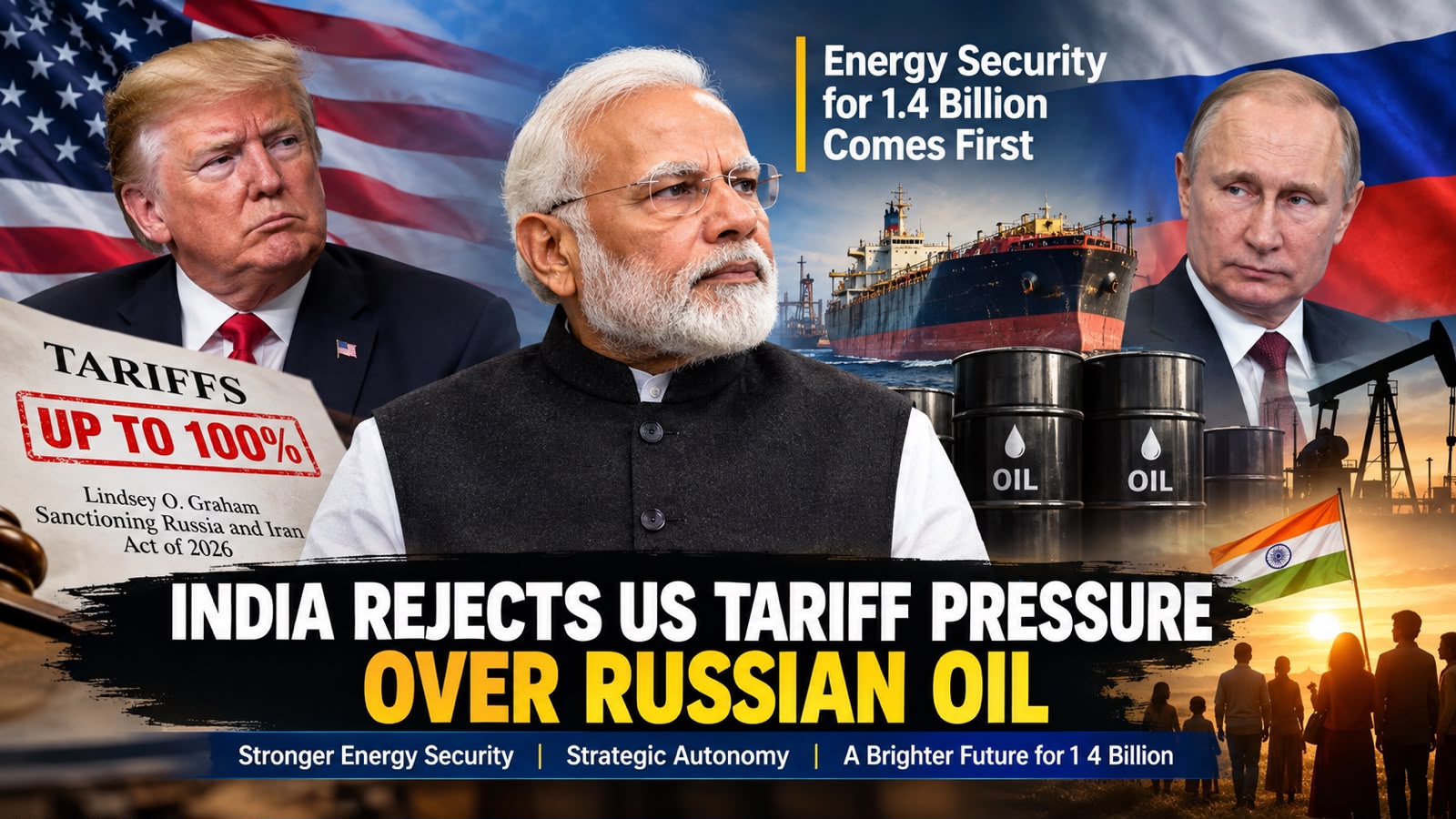
INDIA’S MESSAGE TO WASHINGTON: ENERGY SECURITY COMES FIRST
How far can Washington push India on Russian oil, and how firmly will New Delhi defend its energy
choices?
India has responded to the latest American tariff pressure with a message that is measured, but
unmistakably clear.
The Ministry of External Affairs, has reiterated that India remains firmly committed to ensuring
energy security for its 1.4 billion people, and will continue to pursue diversified sources of oil and
gas according to changing market conditions.
And this is important: The MEA is not presenting this as a new position.
India has said this on several earlier occasions as well.
New Delhi has consistently maintained that India's energy decisions must be guided by the country's
requirements, the interests of its people and the realities of the international energy market.
The MEA has also said that the issue has been discussed at high levels with American interlocutors in
recent months, with India clearly explaining the possible implications: not only for the India-US
relationship, but also for the international energy market.
And, India has gone one step further.
It has made clear that it will take all necessary measures to protect its trade and economic interests,
while working with Indian industry and trade bodies to deal with the consequences of the latest
developments.
WHAT HAS TRIGGERED THIS FRESH RESPONSE?
So, what exactly has triggered this fresh response from New Delhi?
The United States House of Representatives has passed the Lindsey O. Graham Sanctioning Russia
and Iran Act of 2026.
The legislation, which has already cleared the Senate, has now passed the House by 262 votes to 159
and has been sent to President Donald Trump for his approval.
One of its most significant provisions, would give the US President the authority to impose tariffs of
up to, 100 percent on major buyers of Russian oil and gas, including countries such as India and
China.
The stated American objective is: to put greater economic pressure on Russia by reducing the
revenues, it receives from energy exports.
FOR WASHINGTON, RUSSIAN OIL IS A GEOPOLITICAL ISSUE. FOR INDIA, ENERGY IS
ALSO AN ECONOMIC AND NATIONAL-SECURITY ISSUE.
But here is where the Indian perspective becomes crucial.For Washington, Russian oil is a geopolitical issue.For India, energy is also an economic and national-security issue.
India, is one of the world's largest oil importers. Its transportation sector, industries, agriculture,
manufacturing and millions of households are directly or indirectly dependent on affordable and
reliable energy.
So the question New Delhi has to consider is not simply: Should India buy Russian oil or not?
The much larger questions are:
If Russian supplies are reduced, what replaces them?
At what price?
How quickly can alternative supplies be secured?
And, most importantly: Who ultimately bears the additional cost if India's energy bill rises?
The government?
The refining industry?
Or the ordinary Indian consumer?
THIS IS NOT INDIA’S FIRST WARNING
What makes the latest MEA statement particularly significant is its reference to what India has said
on earlier occasions.
The basic argument has remained consistent.
India does not claim that Russia is its only energy supplier.
Instead, it repeatedly emphasized diversification.
India buys energy from multiple sources, and its argument is that the final choice has to reflect
availability, price, market conditions and the country's energy requirements.
This position became particularly important after the global energy market was disrupted by the
Russia-Ukraine war and Western sanctions.
Russian crude became an important source for Indian refiners, partly because it was available at
commercially attractive prices.
That changed the economics of India's oil imports.
Therefore, any external demand that India substantially alter those purchases has consequences that
go beyond foreign policy.
It potentially affects the cost of energy inside India.
And that is why the phrase: “energy security for 1.4 billion people”, is central to India's response.
It is, essentially a reminder that geopolitical decisions have domestic economic consequences.
BUT WASHINGTON’S PRESSURE IS ALSO CHANGING
At the same time, the American position cannot be ignored.
The new legislation represents a significant escalation in the tools available to Washington.
The proposed tariff mechanism is designed to put pressure not only on Russia itself, but also on
major countries continuing to purchase Russian energy.
And, India is one of those major buyers.
The legislation therefore creates a difficult situation for New Delhi.
On one side is India's energy requirement.
On the other is the possibility of much higher American tariffs affecting India's wider trade
relationship with the United States.
And this is where the issue becomes bigger than oil.
India and the United States have built a significant relationship across trade, defence, technology,
critical supply chains and the Indo-Pacific.
But a strategic partnership does not mean that the two countries will have identical interests on every
international issue.
India has historically maintained relationships with multiple major powers while attempting to
preserve room for independent decision-making.
The Russian-oil issue is now putting that principle under considerable pressure.
THE REAL BALANCING ACT FOR INDIA
India is essentially dealing with three interconnected priorities.
- Energy security.
- Economic interests.
- Strategic autonomy.
And, none of these can easily be separated.
India wants reliable and reasonably priced energy.
India also wants to protect its trade relationship with the United States.
And at the same time, New Delhi does not want its energy policy to become entirely dependent on the
geopolitical preferences of another country.
That is why the latest MEA response is significant.
It does not say that India is choosing Russia over America.
It says something different: India will make its energy decisions on the basis of its own national
requirements and evolving market conditions.
And that distinction matters.
WHAT HAPPENS IF THE PRESSURE ESCALATES?
There is now another important question.
The legislation does not automatically mean that India will immediately face a 100 percent tariff.
The bill gives the President significant authority, and the actual use of that authority would depend on
decisions taken by the US administration.
There are also provisions allowing flexibility in the application of the measures.
So there is still diplomatic space.
But the existence of this authority itself changes the negotiating environment.
And that brings us to the central question:
Can India protect its energy interests without allowing the Russian-oil dispute to damage its wider relationship with Washington?
And from the American perspective:
How much economic pressure can Washington place on India before the pressure begins affecting
the broader strategic partnership between the two countries?
There is also a global dimension.
If major energy buyers are forced to reduce purchases from Russia, global oil flows could change.
Supplies could be redirected.
Refinery economics could shift.
Prices could respond.
And therefore, what begins as a Russia-related sanctions strategy could have consequences across
the international energy market.
India has already told Washington that it has raised precisely these concerns.
INDIA’S MESSAGE IS CLEAR
So, what is India's message to Washington?
It is not that, India is ignoring American concerns.
It is not that, India is refusing to diversify.
And, it is not that Russia is India's only energy partner.
The message is that," India's energy security cannot be separated from the needs of 1.4 billion
people."
India will continue to diversify its energy sources.
It will monitor market conditions.
It will engage with the United States.
But it will also protect its trade and economic interests.
And this is where the story becomes much bigger than Russian oil.
It is about who determines India's economic choices when global geopolitical pressures collide with
domestic priorities.
So the question now is not simply:
Will India continue buying Russian oil?
The bigger question is:
Can India maintain strategic autonomy while simultaneously managing pressure from Washington,
its energy relationship with Moscow, and the economic interests of its own 1.4 billion people?
Because India's response today makes one thing clear:
The geopolitical equation may change.
The tariff threats may change.
The global energy market may change.
But, New Delhi is reiterating that the energy security and economic interests of the Indian people will
remain at the centre of its calculations.
And now, the next move belongs to Washington.