


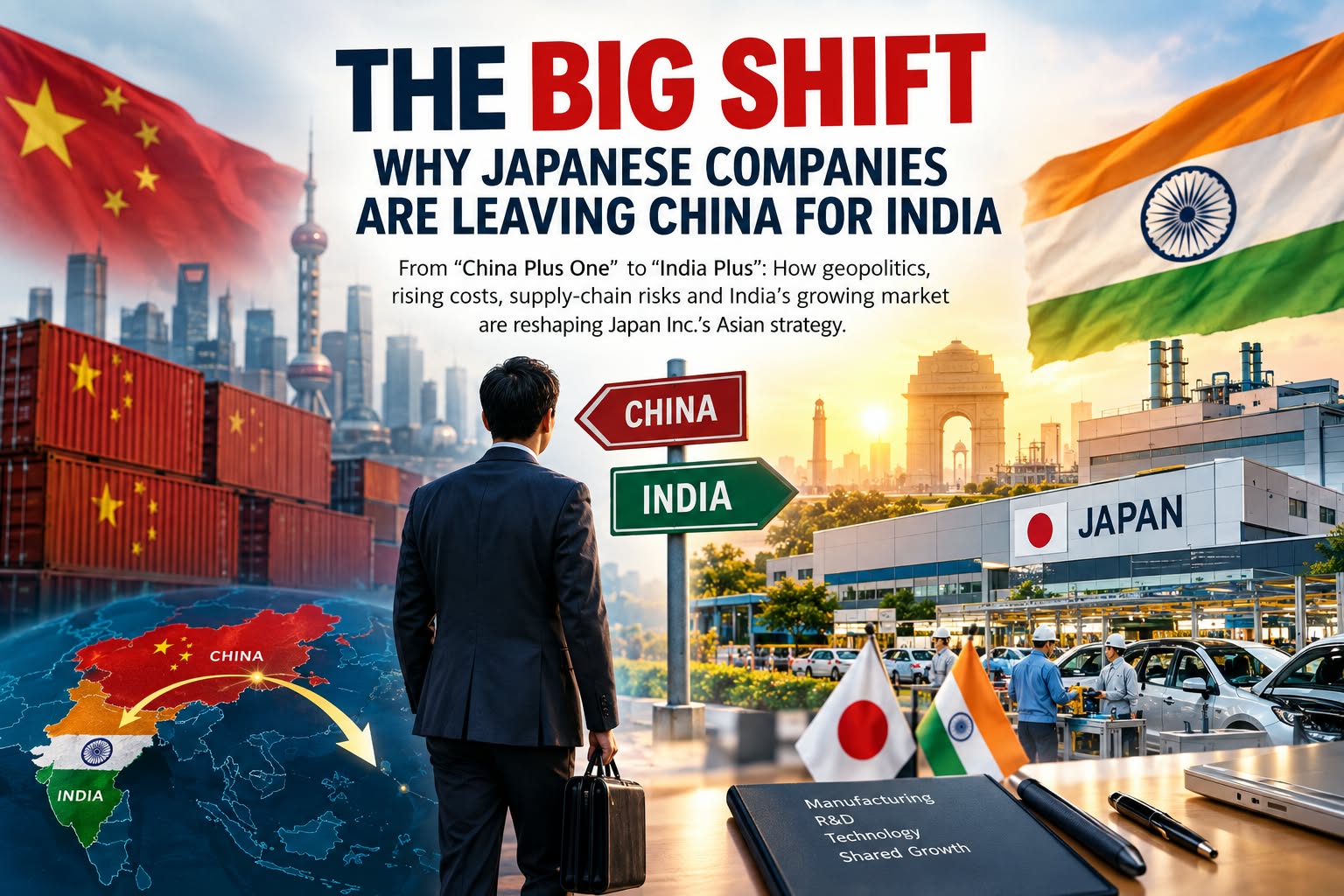
The Asia Pivot: How Japan Inc’s Retreat from China is Triggering a Structural Win for India
A major shift is happening in global trade. More and more Japanese companies are deciding to move their business out of China. For a long time, China was the top choice for factories. Now, India is emerging as the big winner as Japan looks for a safer place to invest.
A report by Teikoku Databank reveals that the number of Japanese firms in China has dropped to a record low of 10,118. In just two years, 4,137 Japanese companies completely left China. They are leaving because of rising factory costs, intense local competition, and political tensions between Tokyo and Beijing.
Why "Japan Inc." is Shrinking in China
China Rising Political Risks and Tightening Laws
For decades, China was the primary factory floor for Japanese corporations (known collectively as "Japan Inc."). However, operating there has become increasingly risky:
The Taiwan Factor: Tensions have flared after Japanese political leaders made firm statements supporting Taiwan's security.Beijing's aggressive response has alarmed Japanese business executives.
Strict National Security Laws: China’s opaque anti-espionage laws have created an atmosphere of fear.The sudden detentions of Japanese businessmen in China have made corporate boards nervous about their employees' safety.
Losing the Market to Local Rivals: Japanese automakers and tech companies are losing ground to aggressive Chinese domestic brands (like BYD in the electric vehicle space), making massive factory operations in China less profitable.
Why India is the Ultimate Opportunity
A Trusted Democratic Ally with an Exploding Consumer Base
As Japanese companies search for a safer home, India is positioning itself as the perfect destination. India offers unique benefits that smaller rivals like Vietnam or Thailand cannot match:
A Massive Consumer Market: India isn't just a place to build goods; it is a place to sell them. With the world's largest young population and a booming middle class, companies have an enormous, ready-made market right outside their factory doors.
Geopolitical Trust & "Friend-Shoring": Unlike China, India shares strong democratic values and deep strategic trust with Japan. This makes it a reliable long-term partner where assets will not be frozen due to sudden political disputes.
Government Support: The Indian government has actively courted Japanese business by setting up dedicated "Japanese Industrial Townships," fast-tracking approvals, and offering massive financial incentives (Production Linked Incentives) for manufacturing.
Japan Bets Big on India
A Billion-Dollar Financial Handshake
During a bilateral summit between Prime Minister Narendra Modi and Japanese Prime Minister Sanae Takaichi, Japan announced a massive $12.5 billion investment package for India. This includes 120 new business agreements.
Japanese companies are expanding into Indian in two major ways:
High-Tech Manufacturing: Tech giants like Renesas Electronics are investing in large microchip factories in Gujarat to build supply chains outside of China.
Everyday Retail: Famous clothing and home stores like Uniqlo, Muji, and Nitori are quickly opening new shops across Indian cities.
How This Changes Global Trade & The US Connection
Rewriting the Rules of the Indo- Pacific Alliance
This movement of money is rewriting the rules of foreign trade. Here is how it impacts international relations, especially India's ties with the United States:
A Massive Boost to India-US Relations: The US views Japan’s shift to India as a major victory for its own foreign policy. Washington has been actively pushing for "friend-shoring"—moving critical supply chains out of China and into friendly democratic countries. With Japan building factories in India, the US is fast-tracking its own technology and defense partnerships with New Delhi.
Stronger Alliances Against China: This economic bond brings India, Japan, and the US much closer under the QUAD alliance (which also includes Australia). It helps these countries secure critical materials, like semiconductors and rare minerals, without relying on China.
Beijing's Unhappiness: China is not happy with this partnership. The Chinese government has criticized the growing ties, claiming that India, Japan, and the US are teaming up just to limit China's power in Asia.
The Reality Check for India
Overcoming the Component Trap and Red Tape
While this is a great opportunity, experts warn that India cannot celebrate just yet. India’s electronics boom still relies heavily on Chinese parts. For example, most smartphones made in India still use 80% imported Chinese components.
The Bottom Line: China’s loss is opening a massive door for India. By aligning with Japan and the US, India is securing its place as the world’s next economic powerhouse. If India can cut through its own bureaucratic red tape, train more skilled workers, expand its supply chain, technology,and export capacity ,it can permanently turn this temporary shift into a historic trade victory.