


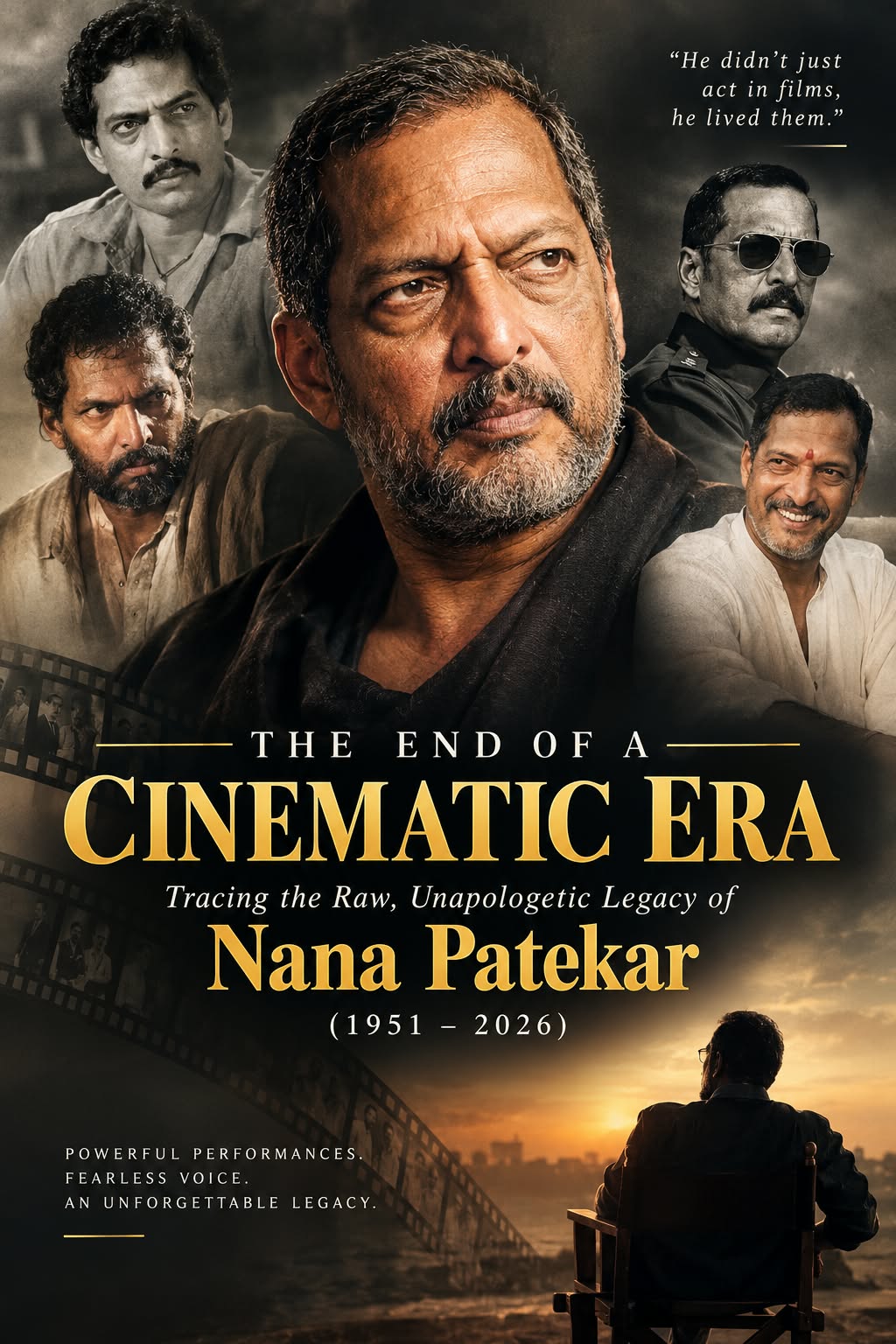
The End of a Cinematic Era: Tracing the Raw, Unapologetic Legacy of Nana Patekar (1951–2026)
The passing of veteran actor Nana Patekar on October 8, 2026, marks the end of a golden, irreplaceable era in Indian cinema. The 75-year-old powerhouse performer passed away following a severe cardiac arrest at his residence in Dona Paula, Goa. In recognition of his monumental five-decade journey across theatre, Marathi, and Hindi cinema, the Maharashtra government has announced he will be accorded a state funeral.
From the Prime Minister to the film fraternity, a nation is mourning a Padma Shri awardee who completely dismantled the traditional tropes of Bollywood stardom. Nana Patekar didn’t just play characters; he possessed them. With his signature staccato dialogue delivery, intense gaze, and a rare vulnerability, he remained a true cinematic force; prioritizing raw authenticity over commercial glamour.
A Masterclass in Acting: Fearless, Real, and Unpredictable
Born as Vishwanath Patekar on January 1, 1951, he studied at the prestigious Sir J.J. Institute of Applied Art before transitioning into theatre and making his Hindi cinema debut with Gaman in 1978. At a time when Bollywood was dominated by polished romantic heroes, Patekar brought a gritty, street-smart, and deeply human realism to the silver screen.
He was a master of contrast, holding an extraordinary ability to weaponize silence and explode into volatility within the same breath. Whether he was delivering a blistering monologue on societal corruption or portraying a deeply wounded father, his performances felt unscripted and intensely real.
The Iconic Roles That Defined a Legacy
Patekar’s filmography is a masterclass in versatility, shifting seamlessly between terrifying antagonist, righteous patriot, and comedic genius:
- The Chilling Villain in Parinda (1989): As the psychotic, fire-phobic underworld don Anna, Nana reinvented modern Indian villainy. His erratically terrifying performance earned him his first National Film Award for Best Supporting Actor.
- The Fiery Patriot in Krantiveer (1994): Playing the fiercely cynical Pratap Narayan Tilak, Nana delivered what is widely considered one of the greatest monologues in Indian film history. His explosive final speech against political apathy and communal division earned him the National Film Award for Best Actor.
- The Gritty Cop in Ab Tak Chhappan (2004): Long before cop procedurals became a formulaic Bollywood genre, he portrayed encounter specialist Sadhu Agashe with a cold, methodical, and profoundly grounded realism.
- The Comedic Genius in Welcome (2007): Proving his incredible range, his transition to comedy as Uday Bhai, a soft-hearted mobster desperately chasing an acting career; revealed an impeccable sense of timing. His brilliant on-screen camaraderie with Anil Kapoor remains a permanent fixture of modern pop culture.
- The Theatrical Masterpiece Natsamrat (2016): In what many consider his magnum opus, his portrayal of Ganpatrao 'Appa' Belwalkar, an aging Shakespearean stage actor facing abandonment, was a devastatingly beautiful, career-defining masterclass in tragedy.
Cinema in Service of Society: The Soldier and Philanthropist
Nana’s fierce commitment to truth extended far beyond his film sets; he was uniquely connected to the land and its people. He underwent rigorous military training for his directorial debut, Prahaar: The Final Attack (1991) and voluntarily served on the ground alongside troops during the Kargil War, eventually rising to the honorary rank of Lieutenant Colonel.
Off-screen, he famously rejected the glitz of celebrity culture, preferring a life of radical, inspiring simplicity. Witnessing the plight of agrarian communities, he co-founded the NAAM Foundation. Through this organization, he spent years dedicating his personal wealth and time to water conservation projects and providing financial survival lines to drought-hit farming families across Maharashtra.
A Void That Cannot Be Filled
Nana Patekar leaves behind an empty throne. He proved that an actor did not need conventional dance routines, glamorous wardrobe changes, or standard heroic tropes to command a nation's attention. He needed only his voice, his conviction, and his unyielding commitment to the craft.
Indian cinema has lost one of its truest, most passionate originals, a man whose heavy silences held profound meaning, and whose roar woke up the conscience of a nation. His voice may have been silenced, but the echoes of his art will remain permanently etched in the annals of history.