

India at a Crossroads: Who Is Fueling the Unrest?
From political mobilisation and institutional controversies to digital amplification and theories of foreign influence, India’s current unrest raises a difficult question: are separate grievances converging into a larger political ecosystem?
India at a Crossroads
India appears to be entering a politically sensitive moment. Across different parts of the country, protests, institutional controversies, political confrontations and social grievances are increasingly appearing to intersect.
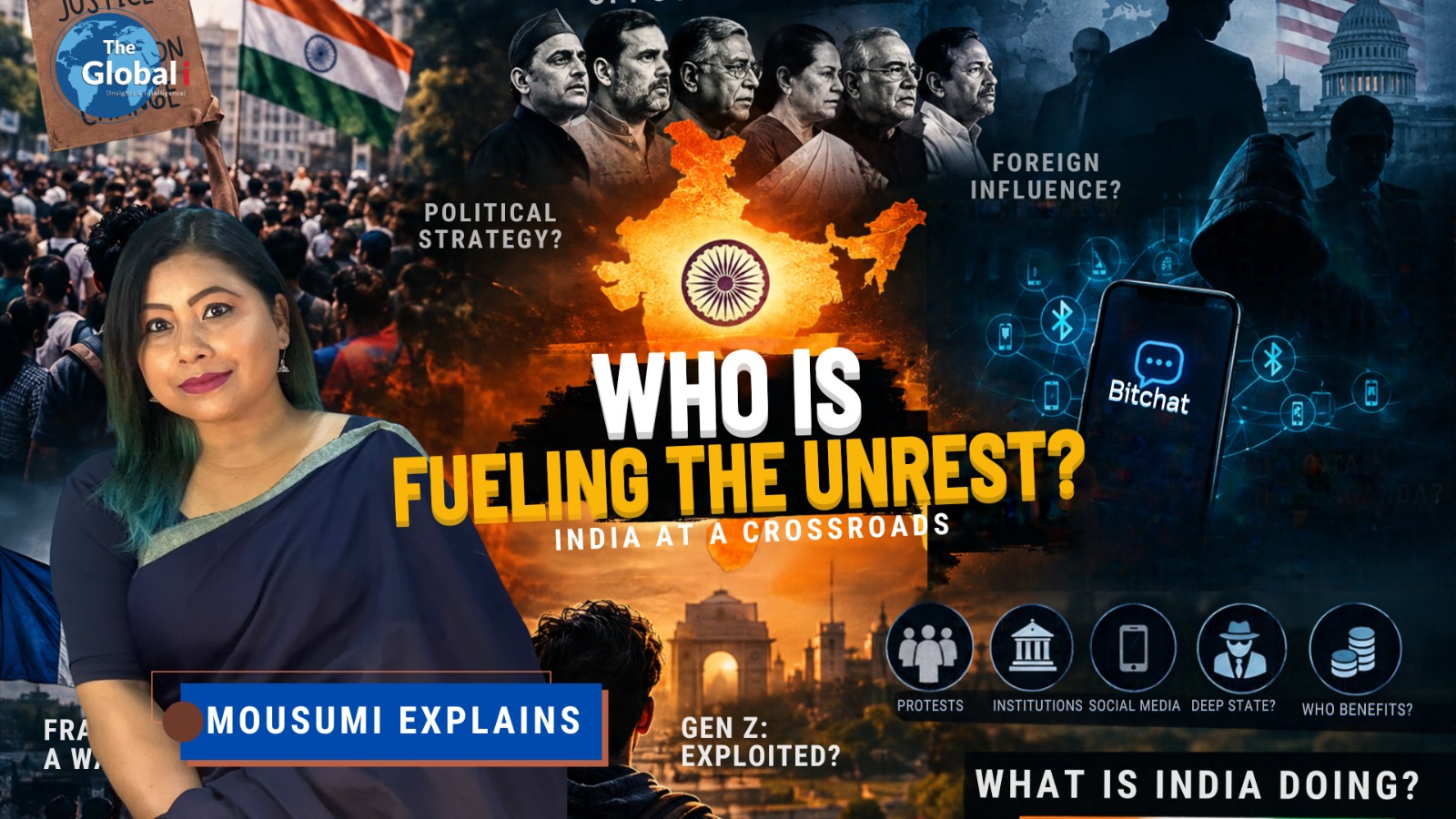
But the biggest question is not simply what is happening. The bigger question is: who is fueling this unrest?
Are we witnessing genuine democratic dissent; the natural turbulence of a democracy in which citizens are angry, frustrated and demanding accountability? Or are different political, digital and possibly geopolitical interests beginning to converge around India’s internal divisions?
When multiple grievances appear at the same time, when opposition parties increasingly unite against the ruling establishment, when institutional credibility becomes a political battlefield, and when social media amplifies every confrontation, another question inevitably follows: are these separate developments, or are they becoming part of a larger political ecosystem?
What Exactly Is Happening in India?
Look at the political landscape today. Questions are being raised around elections, the Election Commission, examination systems, government decisions and institutional functioning.
The controversy surrounding the Election Commission and demands for accountability have brought opposition parties together on a common platform. The opposition has increasingly demonstrated its willingness to coordinate against the ruling establishment.
At the same time, issues that may begin as specific grievances whether involving students, examinations, employment, governance or institutional decisions can quickly become larger political movements.
The question is not whether these grievances are genuine. Many of them may be. The question is what happens when multiple genuine grievances begin converging into one national political narrative: a narrative that the entire system is failing.
Who shapes that narrative? Who amplifies it? Who organizes around it? And ultimately, who benefits?
Is This a Political Strategy?
In any democracy, opposition parties have every right to challenge the government. They have the right to protest, demand resignations and question institutions. Citizens have every right to express anger. That is democracy.
But political strategy is also a reality of democracy. If several opposition parties that normally compete with one another begin finding common ground around a shared objective such as weakening the ruling party or removing its political leadership—it is reasonable to examine the strategy behind that mobilisation.
Is this simply the opposition finally coming together? Or is a larger coordinated political campaign developing?
And most importantly: is the target the government, or Narendra Modi personally? There is a difference between opposing a government and building an entire political narrative around removing one leader.
Is This a Conspiracy Against India or Against Modi?
This is where the debate becomes even more sensitive. Theories are already circulating about a larger conspiracy against India. Some point towards foreign influence, some towards geopolitical interests, some towards intelligence networks, while others invoke the controversial phrase ‘the deep state.’
The term ‘deep state’ is generally used to describe the alleged existence of powerful, unelected networks within or around state institutions, intelligence agencies, security establishments, bureaucracies or influential private interests that can potentially shape policy beyond elected governments.
The important word here is alleged. There is no established public evidence in the supplied material proving that a so-called American deep state is directing India’s current protests.
But the theory continues to attract attention partly because of India’s changing position in the world. India is no longer simply a regional power. It is an emerging global power with a huge economy, a major military, a massive population, technological capabilities and growing geopolitical influence.
India is also pursuing a foreign policy based heavily on strategic autonomy. It works with Washington, maintains strong relations with Moscow, engages with Iran and the Gulf, participates in BRICS, and works with Europe, Japan and other major powers.
That independent position creates a larger geopolitical question: could powerful international networks ever have an interest in weakening, distracting or politically destabilising an emerging India that is becoming increasingly influential and strategically independent?
That is the deep-state theory. But a theory is not evidence and that distinction is crucial.
The more useful questions are therefore: Is there evidence of organised external interference? Who would benefit from a politically weakened India? Are there financial, digital or organisational links connecting domestic unrest with external actors? Or is the deep-state narrative itself being used to explain a crisis that is actually domestic?
Why Is America Being Discussed?
The United States naturally becomes part of this debate because of India’s changing relationship with Washington.
India and America are strategic partners, but strategic partnerships do not mean identical interests. India maintains strategic autonomy, continues its relationship with Russia, engages with Iran, participates in BRICS and other multilateral groupings, and simultaneously works with the United States and other Western powers.
That independent foreign-policy position can sometimes create friction. So when India experiences internal political turbulence, some people naturally ask whether external powers could have an interest in influencing the direction of Indian politics.
Again, that possibility should not automatically become a conclusion. The danger of conspiracy theories is that they can make us stop looking for evidence.
If foreign influence is to be investigated seriously, the questions should be concrete: Who is funding what? Who is coordinating with whom? Where is the information originating? Who is amplifying it? Are foreign networks involved? Is there evidence of organised interference?
The Digital Dimension
Today’s political unrest is very different from the unrest of previous generations. A protest no longer needs a traditional political organisation to reach millions.
One video can become a national issue. One hashtag can become a political campaign. One allegation can spread across platforms before anyone verifies it. Artificial amplification can also make a relatively small movement appear much larger.
This creates a new digital ecosystem of unrest. Domestic political groups can use it. Genuine protesters can use it. Foreign influence operations can potentially use it. And ordinary citizens can unknowingly become part of it simply by sharing information.
That is why the question of who controls the narrative has become as important as who controls the streets.
Bitchat: A New Security Question?
Another development raised in this debate is Bitchat, a decentralised messaging application associated with Twitter co-founder Jack Dorsey.
Its technology allows communication through Bluetooth-based mesh networking rather than depending entirely on conventional mobile networks or central servers. That means communication can potentially continue even when conventional internet connectivity is disrupted.
On one hand, that can be presented as technological resilience. On the other, during protests or civil unrest, authorities may have security concerns. If conventional communication channels are restricted during a serious law-and-order situation, decentralised communication systems can potentially make coordination harder to monitor or interrupt.
This raises a legitimate question: is the concern around Bitchat simply about technology and cyber security, or is there a larger concern about decentralised communication being used during unrest?
Again, the existence of such technology does not prove a conspiracy. It simply creates another question in an already complicated environment: who is communicating, through which networks, and for what purpose?
France: A Warning or a Different Story?
France offers another useful point of comparison. The country has witnessed major waves of protests over pensions, fuel prices, economic pressures, immigration, policing and other political and social issues.
What does France teach us? Perhaps the most important lesson is that large-scale unrest does not necessarily require one mastermind.
A combination of economic anxiety, political dissatisfaction, institutional distrust, social polarisation and digital mobilisation can produce enormous street movements.
That matters for India because we should not automatically assume that every protest is part of a conspiracy. Sometimes societies simply become angry. Sometimes governments lose public trust. Sometimes young people feel unheard. Sometimes opposition parties capitalise on genuine public frustration. And sometimes all these factors come together.
The French experience therefore offers two possibilities: unrest can emerge organically from accumulated grievances; and once unrest begins, political actors can attempt to organise, expand and capitalise on it.
India could face either dynamic—or a combination of both.
The Most Important Question: Who Benefits?
This may be the most important question in the entire investigation.
When multiple grievances converge, opposition parties find common ground, social media magnifies anger, institutions become political battlegrounds and foreign influence becomes a subject of debate, every controversy can quickly be converted into a national political narrative.
Who benefits?
Does the opposition benefit? Does the ruling party benefit by presenting itself as the defender of stability? Do foreign geopolitical competitors benefit from a politically distracted India? Do digital platforms benefit from increased engagement? Or does nobody truly control the situation—and does the unrest simply grow beyond everyone’s expectations?
There is another possibility. Sometimes destabilisation does not require a single mastermind. It can emerge from convergence.
Different actors may have different objectives, but their actions can unintentionally reinforce one another. One group creates a protest. Another amplifies it. Another gives it political meaning. Social media gives it national visibility. Suddenly, separate grievances begin to look like one enormous crisis.
That is what needs to be examined.
And What About India’s Young People?
There is another dimension that cannot be ignored. India has one of the world’s largest young populations.
Young people have every right to protest. They have every right to question authority and demand jobs, education, accountability and justice.
But today’s young protesters also live inside an extraordinarily powerful digital information ecosystem. That creates a vulnerability: young people can become the face of a movement without necessarily knowing who is shaping the movement behind the scenes.
So we must ask: are young people—particularly Gen Z—being drawn into protests in ways that exploit their anger, energy and digital reach?
Are young protesters being encouraged to question, or are they sometimes being encouraged simply to react? And if young people become the visible force on the streets, who remains invisible behind the narrative?
That question deserves serious attention.
So, What Is India Doing?
If India is witnessing a growing convergence of political protests, institutional questions, digital mobilisation and social unrest, what is India doing?
Are these developments being examined individually, or is anyone examining whether they are becoming part of a larger pattern?
And perhaps the most important question: are young people being drawn into unrest without fully understanding who may ultimately benefit from it?
This investigation does not claim to have a definitive answer. It asks whether India is adequately examining the forces shaping the political and information environment around it.
The Final Question
So, what are we actually witnessing?
Democratic dissent? A coordinated political strategy? Foreign influence? Domestic political mobilisation? Or a deeper destabilisation game?
Is this a conspiracy against India, or is it fundamentally a political battle against Narendra Modi? Could external interests exploit India’s internal divisions? Or are we simply witnessing the natural turbulence of a fiercely contested democracy?
If political opposition, public grievances, digital propaganda and geopolitical interests begin converging around the same national narrative, the question becomes unavoidable: who benefits?
Because the question is no longer simply, ‘Who wants Modi out?’
The bigger question is: if India is at a crossroads, who is pushing it, and where?