


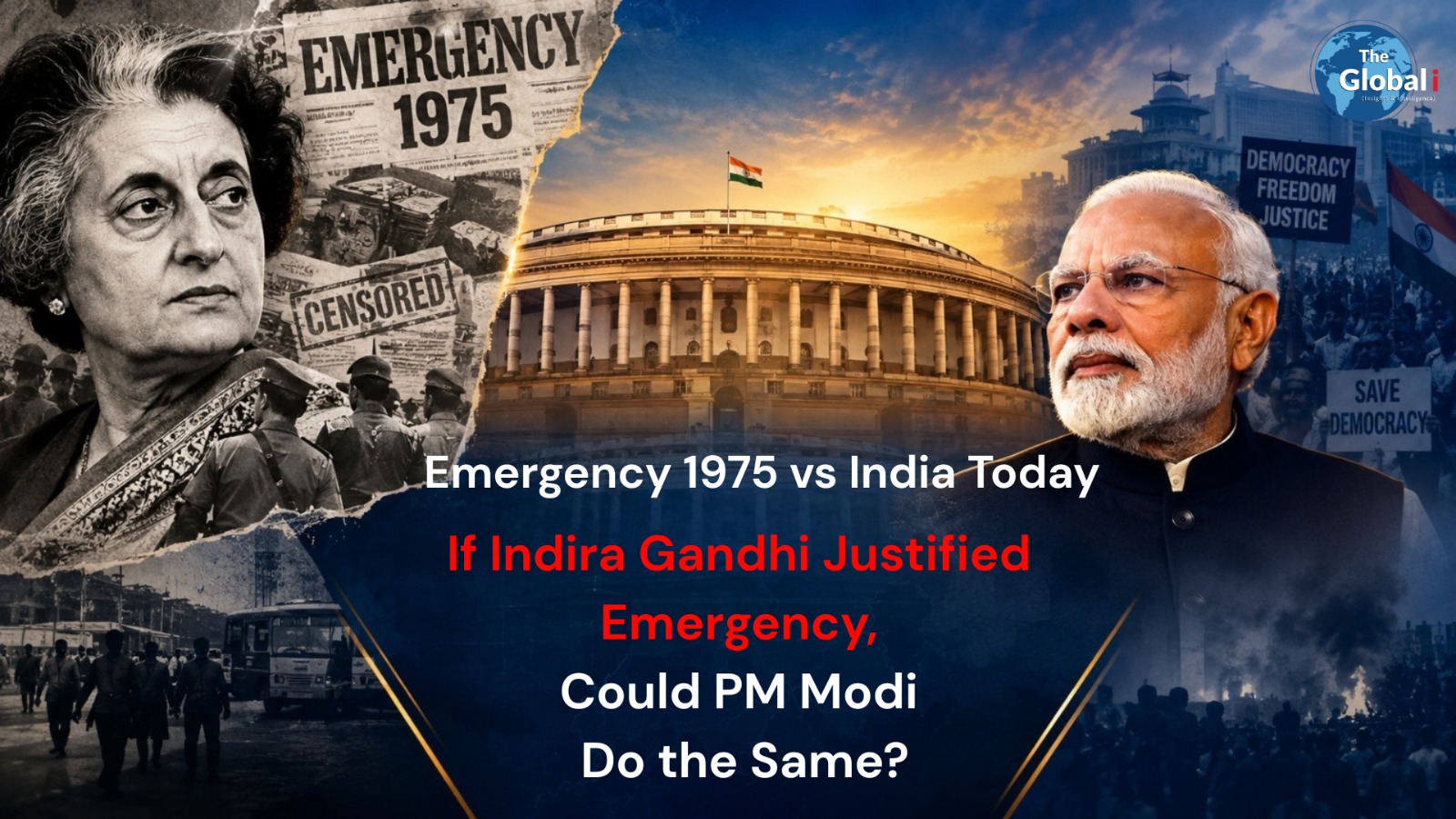
THE EMERGENCY QUESTION: IF INDIRA GANDHI COULD JUSTIFY IT, COULD MODI DO THE SAME?
When Political Unrest Becomes A National Question
What happens when political opposition turns into a nationwide confrontation? When protests spread, public life is disrupted, businesses suffer, and ordinary citizens find themselves caught in the middle of a political battle?
In a democracy, the right to protest is fundamental. But the government also has a responsibility to maintain public order, protect citizens, and ensure that the country continues to function.
So, where does a democracy draw the line between the freedom to oppose a government and the responsibility to prevent prolonged disruption?
India has faced this question before. In 1975, Prime Minister Indira Gandhi declared a National Emergency, arguing that the country was facing a serious internal crisis. Her government referred to political agitation, the threat of disorder, and alleged interference by forces seeking to destabilise the country.
Today, nearly five decades later, India faces a different political and constitutional environment, but the debate over political unrest, opposition unity, national stability, and the powers of the Prime Minister remains relevant.
As opposition parties challenge Narendra Modi and his government, important questions arise. What happens when political confrontation begins to affect public life? What is the responsibility of an elected government when unrest spreads? And how should we understand the justification Indira Gandhi offered for imposing the Emergency in 1975?
To explore these questions, we must return to June 1975 and read what Indira Gandhi herself told the nation.
National Emergency 1975 : Indira Gandhi’s Address to the nation
In her address, Indira Gandhi described what she considered a serious conspiracy against her government. She argued that political agitation was threatening the functioning of elected governments and alleged that certain individuals were encouraging the police and armed forces to disobey orders.
Her government presented the Emergency as a measure to prevent the subversion of democracy and restore stability.
The arguments presented by her are as follows:
She said that the country faced a serious threat, that political forces were attempting to destabilise the government, and that extraordinary action was necessary.
Her government was not presenting the Emergency as an attack on democracy. It was presenting it as a measure to protect democracy and national stability.
And this is where the debate becomes interesting.
If a Prime Minister believes that political agitation is threatening the functioning of the country, should the government simply remain a spectator?
Should public order be allowed to deteriorate while political parties fight for power?
Of course not. An elected government has a responsibility to protect citizens, maintain public order, and ensure that essential services continue functioning.
But the crucial question is: what measures can a government legitimately take, and where must it draw the line?
The consequences of the 1975 Emergency went far beyond the argument presented in that speech. Opposition leaders were detained, press censorship restricted the media, and civil liberties were severely curtailed.
A measure presented as necessary for national stability became one of the most controversial episodes in India's democratic history.
Today, the political circumstances are different. But the questions of public order, government responsibility, and the use of extraordinary powers remain relevant.
When Political Confrontation Affects Ordinary Citizens
Political unrest is often discussed in terms of political leaders and their struggle for power. But what about the ordinary citizen?
What happens to the person who cannot reach work because a road is blocked? What happens to a small business owner who loses a day's income? What happens when transport is disrupted, public services are interrupted, or violence makes people fearful of stepping outside their homes?
Political confrontation has consequences beyond Parliament and political party offices. It can affect the everyday lives of millions of people.
And this is where the responsibility of an elected government becomes particularly important.
The ruling government cannot simply watch as public unrest grows. It has a responsibility to maintain law and order, protect citizens, safeguard public property, and ensure that the normal functioning of the country is not held hostage to political confrontation.
The right to protest is fundamental. But peaceful protest and prolonged disruption are not the same thing. A government must distinguish between legitimate democratic dissent and activities that violate the law or threaten public safety.
It must act firmly, fairly, and within the Constitution.
But this also raises a question: when political protests spread and opposition parties unite against the government, is it enough to look at the people on the streets? Or must we also examine the larger political circumstances surrounding these movements?
That brings us to a question of growing importance.
Are We Forgetting The Lessons Of 1975?
The Emergency of 1975 was justified by the government of the day as a response to a serious crisis.
But the country also witnessed the consequences of the extensive use of emergency powers. Opposition leaders were detained, the press was censored, and civil liberties were restricted.
The Emergency remains a warning about the consequences of concentrating power and restricting democratic freedoms.
But there is another lesson we must not overlook.
A government has a responsibility to act before political unrest becomes a crisis that is much more difficult to manage.
It must not dismiss growing agitation as mere political drama that will eventually disappear. History tells us that small protests can grow into larger movements, movements can become nationwide campaigns, and prolonged confrontation can place increasing pressure on institutions and governance.
The government must remain alert, understand the reasons behind public discontent, and respond appropriately.
Where grievances are genuine, they must be addressed. Where allegations are false, they must be countered with facts. Where violence occurs, the law must take its course.
And where there is evidence of an organised attempt to destabilise public order, it must be investigated.
But the question remains: have our political parties truly learnt the lessons of 1975?
The Emergency should not be remembered merely as a conflict between Indira Gandhi and her opponents. It should remind every government of its responsibility to maintain stability while protecting constitutional freedoms.
The lesson must apply to every political party, whether it is in power or in opposition.
The Congress Question: What If The Same Justification Came From Modi?
Let us now examine a question that deserves serious consideration.
Indira Gandhi belonged to the Congress party. Today, the Congress is a major opposition party challenging Narendra Modi and the BJP-led government.
The Congress has criticised the present government on democratic and constitutional issues. But it also carries the historical responsibility of the Emergency imposed under its own government in 1975.
It would not be accurate to say that the Congress has never acknowledged the Emergency as a mistake. Rahul Gandhi, for instance, described it as a mistake in 2021.
But acknowledging a historical mistake leads us to a larger question.
If Indira Gandhi justified the Emergency by arguing that the country faced a serious threat, what would happen if the present Prime Minister, Narendra Modi, offered a similar justification?
Suppose the government argued that political agitation was threatening public order, that the functioning of the country was being disrupted, and that extraordinary circumstances required extraordinary measures.
What would the Congress say?
What would Rahul Gandhi say?
Would the opposition examine the circumstances and the constitutional grounds for such a decision? Or would it reject the justification because the Prime Minister belonged to the BJP?
These are hypothetical questions, not a prediction that the present government will declare an Emergency.
But they raise an important issue of political consistency.
The Congress has every right to question the government. Equally, the government has a responsibility to maintain public order and protect citizens.
However, the constitutional principles applied to one government must also apply to another.
If the Emergency of 1975 is criticised for the restrictions it imposed on democratic freedoms, those lessons must remain relevant regardless of which party is in power.
And if a government believes that a serious crisis requires extraordinary action, its justification must be examined against the Constitution and the evidence—not simply accepted or rejected on the basis of political allegiance.
Foreign Interference : Who Is Funding The Unrest?
There is another element in Indira Gandhi's argument that deserves attention.
Her government portrayed the situation as a threat extending beyond ordinary political opposition. She alleged that a deep and widespread conspiracy was developing against her government and argued that the country faced forces seeking to destabilise it.
That raises a question that remains relevant today.
India is an increasingly influential global power. Its economic growth, international partnerships, strategic importance, and expanding global role make its political stability a matter of national interest.
Against this backdrop, we are witnessing political mobilisation, the emergence of new political groups, and youth-led protests on different issues.
But beyond the slogans and the people on the streets, there are questions that deserve investigation.
Who is organising these movements? How are large-scale protests funded? Who pays for travel, accommodation, logistics, and other expenses when demonstrations continue over extended periods?
Are these activities being funded by political parties, domestic organisations, individual supporters, or other sources?
And is there any credible evidence of foreign interference?
These are legitimate questions, but they must be answered through investigation, not speculation.
The presence of large crowds does not, by itself, prove a conspiracy. Nor does the emergence of a new political party or a youth-led movement establish that its participants are acting on behalf of external interests.
However, where there are credible grounds to suspect illegal funding, undisclosed financial support, or foreign interference, the appropriate authorities should investigate the matter thoroughly.
The objective should be to establish the facts, identify any unlawful activity, and ensure accountability.
A rising India cannot afford to ignore genuine threats to its stability, but neither should legitimate democratic protest be treated as evidence of a conspiracy without proof.
The question, therefore, is not simply who is protesting.
It is whether we understand the forces behind these movements, the sources of their funding, and the actual objectives they seek to achieve.
Could Modi Declare An Emergency?
We now come to the question that brings this report together.
Could India see another National Emergency?
Under Article 352 of the Constitution, a National Emergency may be proclaimed when the security of India, or any part of its territory, is threatened by war, external aggression, or armed rebellion.
Following the Emergency of 1975, the 44th Constitutional Amendment replaced the earlier ground of internal disturbance with armed rebellion and introduced additional safeguards. These include a requirement for the Union Cabinet's decision to be communicated to the President in writing and parliamentary approval within the constitutionally prescribed period.
This distinction is important.
Political protests, opposition unity, demonstrations, or demands for a Prime Minister's resignation do not, by themselves, constitute sufficient grounds for a National Emergency under the present constitutional framework.
But the larger question remains.
What should a government do when it believes that a serious threat to national security or constitutional order exists?
Should it wait until a situation becomes unmanageable? Or should it take lawful and proportionate action to protect citizens and maintain stability?
The government must act within the Constitution. It cannot use emergency powers simply to silence political opponents or protect itself from electoral defeat.
At the same time, it has a responsibility to investigate credible threats, prevent violence, and ensure that political confrontation does not paralyse the country.
And this brings us to the most important question of all.
If Indira Gandhi could justify an Emergency by arguing that the country faced a serious threat, what would happen if the present Prime Minister offered a similar justification?
Would the opposition examine the constitutional grounds and the evidence? Would it apply the same standards it applies when criticising the Emergency of 1975?
And would the public distinguish between a genuine national-security crisis and an attempt to use extraordinary powers to resolve an ordinary political confrontation?
These are questions that deserve serious public discussion.
A Warning To The Government And A Question To The Opposition
But before we conclude, there is one more aspect that deserves serious attention.
The government must not make the mistake of dismissing public unrest as mere political drama that will eventually disappear.
History tells us that political movements can grow. A small protest can become a larger movement. A movement can develop into a nationwide campaign. And when political confrontation continues without resolution, it can place increasing pressure on institutions, governance, and the everyday lives of ordinary citizens.
Once public anger becomes deeply entrenched, restoring confidence becomes far more difficult. And when competing political narratives dominate the national conversation, controlling the narrative itself becomes increasingly challenging.
Therefore, the government must neither panic nor become complacent.
It must listen where there are genuine grievances. It must investigate allegations fairly and explain its decisions transparently. Where allegations are false, it must present facts to counter them. Where organised violence occurs, it must act according to the law. Where credible evidence of foreign interference or illegal funding emerges, it must investigate thoroughly. And where citizens exercise their peaceful democratic right to dissent, that right must be protected.
Because ignoring public discontent can be dangerous, but suppressing legitimate dissent can be equally damaging.
The responsibility of a government is not simply to remain in power. It is to govern effectively, maintain public confidence, protect national security, and ensure that political confrontation does not come at the expense of the nation.
But now, let us turn the question towards the opposition.
What is the opposition's responsibility in a democracy?
If the political objective is to defeat Narendra Modi, then defeat him democratically.
Present an alternative. Offer voters a vision. Put forward credible policies. Demonstrate leadership. Explain how an alternative government would address unemployment, economic challenges, national security, foreign policy, and India's position in the world.
Give the electorate a reason to choose another government.
Because there is a fundamental difference between uniting political parties around what they oppose and uniting them around what they intend to build.
And that difference matters.
If the entire political narrative becomes "Remove Modi at any cost," then a larger question inevitably emerges:
Who governs India the day after Modi?
What happens to India's foreign policy? What happens to national security? What happens to economic continuity, strategic partnerships, and India's global positioning?
If political forces unite to challenge a Prime Minister, can they also demonstrate that they are prepared to govern a country as complex as India?
And if they succeed in replacing the government, what is the common vision that will hold them together?
These are not questions intended to discourage political opposition. On the contrary, a strong opposition is essential to democracy.
But a democratic alternative must offer more than opposition to an individual leader. It must offer a credible programme of governance.
Equally, the ruling government must understand that electoral victories do not eliminate the responsibility to listen to criticism, address grievances, and remain accountable.
The government must not underestimate public discontent, and the opposition must not mistake public discontent for an automatic mandate to govern.
Both must recognise that the ultimate authority in a democracy belongs to the people, who must be allowed to make their choice freely and constitutionally.
And this brings us back to 1975.
Indira Gandhi faced an intense political challenge. Her government argued that extraordinary circumstances justified extraordinary measures. The Emergency followed, and India experienced the consequences.
Today, the political parties are different, the constitutional safeguards have changed, and the circumstances are not identical.
But the questions surrounding political unrest, national stability, government accountability, and the use of extraordinary powers remain important.
History has shown us what can happen when a political crisis transforms the relationship between the state and its citizens.
The question is whether today's political leadership—both the government and the opposition—will learn from that history before a crisis becomes more difficult to resolve.
Will Modi Step Down, Or Could India Face Another Emergency?
Nearly five decades ago, Indira Gandhi justified the Emergency by arguing that India faced a serious threat.
Her government invoked extraordinary constitutional powers. Opposition leaders were detained, press freedom was restricted, and civil liberties suffered.
That is now part of India's history.
Today, India faces its own political challenges. The government must respond to genuine grievances, maintain public order, and protect national interests. The opposition must challenge the government through democratic means and present a credible alternative.
But if political confrontation intensifies, what happens next?
Will Narendra Modi step down under mounting political pressure?
Will the opposition succeed in building a credible alternative government?
Or could a future political crisis lead the government to consider extraordinary constitutional measures?
Let us be clear: political unrest alone does not provide sufficient grounds for declaring a National Emergency under India's present constitutional framework. Any such declaration would have to satisfy the constitutional requirements.
But the larger questions cannot be ignored.
If Modi's government were to announce an Emergency, citing a serious threat to national security, would the Congress and the wider opposition accept its justification? Would they examine the evidence and constitutional grounds, or would they reject the decision because of the political identity of the Prime Minister?
And if they rejected it, what lessons would they draw from the Emergency imposed under Indira Gandhi in 1975?
Perhaps the most important question is not whether history will repeat itself.
It is whether India's political leaders have learnt enough from history to prevent a political confrontation from becoming a constitutional crisis.
Because democracy is not simply about who occupies the Prime Minister's office.
It is about how a country is governed, how public grievances are addressed, how dissent is treated, and how constitutional freedoms are protected.
So, will Modi step down, will the opposition offer India a convincing alternative, or will the country witness another major constitutional confrontation?
These are questions that only future political developments can answer.
But one lesson from 1975 remains relevant to every political party: the preservation of democracy must never become merely an argument used to justify one's own political position.
It must remain a commitment that applies to everyone.