


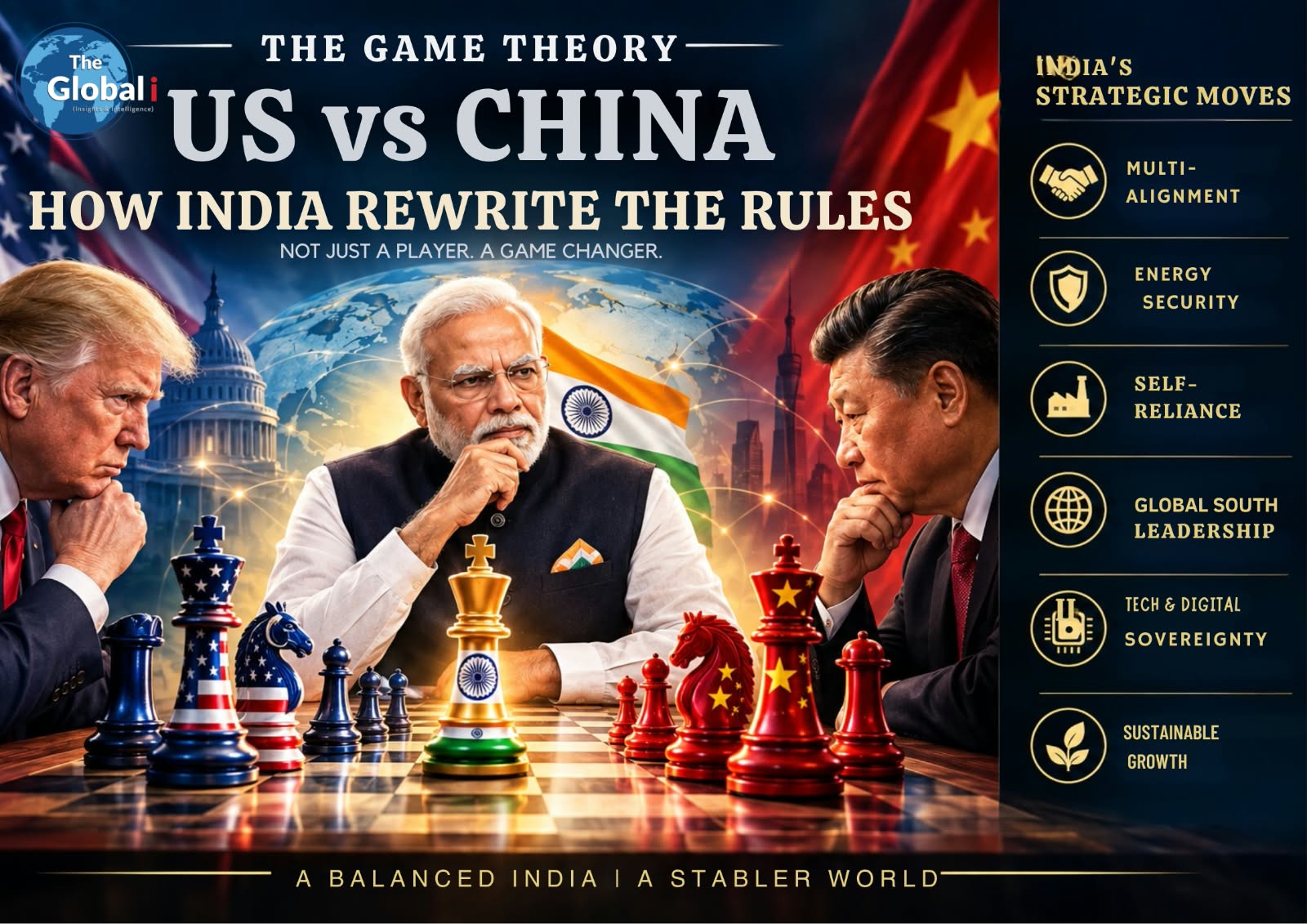
US-China Geopolitics: How India Is Rewriting the New Cold War Matrix
By: Mahima Kansal
Beyond the Bilateral Standoff: India
The global news is filled with stories about a "New Cold War" between the United States and China. Analysts often use game theory, the science of predicting how opponents make strategic moves to figure out who will come out on top. In a simple two-player game, both sides try to anticipate the other's moves regarding tariffs, technology bans, and military posturing.
However, this traditional view ignores a massive variable that completely changes the rules of the game: India. When a powerful third player enters a two-sided contest, the math behind every strategy changes. India is not just a spectator in the US-China rivalry. Instead, India acts as a unique geopolitical force that alters the rewards, risks, and final outcomes for both Washington and Beijing. By looking at how India operates, we can see how it is reshaping the future of global power.
Controlling the Indian Ocean: China's Maritime Dilemma
One of India’s most significant advantages is its geographic location, which alters the military calculations for China. In a direct conflict over the Western Pacific, such as around Taiwan, China could focus all its military planning on countering American ships and aircraft. However, India sits right at the gateway of the Indian Ocean, controlling the critical sea lanes where China gets most of its oil and trade.
By building up its navy, upgrading military infrastructure on the strategic Andaman and Nicobar Islands, and cooperating with the Quad alliance which includes the US, Japan, and Australia; India introduces a major wildcard. If China acts aggressively in the Pacific, it now faces the terrifying risk that India could block its energy supply lines at the Malacca Strait. This shifts the calculations for Beijing, transforming a localized conflict into a highly risky, two-front problem that threatens China's economic survival.
Economic De-Risking: India as the Ultimate "China + 1" Hub
Beyond military strategy, India is fundamentally changing the global economic game by solving a massive dilemma for Western nations. For years, the United States and its allies have wanted to rely less on Chinese factories, but doing so was too expensive and disruptive. Game theory shows that you cannot make a bold move if the cost of doing so ruins your own economy.
India alters this equation by presenting itself as the ultimate alternative through a strategy often called "China + 1." As India scales up its manufacturing capabilities, invests heavily in infrastructure, and builds world-class digital systems, it gives global corporations a viable, large-scale place to move their production. This lowers the economic penalty for the West to distance itself from Beijing, making Western trade sanctions and technology curbs far more credible, enforceable, and effective.
Redefining the Global South: Offering an Alternative to Beijing
At the same time, India is altering how influence is won in developing countries, often called the Global South. For the past decade, China used its massive Belt and Road Initiative to fund infrastructure projects, effectively buying diplomatic loyalty across Africa, Asia, and Latin America. However, many of these projects left developing countries trapped in unsustainable debt. India is disrupting this monopoly by offering a different model based on transparency, sovereignty, and digital innovation. Instead of heavy debt, India provides affordable technology, training, and its highly successful Digital Public Infrastructure (DPI) framework. This ensures that developing nations have genuine choices, preventing China from building an unbreakable voting bloc in international organizations like the United Nations.
Navigating BRICS and the Quad: The Multi-Alignment Strategy
What makes India truly unique in this game is its refusal to pick a side, a strategy known as multi-alignment. In the original Cold War, nations were forced to align entirely with either Washington or Moscow. India rejects this binary choice. India actively participates in Western security groups like the Quad, while simultaneously sitting at the table with China and Russia in groups like BRICS and the Shanghai Cooperation Organisation (SCO).
By remaining independent, India keeps both superpowers guessing. If India were to ally fully with the US, it could corner China and trigger a defensive, cornered-adversary reaction. If it allied with China, the two together would create an unstoppable authoritarian bloc. By staying right in the middle, India ensures that neither side can achieve absolute global dominance.
The Path to Stability: Achieving a Multi-Polar Nash Equilibrium
Ultimately, a New Cold War cannot be won in the traditional sense without causing global economic collapse or a devastating war. The best outcome for the planet is a stable balance where both superpowers are forced to coexist and cooperate on global issues like climate change. By acting as a fiercely independent third pole, India alters the strategic matrix, forcing both the US and China to behave with greater caution. In doing so, India is successfully steering the world away from a dangerous binary standoff and toward a safer, more balanced, multi-polar future.