


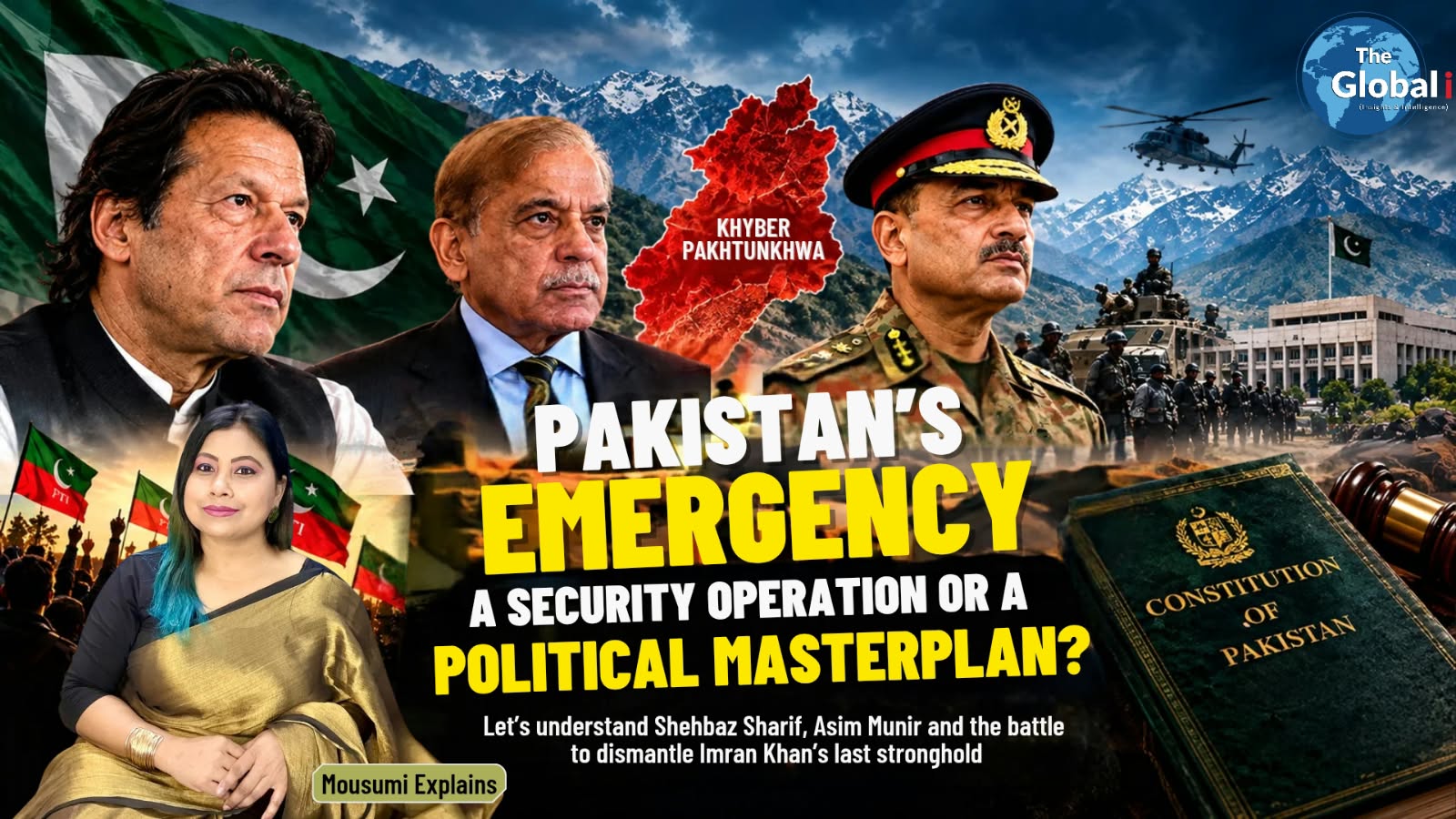
Pakistan’s Emergency: A Security Operation or a Political Masterplan?
Shehbaz Sharif, Asim Munir and the Battle to Dismantle Imran Khan’s Last Stronghold
Shehbaz Sharif, Asim Munir and the Battle to Dismantle Imran Khan’s Last Stronghold
Pakistan’s reported decision to impose emergency rule and governor’s rule in Khyber Pakhtunkhwa has raised critical questions about the relationship between national security, constitutional authority and political power. While the federal government maintains that extraordinary measures are necessary to combat militancy, the timing of the intervention has intensified concerns about the future of jailed former Prime Minister Imran Khan and his Pakistan Tehreek-e-Insaf (PTI) party.
On 11 October 2026, President Asif Ali Zardari reportedly approved the emergency and governor’s rule in Khyber Pakhtunkhwa on the advice of Prime Minister Shehbaz Sharif. The decision effectively displaced PTI’s elected provincial administration and transferred key executive functions to a federally controlled arrangement. The army was also authorised to assist civilian authorities.
The government has defended the decision as a national security necessity, arguing that the provincial administration failed to cooperate adequately in counterterrorism efforts. PTI, however, has described the move as a political takeover.
The timing has made the controversy particularly significant. Imran Khan remains imprisoned, his party continues to demand his release, negotiations between the federal government and PTI have broken down, and the party has been preparing to mobilise supporters.
With the province that serves as PTI’s strongest political bastion now reportedly under federal control, a fundamental question emerges: is Pakistan confronting an extraordinary security crisis, or could the emergency also be reshaping the country’s political balance?
The answer has implications far beyond one province. It touches upon provincial autonomy, civilian-military relations, the treatment of political opposition and the resilience of Pakistan’s democratic institutions.
Why Khyber Pakhtunkhwa Matters to Imran Khan and PTI
Khyber Pakhtunkhwa occupies a central position in PTI’s political strategy. The party first formed the provincial government after the 2013 elections under Chief Minister Pervez Khattak. It returned to power in 2018 and again after the 2024 elections, when PTI-backed independent candidates secured a majority in the provincial assembly.
Although PTI did not govern continuously throughout this period, the province remained an important centre of its electoral strength and political organisation.
Even after Khan’s removal as prime minister in 2022 and his imprisonment in 2023, PTI retained substantial influence in Khyber Pakhtunkhwa. The province provided the party with an elected administration from which it could maintain its political presence, challenge federal government decisions and demonstrate its continuing electoral support.
The reported emergency has fundamentally altered that arrangement. A governor-led administration and an eleven-member advisory council have reportedly replaced the ordinary elected executive structure, while military assistance has been authorised.
The immediate political consequence is that PTI has lost control of its last provincial government at a time when it is attempting to intensify its campaign for Khan’s release.
This makes Khyber Pakhtunkhwa more than a question of provincial administration. It is also a question of whether removing PTI from executive power weakens one of the party’s most important institutional bases and changes its ability to challenge the federal government.
The Constitutional Question: Emergency Powers and Governor’s Rule
Pakistan’s federal government has reportedly invoked Articles 232 and 234 of the Constitution to justify its intervention in Khyber Pakhtunkhwa.
Article 232 concerns the proclamation of an emergency in circumstances involving threats to national security, including internal disturbances beyond a provincial government’s capacity to control. Article 234 addresses situations in which the constitutional machinery of a province is considered to have failed.
Under Article 234, the President may assume provincial executive functions or direct the governor to exercise those functions on the President’s behalf. The proclamation can also provide for the provincial assembly’s powers to be exercised by or under the authority of Parliament.
These provisions establish a constitutional framework for exceptional intervention. However, their application must satisfy the relevant legal requirements, safeguards, approval procedures and time limits.
The distinction between the two provisions is important. Article 232 does not automatically remove a chief minister from office. Article 234 provides a mechanism for intervention when the constitutional conditions for governor’s rule are met.
Consequently, the existence of emergency powers does not, by itself, settle whether their use in a particular situation is justified.
The federal government has accused the provincial leadership of deliberately disengaging from counterterrorism efforts. PTI has rejected the accusation, arguing that Islamabad has failed to provide the resources necessary to address militancy effectively.
Both positions require examination against the available evidence.
The central constitutional question is whether Khyber Pakhtunkhwa has experienced a genuine breakdown of constitutional governance or whether a serious security dispute has become the basis for removing an elected political rival from effective control.
The intervention has already altered the relationship between the federal government and the provincial administration. Its legitimacy, however, depends on more than its immediate political consequences or the government's stated intentions.
Shehbaz Sharif: Security Imperatives or Political Consolidation?
Prime Minister Shehbaz Sharif’s government has presented the intervention as a necessary response to rising terrorism. Deputy Prime Minister Ishaq Dar has rejected the suggestion that the move is politically motivated, arguing that the objective is to confront militancy in a province that has endured years of violence.
That is the government's stated position. Yet political analysis must also examine the practical consequences of a decision, particularly when it changes the balance of power between the ruling coalition and an opposition party.
The intervention has removed PTI’s control over its strongest provincial base, coinciding with a confrontation over Imran Khan’s imprisonment and a planned march demanding his release. It has also changed the administrative environment in which PTI seeks to organise political activity.
The emergency does not automatically dissolve PTI or prohibit every form of political campaigning. Nevertheless, changes in provincial administration and security arrangements can affect the practical conditions under which a party mobilises supporters.
The political context is further complicated by reports that the Pakistan Muslim League-Nawaz-led federal government and the Pakistan Peoples Party, its principal coalition partner, agreed to bring Khyber Pakhtunkhwa under federal control shortly before the proclamation.
According to Dawn, reporting on 11 October, leaders of the two ruling coalition partners had finalised a plan as PTI’s protest march was beginning.
This reported sequence raises several questions. Why was this particular constitutional mechanism selected? Why was it implemented at this particular moment? And why was the transfer of provincial executive authority considered necessary when the federal and provincial leaderships disagreed over how to address the security situation?
The timing does not, by itself, establish that the emergency was designed to weaken PTI. However, the decision delivers a substantial political advantage to the federal government: the party has lost control of its last provincial administration.
That outcome warrants scrutiny alongside the government's stated security objectives.
Asim Munir and the Military Factor in Pakistan’s Power Structure
No assessment of Pakistan’s political landscape can ignore the influence of its military establishment. Field Marshal Asim Munir, identified in the supplied script as Chief of Army Staff and Chief of Defence Forces, occupies a central position in the country's security framework.
Pakistan’s military has historically exercised considerable influence over national security, foreign policy and domestic political developments. Relations between elected governments and the armed forces have repeatedly shaped the country's political trajectory.
The Khyber Pakhtunkhwa emergency brings this relationship into sharper focus because the federal government has justified its intervention on counterterrorism grounds and authorised the army to assist civilian authorities.
The broader political setting is equally significant. The federal government is confronting a prominent opposition movement whose founder remains in prison, while that movement has now lost control of its strongest provincial administration. Meanwhile, the security establishment plays an important role in operations along the Afghan border.
These circumstances raise questions about the relationship between Sharif’s civilian government and Munir’s military leadership.
Could greater federal control over Khyber Pakhtunkhwa facilitate security operations that the military considers necessary? Could the intervention also strengthen the military establishment’s influence over civilian political affairs? And is there a broader alignment of interests between the ruling coalition and the military establishment that could further weaken PTI’s capacity to challenge the existing political arrangement?
These questions must be investigated without assuming that Munir personally ordered the intervention or that every decision was made by the military. The formal proclamation, according to the supplied account, was issued by the President on the Prime Minister’s advice following a federal cabinet decision.
The more consequential issue is whether the intervention’s security objectives and political effects are reinforcing one another.
When a civilian government takes control of an opposition-governed province through extraordinary constitutional measures, and the military has a central role in the security framework used to justify that intervention, the boundary between security policy and political consolidation becomes a legitimate subject of public scrutiny.
The implications extend beyond one province. They concern the distribution of power between elected institutions and the military establishment, and the extent to which security considerations shape Pakistan’s political future.
Imran Khan: A Leader in Prison and a Party Under Pressure
Imran Khan remains at the centre of Pakistan’s political confrontation.
His imprisonment has not erased PTI’s political influence. The party’s continued strength in Khyber Pakhtunkhwa illustrates that removing a political leader from public office does not necessarily eliminate the support that leader commands.
Khan faces multiple legal cases, including proceedings related to Toshakhana, Pakistan’s system for receiving and managing official gifts presented to public officials. Khan and PTI maintain that the legal actions against him are politically motivated, while the authorities have defended the proceedings as matters of accountability.
With Khan behind bars, PTI has been forced to operate without its founder at the centre of its formal political activity. Nevertheless, the party continues to mobilise around demands for his release, concerns about his treatment in custody and its opposition to the federal government.
Khyber Pakhtunkhwa provided PTI with an elected administration even as its founder remained imprisoned. That institutional foothold helped the party maintain its political presence and claim electoral legitimacy.
The reported emergency changes this situation at a particularly sensitive moment.
Reuters reported that hundreds of PTI activists and three of Khan’s sisters were detained ahead of the planned march to Islamabad. PTI described the emergency as a disguised coup intended to prevent the protest.
These developments raise questions about whether the government's actions are responses to a volatile security environment or whether their combined effect is to make PTI’s political mobilisation substantially more difficult.
A political party does not necessarily need to be formally banned for its ability to organise to be weakened. Restrictions on gatherings, arrests of organisers, administrative changes and disruptions to communication can all affect political mobilisation.
The broader issue, therefore, is not simply Khan’s personal future. It is whether Pakistan’s political system continues to provide meaningful institutional avenues for opposition movements to challenge the federal government.
If Khan remains imprisoned while PTI loses control of its provincial administration, the party faces a significantly altered political landscape.
The Toshakhana Controversy: Accountability or Political Weapon?
The Toshakhana controversy forms another important part of the wider struggle surrounding Imran Khan.
Toshakhana is Pakistan’s state system for receiving and managing official gifts presented to public officials by foreign dignitaries and other official guests. During Khan’s premiership, the handling, valuation, retention and declaration of official gifts became the subject of significant legal and political controversy.
In October 2022, Pakistan’s Election Commission disqualified Khan following proceedings concerning declarations of state gifts and the proceeds from their sale. Subsequent Toshakhana-related cases resulted in criminal proceedings and further convictions, followed by appeals and other legal developments.
Khan has maintained that he legally purchased the gifts he retained. The authorities have argued that relevant legal and disclosure requirements were violated.
The controversy raises a fundamental question of public accountability: should senior public officials be required to account transparently for gifts received because of their office?
The answer is yes. Transparency and consistent enforcement of the law are essential to public trust.
However, a second question is equally important: are accountability laws being applied consistently, or have legal proceedings become part of the broader political struggle over Khan’s future?
The existence of legal cases does not, by itself, establish political persecution. Equally, the existence of allegations does not remove the need to examine whether legal processes are fair, transparent and consistently applied.
Toshakhana matters in the present crisis because it forms part of the wider context in which Khan has been imprisoned, PTI has contested the legitimacy of his exclusion from political power, and the federal government has sought to reassert control.
The emergency adds another dimension to this struggle. Khan’s legal battles continue, his party’s provincial government has been displaced, and the political environment in which PTI seeks to organise is changing.
The question is whether these developments are separate events or whether their cumulative effect is leaving Khan and his party with progressively fewer routes back to political power.
The Security Argument: What Does the Evidence Show?
The government's security argument cannot simply be dismissed.
Khyber Pakhtunkhwa has experienced serious militant violence. Its proximity to Afghanistan and the activities of armed groups present substantial challenges for Pakistan’s security forces and civilian authorities.
The federal government says the provincial administration failed to cooperate adequately in counterterrorism operations. It has also accused PTI’s provincial leadership of facilitating militants, allegations that the party denies.
These are serious claims. They require evidence rather than political assertion.
A security justification for emergency rule should be assessed against measurable indicators, including the frequency and severity of attacks, the operational capacity of militant networks, the performance of security institutions and the conduct of the provincial administration.
The Financial Times, reporting on 11 October, cited figures from a local think tank indicating a decline in violence-related deaths in the province. Such figures do not, on their own, settle the wider security question. They do, however, raise an important issue: what specific evidence led the government to conclude that emergency rule was necessary at this particular moment?
The government must explain whether the alleged deterioration relates to the frequency of attacks, the strength of militant networks, the provincial administration’s conduct or a combination of these factors.
It must also establish why existing arrangements were insufficient and why transferring provincial authority was necessary to address the threat.
If the government possesses evidence of deliberate obstruction or collaboration with militant groups, that evidence should be presented through appropriate legal and constitutional processes.
If the central problem is instead a dispute over policy, funding or operational coordination, removing an elected government raises a different set of constitutional questions.
The distinction is fundamental. The existence of terrorism establishes the need for effective security policy, but it does not automatically establish that every extraordinary political measure taken in its name is necessary or proportionate.
The Bigger Game Plan: What Does the Timing Suggest?
The sequence of events provides an important framework for examining the political consequences of the emergency.
Imran Khan remains in prison. PTI continues to mobilise around demands for his release. The party is preparing a march on Islamabad. Negotiations between the federal government and the provincial leadership have broken down. The ruling coalition moves to bring Khyber Pakhtunkhwa under federal control, the President approves the emergency, and the elected provincial executive loses its authority as military assistance is authorised.
Each event may have its own explanation. Taken together, however, they reveal a significant shift in the political balance.
The emergency gives the federal government greater control over a province that has served as PTI’s institutional stronghold. It also changes the circumstances in which the party can organise its political response.
This raises the possibility that the intervention could have two effects at once: providing a framework for counterterrorism operations while also weakening PTI’s institutional capacity to challenge the federal government.
Such a strategy would not necessarily require a formal ban on PTI. A combination of legal pressure, restrictions on mobilisation, changes in provincial administration and security measures could narrow the party’s practical room for political action.
If these developments continue in the same direction, their cumulative effect could weaken PTI’s ability to challenge the existing federal power structure, even if the party retains significant popular support.
For the ruling coalition, the immediate result is greater control over Khyber Pakhtunkhwa. For the military establishment, the intervention could create a more centralised security environment in a strategically sensitive province. For PTI, it means losing provincial executive authority at a moment when the party is attempting to increase pressure over Khan’s imprisonment.
The interests of these actors are not necessarily identical. Nevertheless, the outcome could serve overlapping strategic objectives.
The key question is therefore not merely who signed the proclamation. It is who benefits from the new political arrangement, who gains authority, who loses institutional leverage and whether the intervention could produce a lasting shift in Pakistan’s distribution of power.
The available sequence of events warrants investigation, but it does not, by itself, establish a coordinated political masterplan. Determining the underlying motives requires evidence, scrutiny of the decision-making process and examination of the government's stated security rationale.
Pakistan’s Institutional Crisis: A Test for Democracy
The emergency in Khyber Pakhtunkhwa has implications beyond PTI’s political fortunes.
First, it tests provincial autonomy. If the federal government can assume control of a province under contested circumstances, other provincial governments may question how secure their own constitutional authority is.
Second, it tests Parliament.The constitutional approval process must be meaningful rather than a formality. Legislators must examine the evidence supporting the intervention, its necessity and its scope.
Third, it tests the judiciary.** Courts must be able to assess whether the constitutional conditions for emergency rule have been met and whether restrictions on political activity and the treatment of political leaders comply with the law.
Fourth, it tests the balance between civilian and military power.If extraordinary security arrangements become a means of reshaping civilian political authority, the military establishment’s institutional influence could expand further.
Finally, it tests the legitimacy of Pakistan’s political system.Democracy is not measured solely by whether elections take place. It also depends on whether elected governments can exercise their lawful authority, opposition parties can organise, and constitutional rules protect political competition during periods of crisis.
The government has a responsibility to protect citizens from terrorism. PTI, in turn, has a responsibility to address legitimate security concerns and pursue its political objectives lawfully.
Neither responsibility eliminates the need for constitutional accountability.
If the emergency is justified by a genuine breakdown of constitutional governance, the government must demonstrate that the legal conditions have been satisfied and that its actions are proportionate to the threat.
If the intervention instead becomes a means of weakening an elected opposition government and restricting lawful political mobilisation, Pakistan could face a deeper institutional crisis—one in which constitutional powers become instruments in a struggle for political control.
Conclusion: Who Is Rewriting Pakistan’s Political Future?
Pakistan’s emergency in Khyber Pakhtunkhwa has been presented as a security measure, but its consequences reach into the heart of the country’s political system.
Shehbaz Sharif’s government has moved to exercise greater control over PTI’s strongest provincial base. Asim Munir leads a military establishment with a central role in national security and considerable institutional influence. Imran Khan remains imprisoned, yet his political movement continues to challenge the federal government.
The Toshakhana controversy and the other legal proceedings involving Khan remain part of a wider struggle over accountability, legitimacy and political power. Meanwhile, the reported invocation of Articles 232 and 234 has fundamentally altered the constitutional relationship between the federal government and Khyber Pakhtunkhwa.
The government maintains that the objective is to defeat terrorism. The central question is whether emergency rule will improve security while preserving constitutional government, or whether it will further concentrate power in the hands of the ruling coalition and the security establishment.
Could this be the beginning of a broader strategy to prevent Imran Khan and PTI from challenging the existing power structure through an elected provincial administration? Could the emergency establish a precedent for using security crises to reshape political competition? And if an elected provincial government can be displaced while its founder remains in prison, what protections remain for political opposition when it challenges the federal government?
These questions will define the significance of this moment.
The real issue is not simply whether Imran Khan will return to power. It is whether Pakistan’s constitutional institutions can withstand the combined pressures of political rivalry, military influence and emergency rule.
When security powers begin to reshape political power, the public must ask a fundamental question: **Is the state protecting its institutions, or are its institutions being rearranged to protect the existing power structure?**