


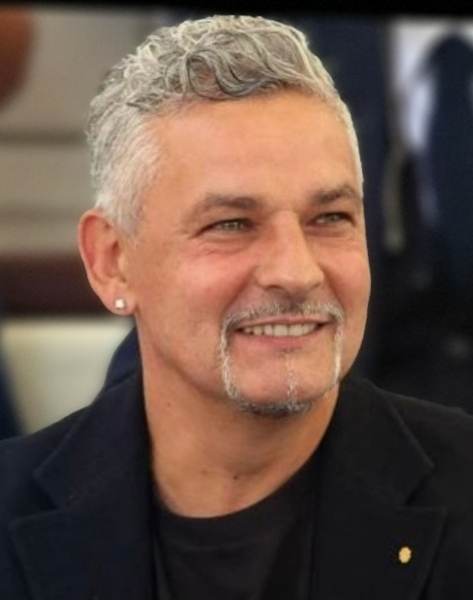
Kids today have forgotten who Roberto Baggio was
This isn't just nostalgia. It's a reflection of how football memory has shifted from poetic dribbles to stat-obsessed propaganda - from legends to bare algorithms. Roberto Baggio, or better known as Il Divin Codino (Italian for The Divine Ponytail) was a name synonymous for Italy. In the 90s, if you asked any Italian football fan, they wouldn't stop talking about the legendary #10.
Baggio's brilliance could only be understood if you consider the context, his battle against his agonising and fatal injury and moments that were impossible for him or any player with his sort of injury to achieve; and frankly his Netflix documentary Il Divin Codino is only an understatement.
If you go back to the numbers, you'd find something remarkable. Baggio was not just effective, he was ruthless and that too, against the very best. Across his 16 years in Serie A, Baggio scored 205 league goals and 120 assists which places him as someone who still has one of the most goal contributions in Italian history.
When Baggio was in Juventus, he averaged roughly 0.59 goals per game with 78 league goals in 141 appearances - something elite in the days when football scores would often end in low-scoring draws. Besides, he wasn't even a finishing striker. He mostly played as a central attacking midfielder or striker-midfielder hybrid. Baggio wasn't even stat padding against weak teams. In 80s and 90s, Serie A was stacked with defensive greatness like Paolo Maldini, Franco Baresi and Alessandro Costacurta. Every stat was much lower in those days of football. Passes, goals and even space to interpret the ball! Problems for Baggio? None.
If today's fans know Baggio for one thing, it is his failure at the finals of the 1994 World Cup: a missed penalty after extra time. That moment alone defined the genius for ages and according to Baggio himself, he wished it was the last day of his life. However harsh he might have been on himself, we must know one thing. Baggio, that year, had carried the entire Italian team to the final single handedly.
In the Round of 16, Baggio scored twice against Nigeria - once in the 88th minute and then again, in the extra time. Nigeria back then, was stacked with talents like Jay Jay Okocha, Uche Okochukwu and Rashidi Yekini. He then went on to score a decisive late goal against a superior Spanish side in the Quarter final which had players like Goikoetxea, Hierro and Luis Enrique. This was followed by a brace against Hristo Stoichkov-led Bulgaria in the semis. He finished the tournament with five goals in the knockout rounds - which proved he could deliver under pressure. Baggio didn't just score, he rescued Italy time and again till the last moment and it's unfortunate he is remembered for the final act - an unlucky miss.
Back in Juventus, he faced some of Europe's strongest sides in the UEFA Cup. In the semi finals, Baggio contributed two goals and an assist the German powerhouse Borussia Dortmund; after scoring against Paris Saint Germain from France in highly tactical match. Unlike modern strikers who benefit from an entire build up to execute their goals, Baggio did it all by himself.
Juventus, in those days, weren't as superior as Barcelona or Bayern but Baggio's presence directly influenced the results. When he signed with Bologna FC 1909, he joined in what was a persistently mid-table side. He scored 22 goals that season against what was considered the most defensively stacked teams of Europe - worthy of Ballon D'Or which he had already won in 1993. To provide a breakdown, he created chances out of thin air, scored from low probability situations and dictated matches against elite oppositions.
Even in his 30s, it was Baggio Brilliance all over with him bagging 45 Serie A goals for Brescia Calcio in 95 appearances. Match after match, there was no one to stop him.
When we talk benchmark, we often omit the quality of opposition whilst discussing raw stats. Baggio played against the behemoth AC Milan; Inter's world-class defensive unit with the likes of Bergomi, Ferri and Brehme and Parma Calcio's greatest side ever featuring Gianfranco Zola and Tomas Brolin. Internationally, he played against Brazil's Golden Generation and the best ever Super Eagles (Nigerian) squad - and delivered against everyone.
Now. It's not the fault of people today or even kids who are influenced by reels and statistics for that is how every footballer is judged these days - which is heartless to say the least. Baggio's highlight reel involves his only failure which eclipsed everything he had ever achieved. He also never won a world Cup; neither did he stay in one single club for most of his career which could have made for a great "club legend narrative". In all contexts from a modern football fan's parameter, Baggio suffers.
However, it is ironically data which redeems his quality. Speaking of FBref, Baggio is shown as a player who delivered no matter which team he was a part of. Plus, he consistently outperformed stronger teams whenever he played them. Roberto Baggio wasn't just a good player. He was one of Italy's best and has countless legends in his name, since he shouldered the responsibility of underdog almost single-handedly. Kids may remember him for his one failure despite all his genius but once they scratch deeper, they'd find a goldmine.
[Authored by Shreyan Laha]
[Photo Credits: Wikipedia]