


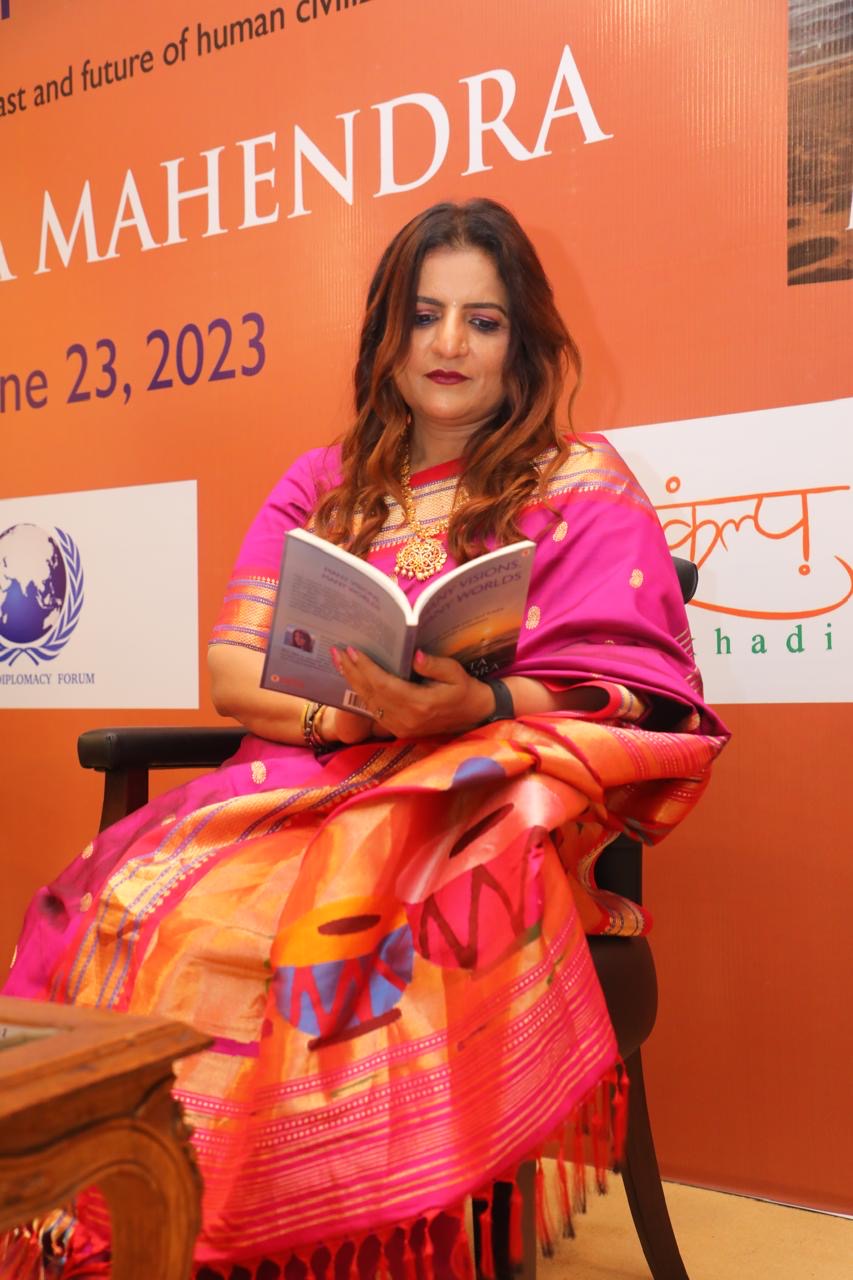
Shweta Mahendra: Coding the Future with Courage, Conscience, and Curiosity Assistant
Shweta Mahendra: Coding the Future with Courage, Conscience, and Curiosity
Assistant Vice President, Reliance Jio | Author | AI Thought Leader
From a small-town classroom in Uttar Pradesh to the frontlines of Artificial Intelligence at Reliance Jio, Shweta Mahendra’s journey is a remarkable story of intellect, resilience, and reinvention. An engineer from IIT Roorkee, a technology leader shaping the AI ecosystem, and an author deeply inspired by philosophy and ancient civilizations, she stands at the intersection of innovation and ethics. In this conversation, she reflects on leadership, resilience, the human side of technology, and why the most powerful innovation of all remains human courage.
In a world racing toward artificial intelligence, algorithms, and digital revolutions, Shweta Mahendra believes the most important code is still human. From her early years in a modest town in Uttar Pradesh to leading multidisciplinary technology teams at Reliance Jio, her journey has been defined by curiosity, conviction, and an unwavering belief that technology must serve humanity. An IIT Roorkee engineer who entered the field when women were still rare in engineering classrooms, she has spent decades navigating corporate boardrooms, technological frontiers, and deeply personal life challenges with remarkable grace.
But Shweta Mahendra is far more than a technologist. She is also a thinker who draws inspiration from Greek philosophy, Persian poetry, Indian metaphysics, and the wisdom of ancient civilizations she has explored through her travels. Her book Many Visions, Many Worlds reflects this intellectual breadth, blending reflection with insight. Whether mentoring young professionals, challenging outdated social norms, or envisioning the ethical future of AI through projects like Vision 2099, she remains guided by a powerful belief: that innovation without conscience is incomplete.
In this interview, Shweta Mahendra speaks about resilience, leadership, motherhood, and the deeper purpose of technology, offering a rare perspective on how courage, empathy, and intellect can shape not only careers but the future itself.
Early Life and Foundations
1. You grew up in a small town in Uttar Pradesh, where educational resources were limited. What early influences in your family or environment shaped your intellectual curiosity and determination?
Shweta : Growing up with limited resources, my family’s belief in education and my own curiosity turned constraints into motivation, pushing me to learn beyond what was available.
2. You have mentioned that confidence was not inherited but earned. Was there a particular moment in your childhood that made you believe you could break conventional boundaries?
Shweta : Confidence came from small, consistent victories each breakthrough proved that limits weren’t real, just accepted beliefs waiting to be challenged. There wasn’t one dramatic moment. It was a gradual realisation, that every time I pushed myself a little further, nothing broke. That’s when I understood: the limits weren’t real they are the virtual walls created by our mind.
Breaking Barriers in Engineering
3. Choosing engineering in the 1990s was still unconventional for many women. What inspired you to pursue engineering, and how did you convince your family?
Engineering wasn’t seen as a natural choice for women back then. But I never saw myself as “doctor too”. There were only two options. At every stage in life, you want to become something different, but that one thing, your childhood dream, never leaves your heart - a Fashion Designer.
4. IIT Roorkee is known for its rigorous academic culture. What were the most defining experiences during your years there that shaped your leadership and independence?
When I entered IIT Roorkee, the challenge was not the syllabus. It was the silence around you, where you constantly question if you belong. And then you remember— “Fortune favours the bold.” from Aeneid
So, you don’t ask for space. You take it. That is where I learned that leadership is not about authority. It is about presence. It made me resilient, but more importantly, it made me inwardly anchored. I stopped seeking validation. Started enjoying my solitude. That’s where leadership begins when you don’t need permission to exist.
Leadership and Innovation in Technology
5. You began your corporate journey at Reliance as a Graduate Engineer Trainee in 1996 and today serve as Assistant Vice President at Reliance Jio. What key lessons shaped your leadership style during this journey?
The moment I realized I could think independently in a system designed for conformity. I can make my own rules, my own way, on my own conditions, which changed everything.
6. You currently lead teams working on cutting-edge technologies like Multimodal AI, Generative AI, VR ecosystems, Blockchain, and the Metaverse. How do you see these technologies shaping the future of society?
The convergence—AI, consciousness, immersive realities. We are not just building tools anymore; we are shaping perception, identity, and human experience itself.
7. You often emphasize that AI should be human-centered. What role do empathy and ethics play in technological innovation?
What does it mean to be human… in a world we are rapidly redesigning?
In Metamorphoses, everything transforms. Ovid say “All things are in flux…”
That is what technology is, a constant metamorphosis. But transformation without awareness…can become distortion. That is why I say AI must have empathy, because intelligence alone is not wisdom.
It means asking not just can we build it, but should we build it. It means designing systems that enhance humanity not replace or diminish it.
Resilience Through Personal Challenges
8. Your personal journey includes moments of profound emotional strength, including challenges related to motherhood and loss. How did those experiences shape your outlook on life and resilience?
Loss changes you in ways nothing else can; it strips away illusions of control and teaches you acceptance. My experience with miscarriage was deeply personal, but it made me stronger, quieter, and more aware of what truly matters.
9. During difficult periods, what helped you regain the strength to return to work and continue moving forward?
That period taught me that resilience is not loud, it is the ability to keep going, to hold pain with grace, and still choose hope.
The Writer, Philosopher, and Explorer
10. Beyond technology, you have a deep interest in philosophy, ancient civilizations, and cultural history. How did this intellectual curiosity develop?
I have always been drawn to ancient civilisations. Because they do not give answers. They give perspective. In Shahnameh, kings rise, fall, and rise again. Power is never permanent. Identity is never stayed with me.
When I went to Greece did not feel like travelling. It felt like a memory as if philosophy was not something I was learning… but remembering.
11. Your book ‘Many Visions, Many Worlds’ reflects a layered understanding of civilizations and ideas. What inspired you to write it?
It came from a need to explore reality beyond one dimension, multiple perspectives, multiple truths. It reflects how I see life not linear, but layered.
12. Your travels across Turkey, Jordan, Greece, and Egypt exposed you to ancient cultures. What lessons from ancient civilizations resonate most strongly with modern technological societies?
They showed me that we are not as advanced as we think we are, just faster. Wisdom still lies in understanding, not accumulation.
Mentorship and Women in Leadership
13. As a mentor to many young professionals, especially women, what advice do you give to women navigating leadership roles in corporate environments?
I mentor women often I see the same pattern, brilliance…held back by hesitation. Not because they are incapable, but because they are conditioned to ask for permission.
I tell them -You do not break systems by fighting them, you outgrow them.
14. In your view, what are the biggest challenges women continue to face in technology and leadership today?
The biggest challenge isn’t capability—it’s perception. Women are still navigating bias, balancing expectations at home and work, and often being judged for choices men are never questioned about.
In leadership, the challenge is not just reaching the table, but being heard without having to constantly prove worth. The real shift will come when women are seen not as exceptions, but as equals.
Life Beyond Work
15. After the age of forty, you consciously redesigned your life, focusing on fitness, writing, travel, and learning languages. What inspired this transformation?
There is a moment in The Divine Comedy…how it starts canto I of Inferno where Dante writes:
“Midway upon the journey of our life, I found myself within a forest dark…”
I think… we all begin there. Before 40—I was building. After 40—I started understanding.
16. You design your own clothes, lift weights, and explore archaeology. How important is it for leaders to cultivate passions outside their professional identity?
It’s essential. What you do outside work is what keeps you grounded, curious, and real—it prevents you from becoming one-dimensional. For me, whether it’s designing, lifting, or exploring history, these passions sharpen my thinking and give me balance.
Motherhood and Personal Values
17. Your son, who studied at IIT Guwahati, reflects the values of discipline and intellectual pursuit you believe in deeply. How has motherhood influenced your perspective on leadership and life?
Motherhood made me more patient, more aware, and more grounded. It shifts your perspective; you stop thinking only about success and start thinking about values, consistency, and what you are quietly passing on. In many ways, it made my leadership more human.
18. You often say motherhood is your foremost responsibility. How do you balance the demands of a high-impact career with family life?
Balance is never perfect—it’s a constant adjustment. I prioritise what truly matters in the moment and let go of the idea of doing everything flawlessly. Motherhood remains my anchor, and everything else aligns around it.
Recognition and Legacy
19. Looking back at your journey from a small-town classroom to the frontlines of Artificial Intelligence, what do you believe has been your most defining strength?
If I look back, my most defining strength has been courage, the willingness to step into spaces where I didn’t fully belong yet, and still stay. It was never about being fearless, but about not letting fear decide my direction..
Closing Reflection
20. If you had to define your life’s philosophy in one thought, what would it be?
Stop asking— “Am I allowed?”
Start asking— “What is possible?”
Because most of what we call limits…are simply inherited fears.
And like in every great epic—from The Odyssey to The Aeneid—the journey was never about the destination.
It was about who you became while walking through uncertainty.
Conclusion
Shweta Mahendra’s journey is not just a story of professional success; it is a powerful narrative of evolution. From navigating the limitations of a small-town upbringing to shaping the future of Artificial Intelligence at Reliance Jio, she embodies the rare balance of intellect and introspection, ambition and awareness.
What sets her apart is not merely her command over technology, but her unwavering commitment to ensuring that innovation remains deeply human. In a world increasingly driven by algorithms and automation, she reminds us that empathy, ethics, and courage are the true forces that will define the future.
Her journey through engineering, leadership, personal loss, motherhood, and philosophical exploration reflects a life lived with intention, one that continuously questions, evolves, and seeks deeper meaning. Whether through her work in AI, her reflections in Many Visions, Many Worlds, or her mentorship to young minds, she continues to inspire a generation to think beyond boundaries.
In the end, Shweta Mahendra does not just code systems; she codes possibilities. And her story leaves us with a thought that resonates far beyond technology:
The future is not something we enter.
It is something we consciously create, with courage, conscience, and curiosity.