


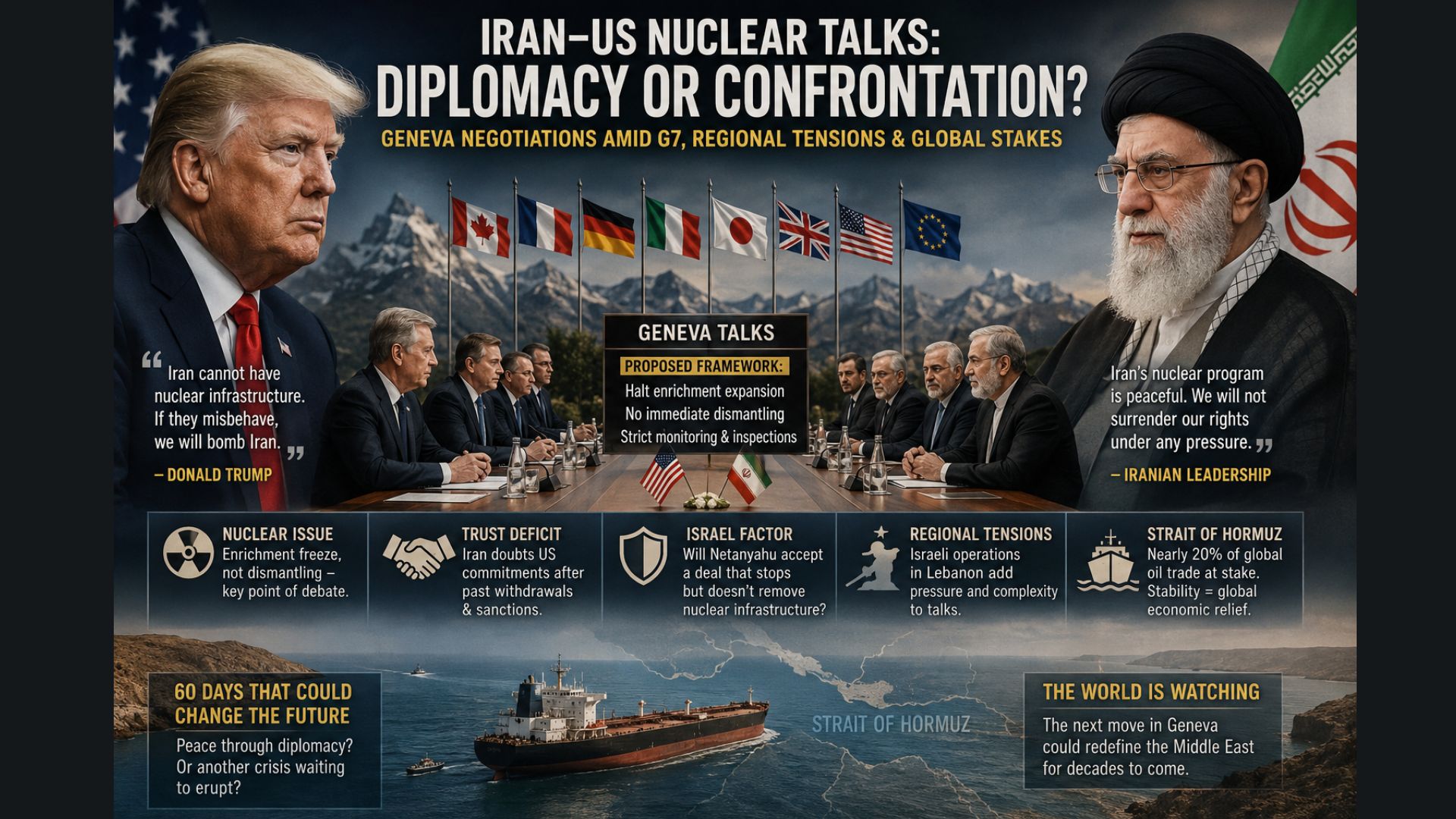
Behind the G7 Curtain: The High-Stakes Negotiations That Could Redefine the Middle East
As world leaders gathered at the G7 Summit to discuss economic stability, security challenges, and the future of the international order, an entirely different conversation was unfolding behind the scenes, one that could determine whether the Middle East moves toward diplomacy or drifts once again toward confrontation.
In a remarkable development, President Donald Trump signaled that a new understanding with Iran may be within reach. Yet, almost in the same breath, he warned that military action remains on the table if Tehran fails to meet Washington's expectations. The message coming out of the G7 was therefore both hopeful and alarming: diplomacy is possible, but so is war.
What makes this moment particularly fascinating is that the proposed framework reportedly focuses on halting aspects of Iran's nuclear activities rather than immediately dismantling them. This raises a fundamental question: if Washington is willing to negotiate a freeze today, why does it continue to insist that Iran ultimately cannot possess nuclear infrastructure? And more importantly, how is Tehran interpreting these mixed signals?
At a time when tensions continue across the Middle East, military operations are expanding in neighboring theatres, and the Strait of Hormuz remains central to global energy security, the stakes could hardly be higher. Is the world witnessing the beginning of a historic breakthrough, or merely the calm before another regional storm?
The development is far more significant than a routine nuclear understanding. It touches the core of three interconnected issues: Iran's security doctrine, Israel's regional strategy, and America's credibility in the Middle East.
The biggest question today is not whether a memorandum will be signed in Geneva. The real question is whether Iran can trust an agreement that comes with a simultaneous threat of bombing.
The proposed understanding reportedly aims at preventing Iran from moving toward a nuclear weapon while placing limits on its enrichment activities. However, there appears to be no immediate requirement for the complete dismantling of Iran's enrichment infrastructure. This is where the debate begins.
President Trump has repeatedly stated that Iran cannot be allowed to possess nuclear weapons. More recently, he has also suggested that Iran should not possess the infrastructure necessary to produce them and warned that military action could resume if Tehran fails to comply.
This creates a strategic contradiction.
If Iran is being asked to freeze certain nuclear activities, that is one thing. But if Washington's ultimate objective remains the elimination of Iran's nuclear infrastructure altogether, Tehran may view the agreement as merely the first step toward future demands.
For Iranian leaders, the question becomes very simple:
Why sign a temporary freeze today if tomorrow the demand becomes complete dismantlement?
This brings us to the issue of trust.
Iran's distrust of the United States is rooted in history. Iranian policymakers continue to point to the collapse of previous agreements and argue that commitments made by one American administration can be reversed by the next. Many in Tehran believe they made concessions in the past only to find sanctions returning later.
Therefore, Iranian negotiators may ask a critical question:
What guarantees exist that a new agreement will survive future political changes in Washington?
Without credible guarantees, Iran may fear giving up strategic leverage while receiving only temporary benefits in return.
Another important question is how Tehran interprets Trump's warning that military action remains an option. From an American perspective, such statements may be intended as deterrence.
From an Iranian perspective, however, they may be viewed as coercion.
Historically, Iran's leadership has reacted strongly against public pressure and external threats. In fact, whenever outside powers have attempted to force concessions through military intimidation, hardline factions inside Iran have often gained strength.
This raises an important possibility.
Could Washington's tough rhetoric actually strengthen those in Tehran who oppose compromise?
Could the threats make an agreement politically harder for Iran's leadership to sell domestically?
At the same time, another major player looms over these negotiations: Israel.
For years, Israel has maintained that Iran's nuclear program represents an existential security challenge. Israeli leaders have consistently argued that limiting Iran's nuclear capabilities may not be enough and that dismantlement remains the safest option.
This raises another crucial question.
Will Israel be satisfied with an agreement that freezes enrichment but does not eliminate Iran's nuclear infrastructure altogether?
Or will it continue pressing for stronger measures?
The timing becomes even more intriguing because these negotiations are unfolding amid continuing military activity in Lebanon.
Is this merely a coincidence?
Or are recent military operations intended to send a broader strategic message to Iran and its regional allies?
Some analysts argue that military pressure and diplomatic negotiations are often conducted simultaneously in the Middle East. Others believe such actions risk complicating negotiations by convincing Tehran that diplomacy is being pursued from a position of coercion rather than mutual compromise.
This naturally leads to another question.
Is the current military activity in Lebanon influencing Iran's calculations regarding the proposed agreement?
And perhaps even more importantly, what discussions are taking place behind closed doors between Washington and Jerusalem?
The United States and Israel share deep strategic ties, but their priorities are not always identical.
Washington's immediate objectives include regional stability, energy security, and avoiding another major military conflict.
Israel's primary concern remains national security and ensuring that Iran never acquires a nuclear weapons capability.
While these objectives often overlap, they do not always lead to identical policy preferences.
If the United States ultimately accepts a limited agreement while Israel seeks complete dismantlement, could differences emerge between the two allies regarding the best path forward?
Then there is the economic dimension.
The Strait of Hormuz remains one of the world's most critical maritime chokepoints. A significant portion of global oil shipments passes through this narrow waterway every day.
Any escalation involving Iran immediately raises concerns about energy supplies, shipping routes, insurance costs, inflation, and global market stability.
If negotiations succeed and regional tensions ease, the Strait of Hormuz could remain open and stable, reassuring global markets.