


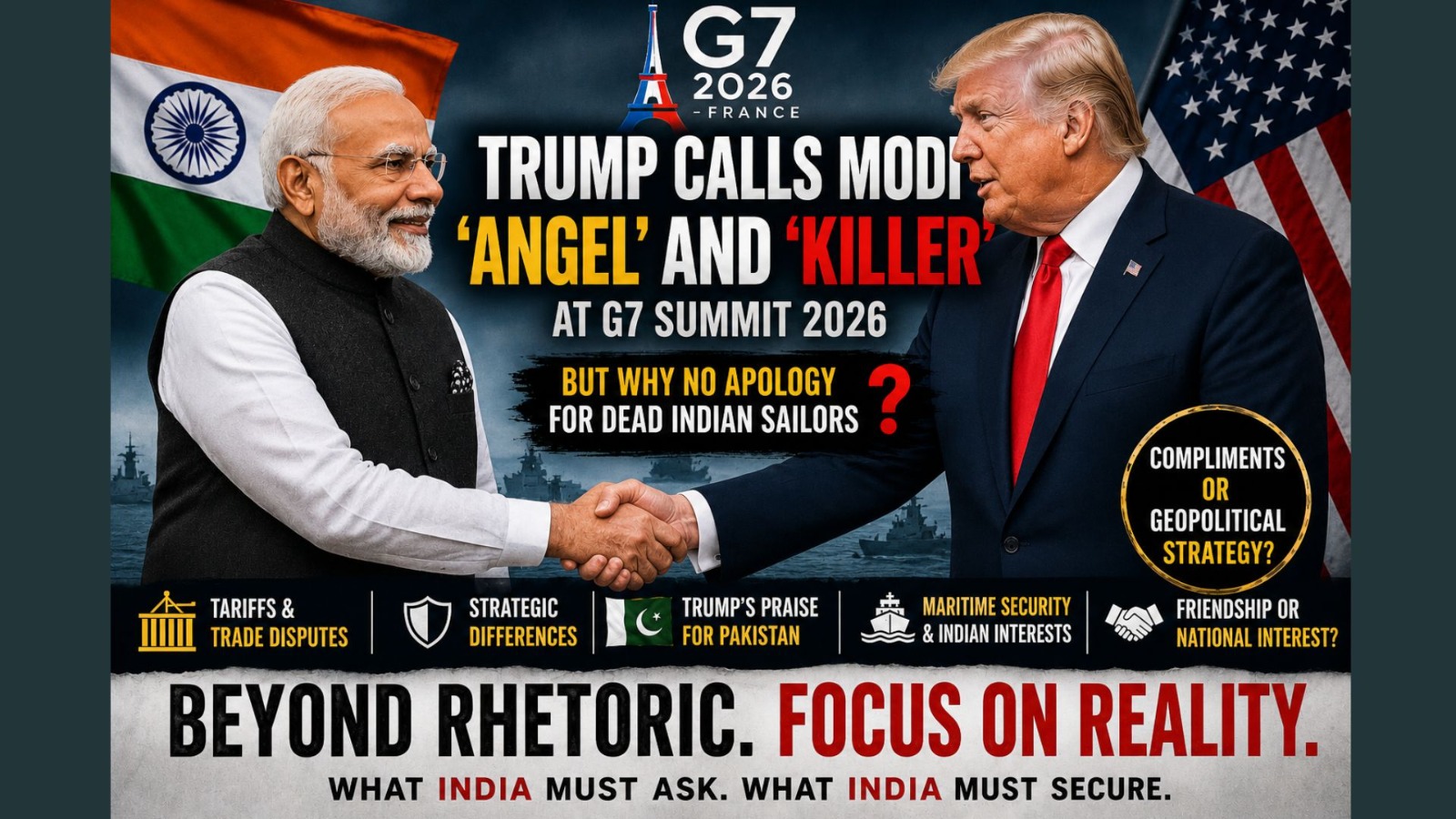
Trump Calls Modi an ‘Angel’ and a ‘Killer’ at G7 2026: Should India Trust the Praise or Watch the Po
ANGEL, KILLER, FRIEND OR NEGOTIATOR?
Should India Still Be Flattered by Trump's Praise?
Let's know, When Compliments Become Headlines and Reality Becomes a Footnote
At the G7 Summit, the world once again witnessed one of the most intriguing political relationships of modern times, the Donald Trump-Narendra Modi equation.
President Donald Trump described Prime Minister Narendra Modi as a "killer," an "angel," a "good-looking man," a "tough negotiator," and once again reminded the world that he "loves" Narendra Modi.
Indian television channels instantly turned these remarks into breaking news. Social media celebrated. Supporters rejoiced. Memes flooded the internet.
But amid all the excitement, a more important question emerged.
Should India judge the United States by Trump's words or by America's actions?
Because behind the compliments lies a much larger story involving tariffs, trade disputes, strategic disagreements, Pakistan, maritime security, Indian sailors who lost their lives, and India's evolving role in a rapidly changing world order.
And perhaps that is where the real story begins.
The Trump Formula: Praise First, Negotiate Later
Anyone who has observed Donald Trump over the years understands that compliments are one of his favourite diplomatic tools.
He has praised Narendra Modi.
He has praised Pakistan's leadership.
He has praised leaders in Japan.
He has praised Gulf rulers.
He has even praised political rivals before fiercely disagreeing with them later.
Trump's diplomatic style often resembles a reality television script.
First comes the praise.
Then comes the negotiation.
Then comes the pressure.
Then comes the demand.
This is not necessarily personal. It is political.
Trump understands the power of personal chemistry. He often creates goodwill through flattering language before moving towards difficult negotiations.
Which is why when Trump says, "I love Modi," perhaps the more relevant question is:
What does America want from India?
If Modi Is Such A Great Friend, Why The Pressure?
This is where the contradiction becomes impossible to ignore.
Even while praising Modi repeatedly, Washington has continued to pursue policies that often clash with Indian interests.
Trade disputes continue.
Tariff disagreements continue.
Differences over energy security continue.
Differences over strategic autonomy continue.
India continues to purchase energy based on its own national interests rather than external pressure.
The reality is simple.
Countries do not have permanent friends.
Countries have permanent interests.
The United States values India because India is a rising economic power, a major market, a technological force, and a critical player in balancing China's rise.
India values the United States because of technology, investment, defence cooperation, and global influence.
The relationship is important.
But it is also transactional.
And that is why India must look beyond flattering rhetoric.
The Story Hidden Behind The Headlines: Indian Lives Lost At Sea
Perhaps the most important issue discussed during the summit received far less attention than Trump's compliments.
Prime Minister Narendra Modi raised concerns regarding the safety of Indian seafarers and the security of maritime routes, particularly in sensitive regions such as the Strait of Hormuz.
This issue was not raised casually.
Several Indian sailors lost their lives during military actions linked to the ongoing tensions in the Gulf region.
While television studios debated Trump's compliments, Prime Minister Modi focused on something far more serious.
The lives of Indian citizens.
And this raises a difficult but necessary question. If India and the United States are strategic partners, if President Trump repeatedly says he loves India and admires Narendra Modi, then why have we not seen a clear apology from the American side for the loss of Indian lives?
Why has there been no public acknowledgement of responsibility?
Why has there been no transparent explanation shared with India?
Why has there been no public discussion regarding compensation for the families who lost their loved ones?
And if discussions are taking place privately, why has there been so little public clarity?
These are not anti-American questions.
These are pro-Indian questions.
Every sovereign nation has the right to seek accountability when its citizens lose their lives.
Strategic partnerships are tested not during celebrations but during crises.
Friendship between nations cannot merely be measured through compliments exchanged before cameras.
It must also be measured through accountability when mistakes occur.
This is where the contrast becomes striking.
The headlines focused on Trump calling Modi an angel, a killer, a friend, and a handsome leader.
But the families of the deceased sailors are unlikely to find comfort in diplomatic compliments.
For them, the questions are much simpler.
Who was responsible?
Could these deaths have been prevented?
Will there be accountability?
Will there be compensation?
Will there be assurances that such incidents will never happen again?
And until these questions receive satisfactory answers, India has every right to continue raising them firmly and unapologetically.
Because strategic partnerships are not judged by speeches.
They are judged by actions.
The Missing Warmth Behind The Compliments
Another interesting aspect of the summit was what many observers noticed.
The famous political theatre that once defined the Trump-Modi relationship appeared less visible.
The spectacular hugs.
The grand stadium events.
The larger-than-life public displays.
They were largely absent.
There were smiles.
There were handshakes.
There were compliments.
But there was also visible seriousness.
Perhaps both leaders understand that the relationship has entered a more mature phase.
The era of symbolism is giving way to the era of hard negotiations.
And that is how serious relationships between major powers evolve.
Why Does Trump Praise Modi So Much?
There are several reasons.
First, Trump respects political strength.
Modi remains one of the most influential leaders in the democratic world with a strong political mandate.
Second, India has become too important to ignore.
The world's fastest-growing major economy.
A technological powerhouse.
A manufacturing alternative.
A critical Indo-Pacific player.
A major defence partner.
Any American president understands India's growing importance.
Third, Trump understands optics.
He knows that every compliment directed at Narendra Modi generates enormous attention in India.
It creates positive headlines.
It generates goodwill.
And in diplomacy, goodwill is often a valuable negotiating tool.
And, remember, The Pakistan Question India Must Not Ignore. One important fact often overlooked in India is that Trump's compliments are not exclusive. He has praised Pakistan's leadership as well.
He has spoken positively about leaders from countries that often have competing interests.
This reflects a simple reality.
Trump's compliments should not be confused with commitments.
His praise should not be mistaken for strategic guarantees.
His admiration should not be interpreted as unconditional support.
For Trump, relationships are often flexible.
Interests come first.
That is how great powers operate.
And India must recognize that reality.
Should India Get Carried Away By Trump's Rhetoric?
The answer is no.
India should welcome goodwill.
India should appreciate mutual respect.
India should strengthen ties with Washington.
But India should never confuse rhetoric with policy.
The true measure of any partnership is not compliments.
It is trade agreements.
Technology transfers.
Defence cooperation.
Investment flows.
Maritime security.
Respect for national interests.
And accountability during crises.
These are the real indicators of partnership.
Not adjectives.
Not handshakes.
Not headlines.
Should India Reset Its Approach To America?
Rather than resetting relations, India should continue strengthening its policy of strategic autonomy.
India should deepen ties with the United States.
But simultaneously strengthen relations with Europe.
Maintain strong ties with Russia.
Expand engagement with the Gulf.
Build stronger partnerships in Southeast Asia.
Increase economic engagement in Africa and Latin America.
The lesson from modern geopolitics is clear.
No country places India's interests above its own.
Therefore India must place India's interests above everyone else's.
That is not hostility.
That is strategic maturity.
Now, One cannot help but smile at the uniqueness of modern diplomacy.
Within hours, global discussions shifted from tariffs, maritime security, energy routes, and geopolitical tensions to debating whether Trump had delivered the most unusual compliment in diplomatic history.
Imagine future diplomatic textbooks carrying a chapter titled:
"How To Call A Foreign Leader An Angel, A Killer, A Great Negotiator, And A Handsome Man , All In The Same Conversation."
It is certainly entertaining.
But it also teaches an important lesson.
When politics becomes theatre, citizens must pay closer attention to the script hiding behind the performance.
Conclusion: Beyond Angels And Killers
The G7 Summit offered a fascinating glimpse into twenty-first-century diplomacy.
Donald Trump praised Narendra Modi in unusually warm terms.
He called him an angel.
He called him a killer.
He called him a friend.
He called him a good-looking man.
The headlines celebrated.
The cameras rolled.
The world watched.
But beyond the compliments remain the harder realities.
Tariffs.
Trade disputes.
Strategic disagreements.
Regional conflicts.
Maritime security concerns.
And unanswered questions surrounding the loss of Indian lives.
That is the paradox India must understand.
A compliment is not a concession.
Friendship is not a treaty.
Admiration is not alignment. And praise is not policy. India should neither become suspicious of every compliment nor become intoxicated by every flattering word.
Instead, India should remain clear-eyed, confident, and focused on outcomes.
Because in international politics, what matters is not what leaders say about each other.
What matters is what they do for each other when it truly counts.
And perhaps that leaves us with the most important question of all:
When world leaders exchange compliments before the cameras, are we witnessing genuine friendship?
Or are we watching negotiations wrapped in praise?
That may be the real story behind the headlines.
And that may be the question India must continue asking long after the applause fades.