


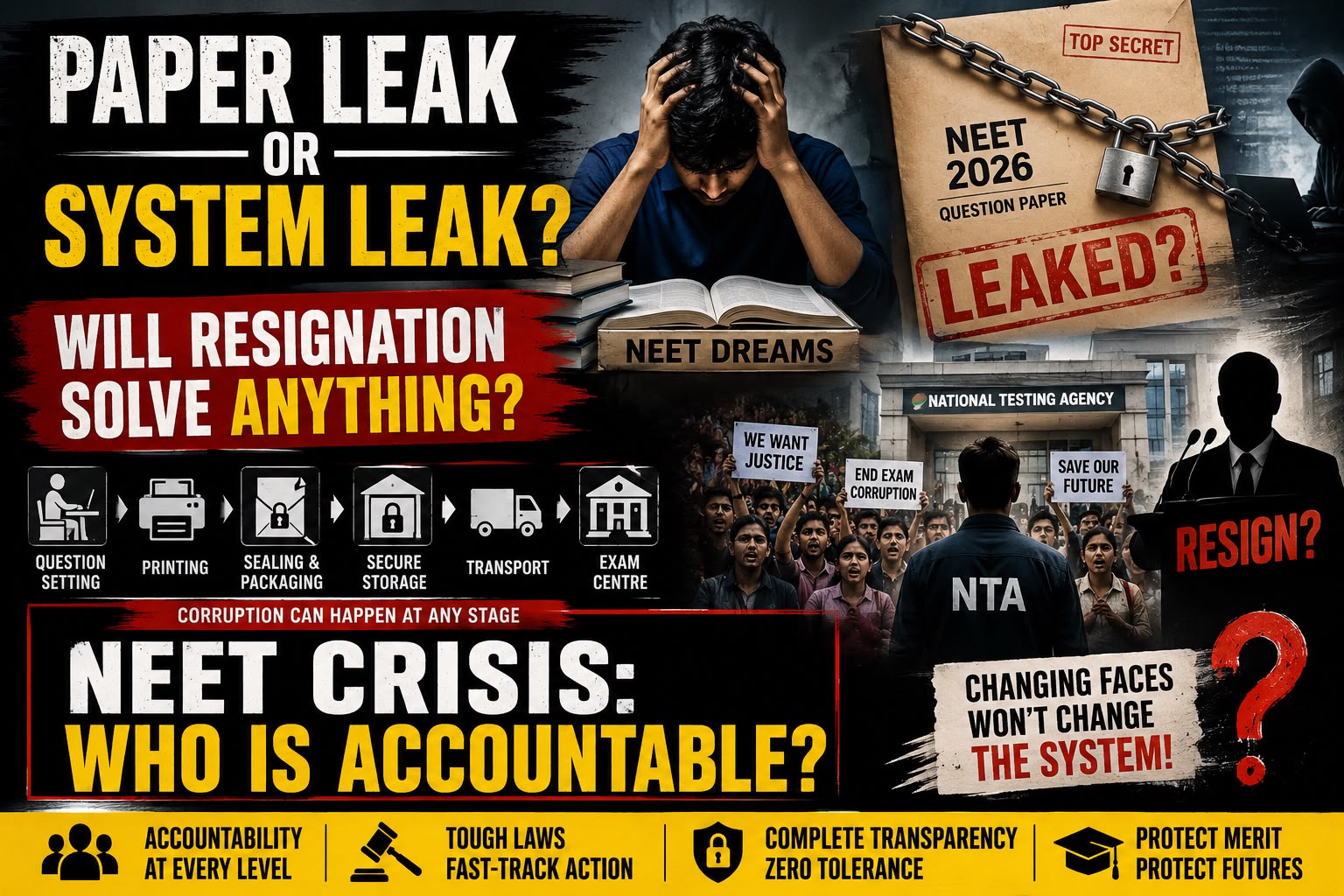
Paper Leak Or System Leak? The Questions India Must Answer
NEET 2026: The Real Question Is Not Whether the Paper Leaked: The Real Question Is Why Our System Keeps Failing
The controversy surrounding the NEET 2026 examination refuses to die down.
After allegations of a paper leak in the original examination led to the decision for a re-exam, fresh claims have now surfaced on social media that the Re-NEET paper itself has been leaked. The National Testing Agency, or NTA, has categorically denied these claims, calling them fraudulent and the work of organized cheating rackets trying to exploit anxious students and parents. Authorities have also warned candidates against paying money to channels and groups claiming to provide the question paper.
But whether this latest claim turns out to be a rumor or a reality, one question remains:
How many times can students be asked to trust a system that repeatedly finds itself under suspicion?
Every year, lakhs of students spend months, even years, preparing for one examination that can define their future. Behind every NEET application is a family making sacrifices, a student battling pressure, anxiety, sleepless nights, and uncertainty.
And yet, every paper leak allegation shakes not just an examination, but the faith of an entire generation.
Today, the public debate has become too simplistic.
People demand resignations.
People blame NTA.
People blame the Education Minister.
But let us ask a more serious question:
Much of the public discussion has focused on the government's decision to deploy extraordinary security measures, including military-grade logistics and even the use of Army helicopters or Air Force support for transporting question papers in certain regions. The intention is understandable, to ensure that sealed question papers reach examination centres safely.
But does a paper leak happen only during transportation?
That is the question the country must ask.
The movement of sealed packets from one location to another is only the final stage of a much longer process.
Long before a question paper reaches an examination centre, it passes through several critical stages.
First, subject experts prepare the questions in highly secure environments. Then the final paper is stored on restricted systems with limited access. After that, it is sent to authorised printing presses where printing takes place under CCTV monitoring and strict supervision. The papers are then packaged, sealed, stored in secure facilities or bank vaults, and only thereafter transported to examination centres under security arrangements.
So if a leak occurs, the possibility does not begin only when a sealed packet is being transported.
The breach could theoretically occur at any point in the chain.
Was it during paper setting?
Was it during moderation?
Was it during digital storage?
Was it during printing?
Was it during packaging?
Was it during storage?
Or was it during transportation?
These are the questions investigators must answer.
Because if the focus remains only on the transportation stage, then India risks securing the last link of the chain while ignoring vulnerabilities that may exist much earlier in the process.
In fact, several reports examining the NEET process have pointed out that investigators typically look at the entire paper trail—from question setters and secure computer systems to printing presses, storage facilities, transport mechanisms, and examination centres—to identify where a breach may have occurred.
Therefore, the debate should not be whether the government deployed helicopters, police escorts, GPS tracking, or even the Air Force.
The debate should be whether every single stage of the examination ecosystem has become leak-proof.
Because if even one weak link survives, the entire chain remains vulnerable.
And that is why the challenge before the government is much bigger than transporting papers safely.
The challenge is to identify where corruption enters the system, who enables it, who profits from it, and how every possible point of compromise can be eliminated permanently. But perhaps it is time to ask some uncomfortable questions—not just to the government, not just to the NTA, but to ourselves as a society.
Every time a controversy erupts, the streets fill with protests, slogans, and demands for resignations. The Education Minister becomes the face of public anger. But let us pause and ask: if one minister resigns today, will corruption disappear tomorrow? Will the next minister magically eliminate every dishonest official, every criminal network, every insider willing to sell the future of students for money?
The truth is far more complicated.
If corruption exists at the ground level, if people within the system are willing to compromise integrity for profit, then changing one face at the top cannot solve the problem. The disease lies deeper than the individual occupying the chair.
This is not an argument against accountability. Accountability is essential. But accountability must go beyond politics. It must go beyond television debates and street slogans.
What if, instead of spending weeks demanding resignations, student groups, parents, education experts, and civil society organizations came together to demand something more meaningful—a national consultation on examination reforms?
What if those protesting on the streets also demanded a direct dialogue with policymakers?
What if students, who are the biggest stakeholders in this system, were invited to sit across the table from the Education Ministry, NTA officials, technology experts, cybersecurity specialists, and law enforcement agencies to discuss practical solutions?
Because outrage may create headlines, but solutions create change.
The real battle is not against one minister, one government, one political party, one religion, or one institution.
The real battle is against a culture where corruption has become so deeply embedded that it threatens the dreams of millions.
And that is why the biggest question before India today is not whether another paper leaked.
The biggest question is this:
Do we have the courage to fix the system instead of merely blaming it?
Do we have the determination to identify every weak link from the question setter to the printing press, from the transport chain to the examination centre, from the local official to the highest authority—and make every single person accountable?
Because students deserve more than sympathy.
They deserve certainty.
They deserve trust.
And they deserve an examination system where success is determined by hard work, not by connections, corruption, or criminal networks.
Until that happens, every paper leak allegation will remain a reminder that India's greatest educational challenge is not conducting examinations; it is protecting the integrity of those examinations.
And that responsibility belongs not only to the government, but to every institution, every official, every stakeholder, and every citizen who claims to care about the future of the country's youth. The Globali welcomes your solutions and stand as a voice for the students . Jai Hind