


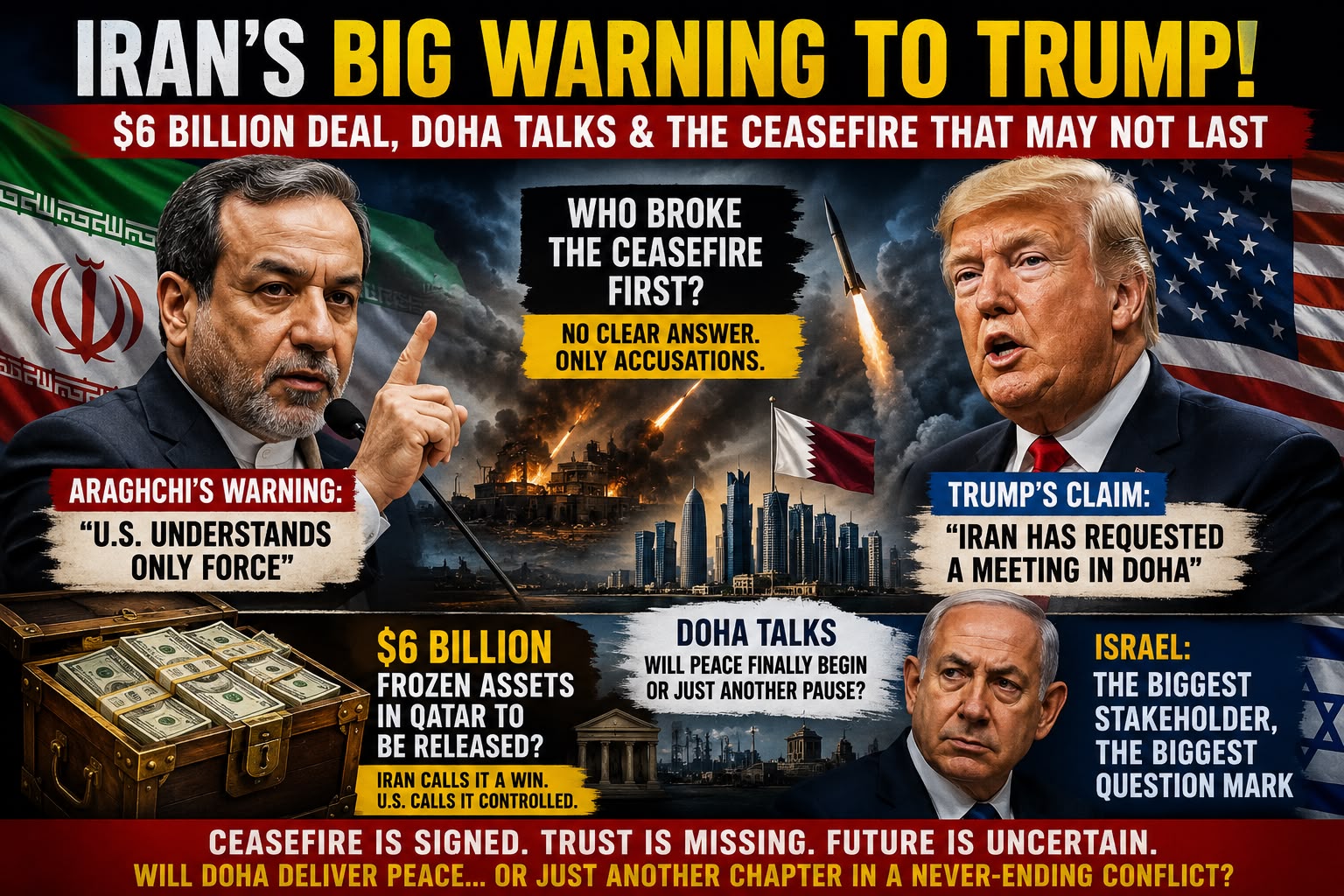
IRAN'S BIG WARNING, TRUMP'S BIG CLAIM: IS THE U.S.-IRAN CEASEFIRE ALREADY COLLAPSING?
IRAN'S BIGGEST WARNING TO TRUMP... TRUMP'S BIGGEST CLAIM... BILLIONS OF DOLLARS AT STAKE... AND NOW ALL EYES ARE ON DOHA.
Has the Middle East finally found a path to peace... or are we simply witnessing another pause before the next crisis?
Just days after the United States and Iran announced what was described as a fragile ceasefire, the diplomatic battlefield has once again become as intense as the military one.
The missiles may have fallen silent for now, but the battle over truth, perception and political messaging has only intensified.
And that is exactly why the latest developments deserve much closer attention.
The first major development came from Tehran.
Iran's Foreign Minister Abbas Araghchi issued a fresh and direct warning to U.S. President Donald Trump. In a strongly worded statement, Araghchi accused Washington of repeatedly failing to honour diplomatic commitments and relying on threats and military pressure instead of genuine negotiations. His message was blunt: the United States, he said, understands only the language of force.
That statement alone was enough to raise concerns that the fragile ceasefire was already under pressure.
But almost immediately after Araghchi's warning came another dramatic announcement.
President Donald Trump posted on Truth Social that Iran has requested a meeting and that American and Iranian representatives are expected to meet in Doha.
At first glance, this appears to be a positive diplomatic breakthrough.
But look a little deeper, and a completely different picture emerges.
Because Iran has not publicly accepted Trump's version of events.
Tehran has not acknowledged that it approached Washington seeking talks. Iranian officials have instead maintained that diplomatic contacts are taking place through mediators and have disputed the suggestion that Iran requested negotiations in the manner described by President Trump.
So, who is telling the truth?
Did Iran genuinely ask for talks?
Or is this another example of political messaging where each side wants to appear stronger than the other?
This is not just a disagreement over words.
It is a battle over who appears to be negotiating from a position of strength.
To understand why this matters, we have to go back to the ceasefire itself.
The agreement signed earlier this month was never meant to be a comprehensive peace treaty.
It was an interim understanding designed to stop direct military confrontation, reduce tensions, reopen diplomatic channels and create space for future negotiations.
But perhaps its biggest weakness was what it did not include.
The agreement did not resolve Iran's nuclear enrichment programme.
It did not permanently settle sanctions.
It did not establish a long-term regional security framework.
In simple terms, it stopped the immediate crisis but left the biggest disputes untouched.
And perhaps that is why the ceasefire almost immediately came under strain.
Washington says Iran violated the spirit of the agreement through renewed actions linked to maritime security and regional tensions.
Tehran says it was the United States that continued military pressure and targeted Iranian strategic infrastructure despite the understanding.
So who actually broke the ceasefire first?
The honest answer is that, at this stage, there is no independently verified evidence that conclusively proves which side violated the agreement first.
Both governments accuse the other.
Both claim they acted in self-defence.
And both insist the other side is responsible for escalating tensions.
That is exactly what makes this crisis different.
The conflict is no longer being fought only with missiles.
It is also being fought through competing narratives.
Washington wants the world to believe that President Trump's maximum-pressure strategy forced Iran back to the negotiating table.
Tehran wants the world to believe that it has never negotiated under pressure and has not surrendered to American demands.
Both narratives are politically useful.
Both are designed for domestic audiences.
And both make genuine trust even more difficult to build.
But as if the war of words was not enough, another major development has added a completely new dimension to the negotiations.
Iranian President Masoud Pezeshkian has announced that $6 billion of Iran's frozen assets held in Qatar are expected to be released, calling it a major victory for the Iranian people.
If implemented, this would mark one of the most significant economic developments since the latest round of diplomacy began.
However, this announcement also comes with important questions.
Iran is presenting the move as proof that its strategy of resistance has succeeded and that billions of dollars belonging to the Iranian people are finally being returned.
The American position, however, has been far more cautious.
Washington has indicated that any access to these funds would be linked to agreed mechanisms and oversight, with restrictions on how the money can be used, rather than becoming unrestricted cash flowing directly into the Iranian government's hands.
So once again, both sides are describing the same development in completely different ways.
For Tehran, it is a diplomatic victory.
For Washington, it is a carefully controlled confidence-building measure linked to the broader peace process.
And that raises another important question.
Is this truly Iran's biggest diplomatic success in years...
Or is it simply a phased sanctions arrangement that both governments are presenting differently for political reasons?
Now let us bring in another key player that cannot be ignored.
Israel.
Although this ceasefire is officially between Washington and Tehran, Israel remains one of the biggest stakeholders in whether it survives.
For years, Prime Minister Benjamin Netanyahu has argued that Iran's nuclear programme poses an existential threat to Israel's security.
From Israel's perspective, any agreement that postpones difficult decisions on uranium enrichment rather than resolving them leaves the central security concern untouched.
Does that mean Israel wants this ceasefire to fail?
There is no credible evidence that Israel deliberately violated the ceasefire or engineered its collapse.
But there is also little doubt that Israel remains deeply sceptical of any agreement that allows Iran to retain significant nuclear capabilities without long-term verification.
If diplomacy fails to produce meaningful restrictions on Iran's nuclear programme, pressure inside Israel for tougher military action could grow.
In that sense, Israel may not be the spoiler of peace, but it remains one of the most important variables in determining whether peace can actually last.
And now, all roads lead to Doha.
If the proposed meeting takes place, it will be far more than another diplomatic gathering.
It will test whether Washington and Tehran are prepared to move beyond public rhetoric and begin rebuilding the trust that has been missing for decades.
Because the real challenge is no longer stopping the missiles.
The real challenge is ending the mutual distrust.
And perhaps that is why the world should not focus only on whether leaders meet in Doha.
The world should focus on whether they are finally prepared to solve the issues that have brought them repeatedly to the brink of war.
So before celebrating another diplomatic breakthrough, perhaps we should ask just three questions.
If peace has truly begun, why are both sides still telling completely different stories about the same agreement?
Will the reported release of billions of dollars help build trust, or will it create fresh divisions between Washington, Tehran and America's regional allies, particularly Israel?
And finally, will Doha become the city where a lasting peace begins... or will it simply become another chapter in the long history of U.S.-Iran negotiations, where every ceasefire is only an interval before the next confrontation?