


India Surrounded? Pakistan's Water Threats, China's Warning & America's Diplomatic Game
Pakistan's Nuclear Threats, China's Strategic Shadow, America's Diplomatic Game; Is South Asia Entering a New Geopolitical Storm?
What if the next war between India and Pakistan is not fought over Kashmir... but over water?
What if Pakistan's repeated nuclear warnings are not merely political rhetoric but part of a much larger geopolitical design?
And what if, while India believes it is emerging as a global power, a new strategic axis is quietly taking shape around it?
Pakistan is threatening military action.
Its leaders are openly speaking about nuclear weapons.
China is issuing carefully worded warnings.
The United States is once again engaging Pakistan despite calling India its strategic partner.
Bangladesh is rebuilding ties with Islamabad.
So the biggest question tonight is—
Is India facing a coordinated geopolitical pressure campaign? Or is this merely the optics of changing global diplomacy?
Pakistan's Latest Threat:Why Water Has Become a Weapon
For nearly sixty-five years, the Indus Waters Treaty stood as one of the world's most successful examples of cooperation between two hostile neighbours.
Signed in 1960 with World Bank mediation, the treaty divided the six rivers of the Indus Basin.
India retained exclusive rights over the eastern rivers—Ravi, Beas and Sutlej.
Pakistan received the western rivers—Indus, Jhelum and Chenab.
In effect, nearly 80 percent of the basin's waters flowed to Pakistan, while India retained around 20 percent.
This arrangement was extraordinarily generous from India's perspective because the rivers originate upstream.
Yet India honoured the treaty even after the wars of 1965, 1971 and Kargil, and despite decades of cross-border terrorism.
Mumbai.
Pathankot.
Uri.
Pulwama.
India never touched the treaty.
The question is—
If India did not suspend the treaty after Mumbai, why after Pahalgam?
Because New Delhi believes something fundamental has changed.
The government argues that terror and normal cooperation cannot coexist indefinitely.
Prime Minister Narendra Modi summed it up in one sentence—
Blood and water cannot flow together."
That statement has now become India's new strategic doctrine.
Pakistan's Response: The Language Has Changed
Pakistan is no longer merely protesting diplomatically.
Its leaders are speaking the language of deterrence.
Climate Change Minister Musadik Malik warned that anyone attempting to stop Pakistan's waters would have "their hands cut off."
Foreign Minister Ishaq Dar described India's move as an act of aggression.
Bilawal Bhutto Zardari warned of severe consequences.
Several Pakistani officials and commentators have even linked the issue to Pakistan's nuclear doctrine.
This raises an uncomfortable question.
Why has Pakistan suddenly become so confident?
Is it merely domestic politics?
Or does Islamabad believe powerful countries will stand behind it?
The China Factor—Pakistan's Permanent Strategic Shield
Whenever India and Pakistan enter a diplomatic confrontation, China rarely remains neutral.
There is a reason.
Pakistan is China's closest strategic partner in South Asia.
The China-Pakistan Economic Corridor is worth tens of billions of dollars.
Pakistan gives China direct access to the Arabian Sea through Gwadar Port.
From Beijing's perspective, Pakistan is an indispensable strategic asset against India.
So when India suspended the Indus Waters Treaty, China subtly reminded New Delhi that countries should not do to others what they themselves would oppose.
It was a carefully crafted diplomatic message.
No direct threat.
No mention of military action.
Yet everyone understood who the message was directed at.
But here lies the irony.
China itself controls the upper reaches of the Brahmaputra.
If India begins asserting greater upstream rights over the Indus, could Beijing one day use similar logic regarding rivers flowing into India?
Water politics, therefore, is no longer just about Pakistan.
It is becoming part of a larger Asian power competition.
America's Return to Pakistan: A Diplomatic Game India Cannot Ignore
Perhaps the most interesting development is not Pakistan's rhetoric.
It is Washington's diplomacy.
For years, India believed the United States had largely shifted its strategic focus toward New Delhi.
And in many respects, it has.
The defence relationship has deepened.
Technology partnerships have expanded.
The Quad has become a major Indo-Pacific platform.
Yet geopolitics rarely works in absolutes.
The United States never completely walks away from countries that continue to hold strategic value.
Pakistan remains important because of Afghanistan, counterterrorism, regional intelligence networks, West Asia, and increasingly, because Washington does not want Beijing to enjoy exclusive influence in Islamabad.
This explains why the Trump administration has signalled a willingness to maintain engagement with Pakistan even while strengthening relations with India.
Some observers in India see this as contradiction.
Washington calls India its indispensable partner.
Yet it simultaneously keeps Pakistan diplomatically relevant.
But perhaps this is not contradiction.
Perhaps this is classic American statecraft.
The United States rarely puts all its strategic eggs in one basket.
It maintains relationships with rivals.
It speaks to both sides.
It preserves leverage.
That has been the hallmark of American foreign policy for decades.
The real question, therefore, is not,
Is America supporting Pakistan?"
The real question is,
How much strategic space is Washington willing to give Islamabad while expecting India to remain its closest Indo-Pacific partner?"
That answer will shape South Asia's future.
Bangladesh: Another Variable
Meanwhile, Bangladesh has begun cautiously improving ties with Pakistan after years of distance.
Is Bangladesh abandoning India?
No.
Its economic relationship with India remains substantial.
But New Delhi cannot ignore the symbolism.
Whenever multiple neighbours simultaneously improve relations with one another, Indian strategic planners naturally pay attention.
Even if these developments are independent, together they create a perception of strategic encirclement.
And in geopolitics—
Perception often matters almost as much as reality.
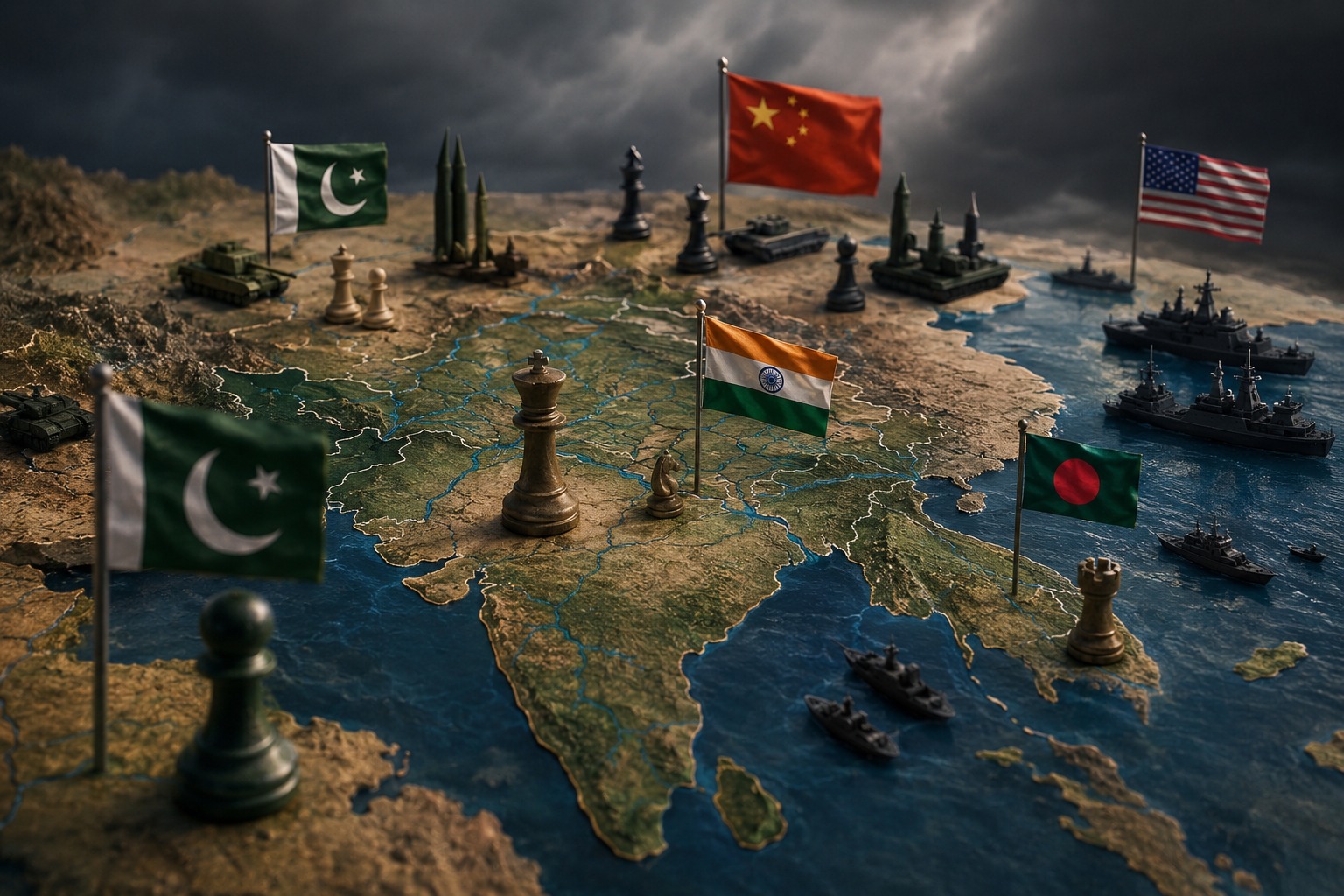
The Bigger Picture
Look at the map.
Pakistan on one side.
China on another.
Growing China-Pakistan military cooperation.
Bangladesh recalibrating parts of its diplomacy.
The United States reopening channels with Islamabad.
Is this coincidence?
Or is South Asia witnessing a quiet geopolitical realignment?
No one knows for certain.
But India must prepare for every possibility.
Because modern geopolitics is not about permanent friends.
It is about permanent interests.
India's Response
India is unlikely to respond emotionally.
Its response is expected to be strategic.
More dams.
Greater utilisation of river waters.Accelerated border infrastructure.
Closer cooperation with Quad partners.
Expanded defence manufacturing.
Economic resilience.
Diplomatic outreach.
India understands that the twenty-first century will not be won merely through military strength.
It will be won through economics, technology, infrastructure, energy security and water security.
The Indus Waters Treaty was signed in an era when diplomacy still carried the hope of overcoming conflict.
Today, South Asia stands at a crossroads.
Pakistan says water is its lifeline.
India says terrorism has crossed every red line.
China sees an opportunity to strengthen its regional influence.
The United States is carefully ensuring that it retains influence with both New Delhi and Islamabad.
And that brings us to the final question.
Is this merely another India-Pakistan dispute?
Or are we witnessing the beginning of a new geopolitical contest where rivers become strategic weapons, diplomacy becomes psychological warfare, and every major power is positioning itself for the next chapter of Asia's rise?
Because in the twenty-first century...
the battle may no longer be fought over territory alone.
It may be fought over water, influence, alliances and the ability to shape the future of an entire region.