


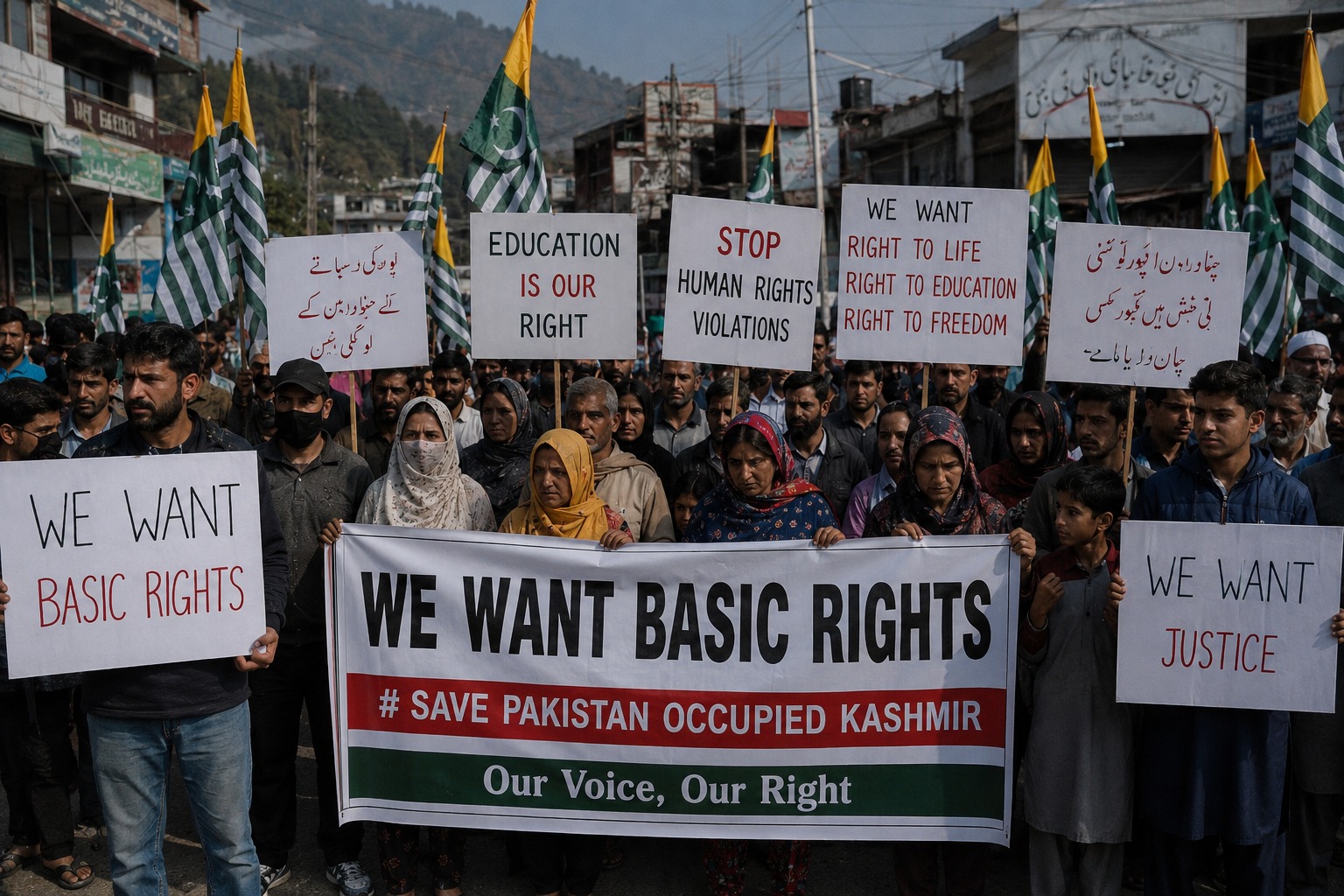
Pakistan Faces Fresh Challenge as Protests Intensify in PoK: What's Driving the Movement?
The Rising Storm in Pakistan-Occupied Kashmir: Is This an Economic Revolt, a Political Awakening, or the Beginning of a Larger Crisis?
When ordinary citizens begin confronting the very state that claims to represent them, is it merely another protest or the first sign of a deeper transformation? Why are thousands of people in Pakistan-occupied Kashmir (PoK) repeatedly taking to the streets? Are they demanding better governance, greater autonomy, independence, or something else entirely? And could this movement reshape the political future of one of South Asia's most sensitive regions?
For decades, Pakistan-occupied Kashmir has often been viewed primarily through the lens of the India-Pakistan dispute. Yet today, a different story is unfolding, one driven less by geopolitics and more by the daily realities of inflation, electricity shortages, unemployment, governance, and public frustration.
The latest warnings issued by the Joint Awami Action Committee (JAAC), including an ultimatum to the Pakistani government and threats of a region-wide agitation, have once again brought international attention to PoK. Protest leaders have accused Pakistani authorities and security forces of suppressing public voices and using force against demonstrators. Such allegations have circulated during previous protest waves as well, although the Pakistani government has generally defended its actions as necessary to maintain law and order.
The central question now is no longer whether protests exist.
The bigger question is:
What exactly are the people protesting for and where could this movement ultimately lead?
A Region Living With Unresolved Questions
Pakistan-administered Kashmir has existed under a unique constitutional and administrative arrangement since 1947.
Unlike Pakistan's provinces, it has historically operated under a separate governance framework, with significant influence from Islamabad over key policy areas.
Over the decades, critics including local political groups have argued that decision-making remains heavily centralized, while supporters of the existing arrangement contend that the region enjoys substantial self-governance within Pakistan's constitutional structure.
These differing narratives have shaped politics in the region for decades.
The Roots of the Current Movement
Contrary to many headlines, the present movement did not begin as an ideological campaign.
It emerged primarily from economic grievances.
Residents increasingly complained about:
Rising electricity prices despite the region producing hydropower.
High inflation.
Expensive wheat flour and essential commodities.
Limited employment opportunities.
Concerns over governance and accountability.
Many protesters questioned why a region that generates electricity through major hydroelectric projects continues to face high electricity costs.
That question became one of the movement's most powerful rallying points.
Who Is the Joint Awami Action Committee?
The Joint Awami Action Committee (JAAC) is not a single political party.
It is a coalition bringing together traders, civil society representatives, transport associations, lawyers, and various local organizations around shared socio-economic demands.
Its support base has expanded during successive protest movements because many participants view it as representing everyday public concerns rather than traditional party politics.
This broad social composition explains why its demonstrations have attracted significant public participation.
Why Has the Movement Intensified Again?
Recent statements from JAAC indicate growing frustration with what its leaders describe as inadequate implementation of earlier commitments.The organization has accused Pakistani authorities of:
failing to fulfill agreed demands;
restricting peaceful dissent;
using force against demonstrators.
These are serious allegations. Independent reporting has documented confrontations during previous protest phases, although competing accounts differ regarding responsibility for specific incidents.
What is beyond dispute is that public frustration has not disappeared.
Instead, it appears to be resurfacing.
The Symbolism of "Sarfaroshi Ki Tamanna"
One striking feature of recent demonstrations has been the repeated use of the revolutionary poem "Sarfaroshi Ki Tamanna."
Originally associated with Indian freedom fighter Ram Prasad Bismil, the poem has historically symbolized courage, sacrifice, and resistance against perceived injustice.
Its appearance in PoK protests is therefore politically significant.
However, caution is essential.
The use of revolutionary symbolism does not automatically indicate support for India.
Political slogans often transcend their historical origins and are adopted by diverse movements worldwide to express determination rather than identical political objectives.
Do the People of PoK Want India's Help?
This is perhaps the most frequently asked and most politically sensitive question.
The available evidence does not support a single, uniform answer.
Public opinion in PoK is not monolithic.
Different sections of society hold different aspirations.
Some demand:
Lower electricity tariffs.
Economic reforms.
Better governance.
Administrative accountability.
Others advocate:
Greater autonomy.
Constitutional reforms.
Independence from both India and Pakistan.
A smaller number express pro-Pakistan or pro-India positions.
There is no credible evidence that the entire population has united behind one political outcome or collectively seeks intervention from India.
Portraying all protesters as supporting any single political objective oversimplifies a highly diverse movement.
Why Does Pakistan View These Protests Seriously?
For Islamabad, the challenge extends beyond economics.
Pakistan has consistently maintained that Kashmir reflects the wishes of its people.
Large-scale protests against governance in Pakistan-administered Kashmir therefore create an uncomfortable political narrative.
They invite difficult questions:
If governance is effective, why do protests continue to reappear?
Why are economic grievances becoming stronger instead of weaker?
Why are local organizations increasingly mobilizing independently?
These questions carry both domestic and international significance.
Pakistan's Growing Internal Challenges
The PoK movement does not exist in isolation.
It unfolds against a backdrop of multiple national pressures.
Pakistan continues to face:
persistent inflation;
external debt obligations;
IMF-linked economic reforms;
unemployment concerns;
security challenges in Balochistan and Khyber Pakhtunkhwa;
political polarization at the national level.
Each additional protest movement stretches administrative capacity further.
Governments confronted by simultaneous economic, political, and security pressures often find compromise increasingly difficult.
Strategic Implications for India
India officially considers the entire former princely state of Jammu and Kashmir, including Pakistan-administered territories, to be an integral part of India.
From New Delhi's perspective, recurring protests highlighting governance or economic grievances may reinforce its longstanding argument that Pakistan has struggled to administer the territory effectively.
At the same time, India has generally avoided officially endorsing specific protest movements in PoK, while continuing to assert its constitutional claim over the region.
For India, these developments also carry strategic communication value internationally, particularly when discussing governance and human rights in disputed territories.
Is This an Economic Protest Becoming a Political Movement?
History suggests that many major political movements begin with economic demands.
When everyday grievances remain unresolved over long periods, citizens often begin questioning broader political structures.
Whether PoK is approaching such a transition remains uncertain.
But the possibility cannot be ignored.
The evolution of the movement over the coming months will largely depend upon whether economic concerns are addressed through dialogue or whether confrontation becomes the dominant response.
Possible Future Scenarios
Scenario One: Negotiated Settlement
Islamabad offers additional subsidies, addresses electricity pricing, and implements administrative reforms.
Public anger gradually subsides.
This remains the least disruptive outcome.
Scenario Two: Cyclical Protest Politics
Authorities make limited concessions.
Protests pause temporarily.
Economic pressures return.
Fresh demonstrations emerge months later.
Many analysts consider this a plausible medium-term scenario if structural issues remain unresolved.
Scenario Three: Political Radicalization
If repeated protests fail to produce meaningful reforms, sections of the movement could adopt broader political demands beyond economic issues.
Such a transition would significantly alter the regional political landscape.
At present, there is no conclusive evidence that this transformation has occurred across the movement as a whole.
Questions Worth Asking
Instead of asking only whether protests will continue, perhaps the more important questions are:
Why does a region that generates substantial hydroelectric power continue to witness protests over electricity prices?
Can economic grievances be permanently separated from political aspirations?
Will repeated reliance on security measures resolve public dissatisfaction—or deepen it?
How should competing narratives about PoK be evaluated without reducing a diverse population to a single political viewpoint?
As economic pressures mount across South Asia, could governance become a more decisive factor than ideology in shaping future movements?
Conclusion
The latest wave of unrest in Pakistan-administered Kashmir is not merely a regional protest; it is a reflection of the complex intersection of economics, governance, identity, and political expectations. The movement appears to have been driven initially by everyday concerns electricity tariffs, inflation, employment, and accountability but its persistence has elevated broader questions about representation and governance.
At the same time, it is important to distinguish verified facts from political narratives. There is credible evidence of recurring public protests and socio-economic grievances. There are also allegations by protest leaders of suppression by Pakistani authorities, while the authorities maintain that their actions are aimed at preserving public order. What cannot be concluded from the available evidence is that the movement speaks with one voice or that the entire population seeks a single political outcome, including support or intervention from India.
The deeper lesson may be this: lasting stability in any region depends not only on territorial control or political claims, but on responsive governance, economic opportunity, and public trust. If those foundations weaken, protests are likely to recur regardless of borders or rhetoric.
The most consequential question, therefore, is not simply where this movement stands today, but whether those who govern it are prepared to address the underlying grievances before they evolve into a broader political challenge.