


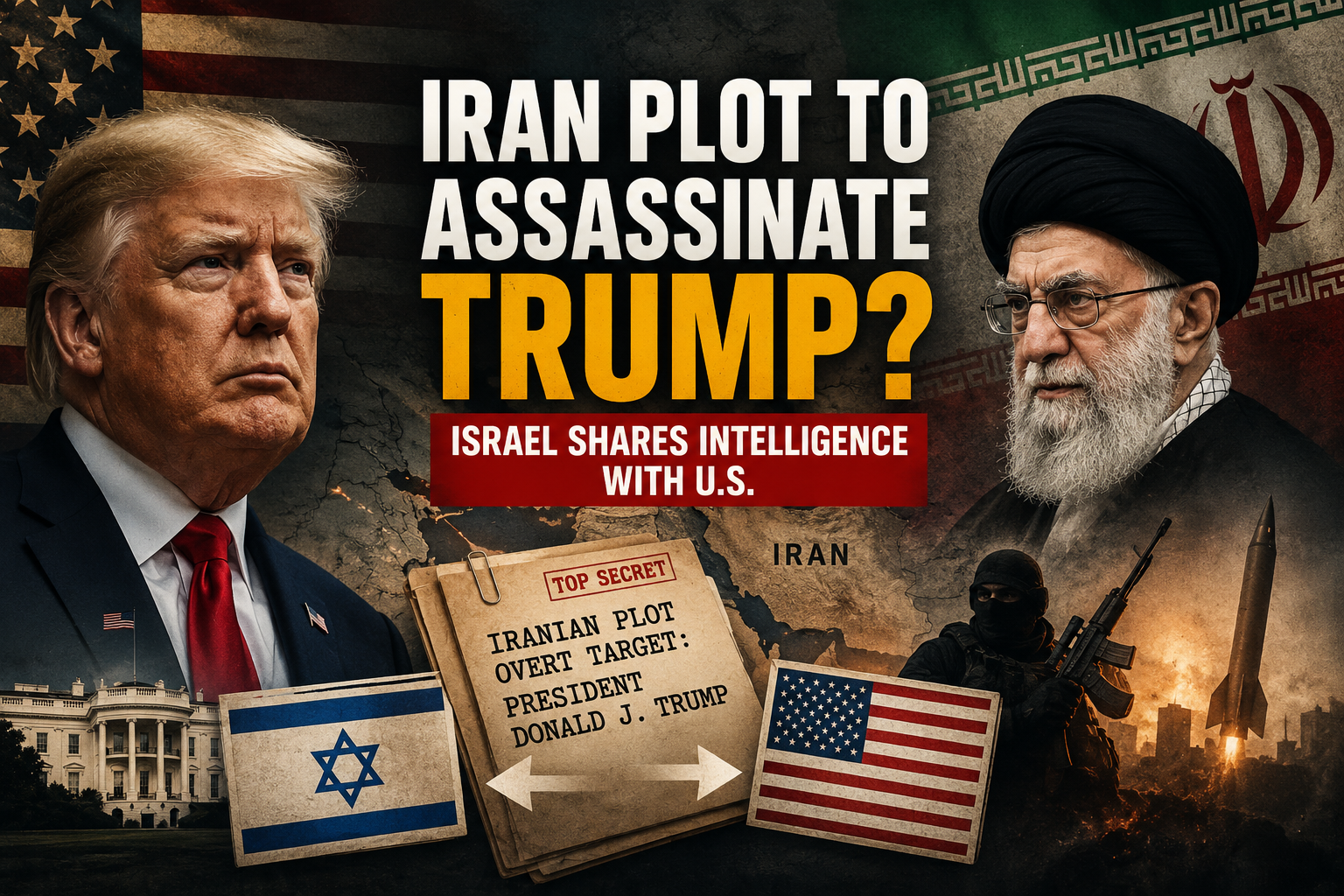
Trump Assassination Threat? Israel's Intelligence Raises New Fears of U.S.-Iran Escalation
Is President Donald Trump on Iran's Alleged Hit List? Israel's Intelligence Warning Raises a Dangerous Global Question.
What if the next flashpoint between America and Iran isn't fought in the skies over the Middle East... but revolves around the life of one man?
That possibility is once again making headlines after reports that Israel has shared fresh intelligence with Washington, warning of a possible Iranian plot targeting U.S. President Donald Trump.
If true, this isn't merely an assassination threat; it could become the trigger for an international crisis.
For years, Donald Trump has publicly maintained that he remains one of Iran's primary targets. The latest intelligence reports have once again brought that claim into sharp focus. But behind this story lies something much deeper than a possible assassination plot. It is a story of revenge, strategic deterrence, intelligence warfare, and a rivalry that has been intensifying for years.
So, how serious is this alleged threat? Why would Israel know about it before anyone else? And why does Donald Trump continue to occupy such a central place in Iran's strategic thinking?
Why does Donald Trump remain at the centre of Iran's anger?
To understand today's developments, one must revisit January 2020, when President Donald Trump authorized the U.S. drone strike that killed General Qasem Soleimani, the commander of Iran's elite Quds Force.
For Washington, Soleimani was considered one of the architects of Iran's regional military network and was accused of orchestrating attacks against U.S. personnel and allies.
For Iran, however, he was far more than a military commander. He was viewed as a national hero and a symbol of resistance. His death fundamentally altered the relationship between Tehran and Washington. Since then, influential figures within Iran have repeatedly vowed that those responsible would one day be held accountable.
But the story did not end with Soleimani.
The regional conflict has since grown even more bitter. The death of Supreme Leader Ayatollah Ali Khamenei during the recent Iran-Israel-U.S. conflict further intensified anti-American and anti-Trump sentiment among many supporters of Iran's ruling establishment. His death reinforced the belief among hard-line factions that the United States remains directly responsible for Iran's mounting losses.
At the same time, Donald Trump's return to the White House has revived memories in Tehran of the "maximum pressure" campaign, America's withdrawal from the nuclear agreement, crippling economic sanctions, and the decision to eliminate Soleimani. For many within Iran's political and security establishment, Trump's presidency is associated with one of the most confrontational periods in U.S.-Iran relations.
It is this combination of historical grievance, political symbolism and strategic rivalry that explains why President Trump continues to be viewed as one of Iran's most significant adversaries.
Why would Israel know before anyone else?
This is perhaps the most intriguing aspect of the story.
Israel possesses one of the world's most sophisticated intelligence networks focused on Iran. Over decades, Israeli intelligence agencies have developed extensive capabilities to monitor Iran's Revolutionary Guard, missile programme, proxy groups and strategic decision-making.
From exposing secret nuclear facilities to conducting covert operations deep inside Iranian territory, Israel has repeatedly demonstrated an extraordinary ability to penetrate Iranian security structures.
If discussions regarding any operation involving a high-profile American target were taking place within Iranian security circles, Israel would likely be among the first countries attempting to detect them.
However, one important distinction must always be remembered.
Intelligence is not the same as proof.
Governments often act on intelligence assessments long before every fact is independently verified. Intelligence reflects intercepted communications, human sources, surveillance and strategic assessments, not necessarily conclusive evidence.
Is Iran actually planning to assassinate Donald Trump?
This remains the most important question and one that cannot yet be answered with certainty.
At present, no government has publicly released evidence proving that an operational assassination attempt is underway.
Three possibilities therefore emerge.
The first is that the intelligence reflects a genuine and active Iranian plan that has not yet reached execution.
The second is that intelligence agencies have intercepted discussions, intentions or preliminary planning rather than evidence of an imminent attack.
The third is that making the intelligence public serves as a strategic warning to Tehran—signalling that any such planning has already been detected and would invite overwhelming consequences.
This distinction is critical.
The existence of intelligence does not automatically confirm that an attack is imminent. At the same time, dismissing such warnings would be equally irresponsible, given the history of hostility between the two countries.
Is all of Iran united in seeking revenge?
Not necessarily.
This is where public perception often differs from reality.
Iran is not politically uniform.
The Supreme Leader's supporters, the Revolutionary Guard and hard-line political factions have consistently adopted a far more confrontational position toward the United States.
Many continue to blame Donald Trump for withdrawing from the nuclear agreement, imposing sweeping economic sanctions, ordering the strike that killed Soleimani and shaping policies they believe isolated Iran internationally.
However, millions of ordinary Iranians are primarily concerned with inflation, unemployment, economic hardship and domestic governance.
Therefore, it would be inaccurate to suggest that every Iranian supports violent retaliation against the United States or President Trump.
What does this mean for Donald Trump?
Whether or not the alleged plot ultimately proves credible, one consequence is already evident.
Security surrounding the President of the United States is likely to remain at its highest level.
Every intelligence warning strengthens coordination between American intelligence agencies, the Secret Service, military planners and allied nations.
For Donald Trump, the issue has moved beyond politics. It has become an enduring national security concern.
The bigger picture
Perhaps the most significant aspect of this story is not whether an assassination attempt ultimately occurs.
It is the fact that events separated by six years, the killing of Soleimani, the escalation of regional conflict, the death of Ayatollah Khamenei, and Donald Trump's return to the White House continue to shape one of the world's most dangerous geopolitical rivalries.
Modern conflicts are no longer fought only through missiles and armies.
They unfold through cyber warfare, intelligence operations, covert missions, economic sanctions and psychological deterrence.
Sometimes, the most dangerous battles are the ones the public never sees.
Questions the world should now be asking:
If Israel's intelligence is accurate, how deeply has it penetrated Iran's security establishment?
Is this warning based on an imminent operational threat, or is it part of a broader strategy of deterrence and intelligence signalling?
And perhaps the biggest question of all, can the United States and Iran ever break this cycle of retaliation, or has revenge itself become a permanent feature of their relationship?
Conclusion
The confrontation between the United States and Iran is no longer measured only by missiles, sanctions or military deployments. It is increasingly being fought through intelligence, covert operations and strategic signalling.
And when intelligence reports begin to focus not on military bases or nuclear facilities but on the President of the United States himself the world has every reason to pay attention.
Because the biggest question may not be whether this alleged plot is real... but whether Donald Trump has now become the most consequential figure in the next chapter of the U.S.-Iran confrontation. As the shadow war grows darker, one question refuses to disappear: Is Donald Trump simply leading America's policy toward Iran or has he himself become the central battlefield of that conflict?