


If Justice Takes Years, Why Would Criminals Fear the Law?
Justice Delayed... Justice Denied? The Questions India Cannot Ignore today.
If you ever wonder why brutal crimes continue to shake India...
Stop wondering.
Criminals do not fear laws that take years to act.
They do not fear a justice system where trials stretch endlessly.
And they certainly do not fear punishment when punishment itself seems uncertain and distant.
A society where justice is delayed slowly becomes a society where crime loses its fear of the law.
Today, one development has once again reopened an old wound that millions of Indians have never forgotten.
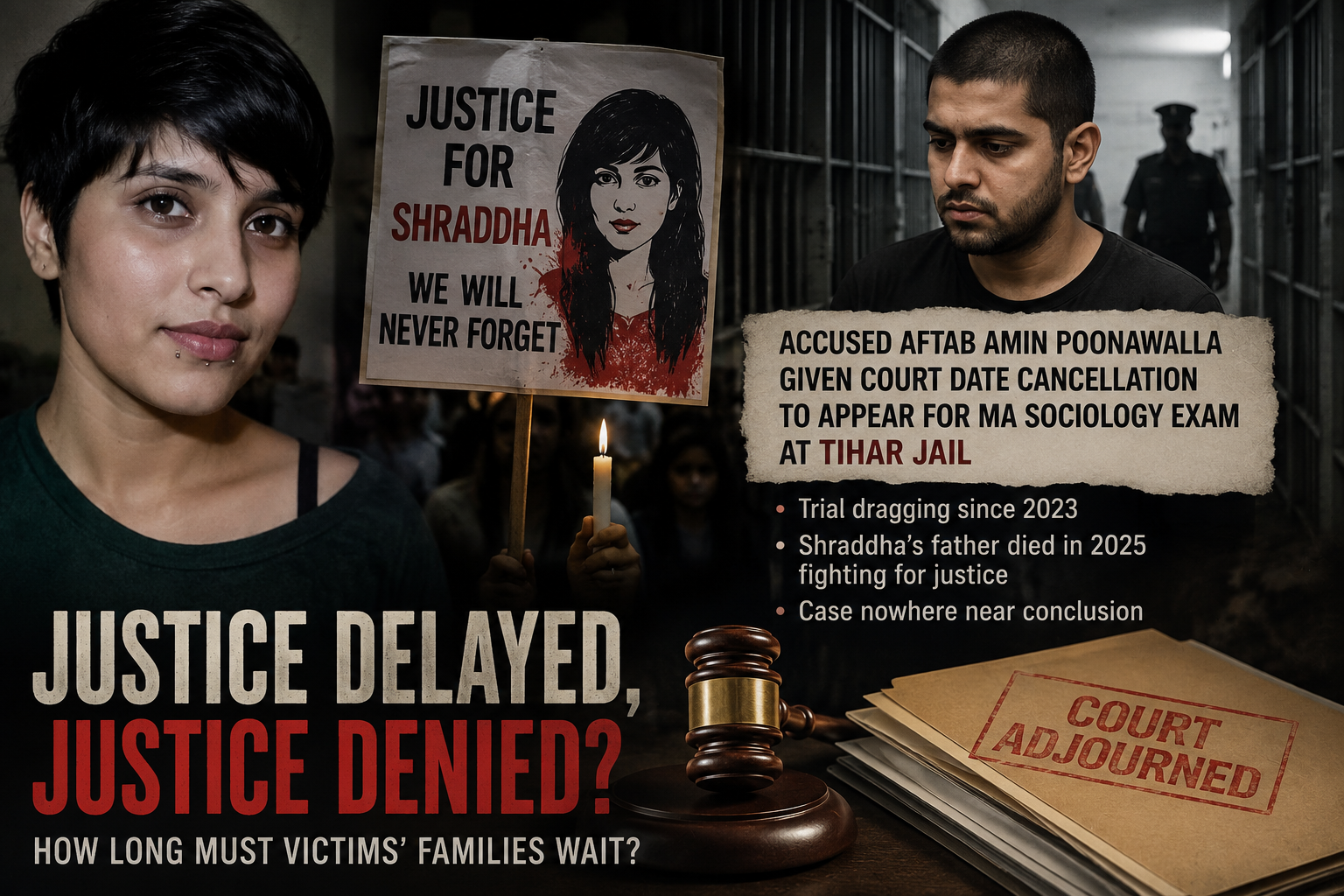
A Delhi court has postponed a scheduled hearing in the Shraddha Walkar murder case after accused Aaftab Amin Poonawala sought exemption to appear for his final M.A. Sociology examination inside Tihar Jail. The examination and the court hearing were scheduled for the same day, and the court allowed the exemption.
Legally, every undertrial prisoner has rights.
Every accused has the right to education.
Every accused has the right to a fair trial.
These are constitutional principles that cannot simply be ignored.
But there is another question that refuses to go away.
Where are the rights of the victim?Where is the justice that was promised?
The Shraddha Walkar case horrified the entire country in 2022.
According to the prosecution, Shraddha was allegedly murdered by her live-in partner, her body was allegedly dismembered into multiple pieces, and her remains were allegedly disposed of over several days.
The allegations shocked the conscience of the nation.
Charges were filed in 2023.
Yet, years later, the trial is still continuing.
Hearing after hearing.
Adjournment after adjournment.
Delay after delay.
Perhaps the most heartbreaking chapter is that Shraddha's father, Vikas Walkar, spent years fighting for justice for his daughter.
He passed away in 2025 without witnessing the conclusion of the trial.
A father left this world carrying the pain of losing his daughter—and without receiving the justice he had spent years seeking.
That fact alone should shake every citizen of this country.
This debate is not really about one examination.
Nor is it about whether an accused person should or should not pursue higher education.
The real issue is much larger.
Let us also make one thing absolutely clear.
This is not a fight between one religion and another.
This is not about Hindu versus Muslim, or about any community.
The moment we reduce a crime to the religion of either the accused or the victim, we weaken the very idea of justice.
This is a fight between justice and crime.
A murderer does not deserve protection because of religion.
A rapist does not deserve sympathy because of religion.
A criminal is a criminal, irrespective of caste, religion, language, region, or political ideology.
The law must remain blind to identity and unwavering in its duty.
Because the day we begin defending criminals based on their religion, we stop standing with victims and start standing against justice itself.
India does not need selective outrage.
India needs equal justice.
Every innocent victim deserves justice.
Every person found guilty after due process of law deserves punishment.
Only then can society send a clear message that no one is above the law and that heinous crimes will never be tolerated regardless of who commits them.
Now let us return to the larger question.
Why do some of India's most shocking criminal trials continue for years?*
Why do victims' families spend years moving from one hearing to another?
Why must parents grow old inside courtrooms while waiting for answers?
And why does justice often appear to move slower than the pain suffered by those left behind? Justice is not measured only by the fairness of a trial.
Justice is also measured by its timeliness.
When justice takes years, public confidence in the system begins to weaken.
When delays become routine, deterrence weakens.
And when deterrence weakens, criminals begin to believe that even if they are caught, the legal process itself may become their greatest shield.
The pain of a victim's family does not pause while files move from one date to another.
Their grief does not wait for the next hearing.
Their lives remain suspended while justice remains pending.
A democracy must protect the rights of every accused person.
That is what distinguishes the rule of law from mob justice.
But a democracy also owes something equally important to victims.
It owes them dignity.
It owes them certainty.
And above all, it owes them justice within a reasonable time.
This case has become much more than a criminal trial.
It has become a mirror reflecting one of the deepest concerns facing India's judicial system, the widening gap between justice promised and justice delivered.
If one of the country's most closely watched criminal cases can continue for years without reaching its conclusion, what message does that send to thousands of ordinary citizens whose cases never become national headlines?
Justice delayed may still be justice in legal theory.
But for grieving families, justice delayed often feels no different from justice denied.
A nation cannot hope to reduce heinous crimes if punishment remains uncertain and justice remains endlessly postponed.
Because criminals fear only one thing, not headlines, not public outrage, but swift, certain, and impartial justice.
And perhaps that is the question every Indian should ask today:
If justice keeps waiting while victims keep suffering, can we truly expect crime to decrease or are we, through delay itself, encouraging the next criminal to believe that justice can always wait?