


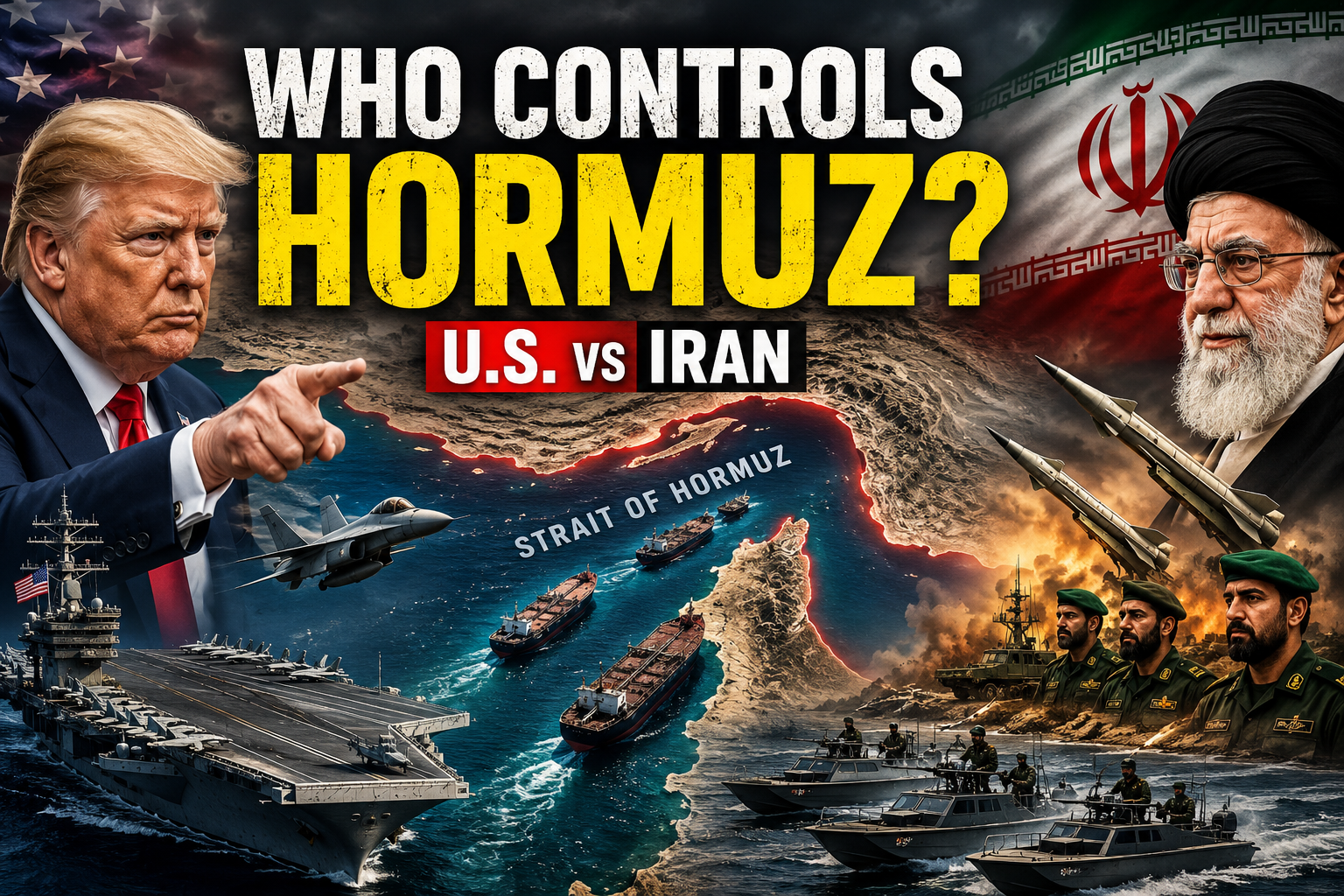
Who really controls the strait of Hormuz? Iran? The United States? Or international law?
Who really controls the strait of Hormuz? Iran? The United States? Or international law?
Is the Next Great War No Longer About Nuclear Weapons… But About the Strait of Hormuz?
What if the next global war isn't fought over nuclear bombs... but over a narrow strip of water?"
"What if the world's most important oil chokepoint becomes the battlefield that decides the future of global power?"
And if President Donald Trump says America has taken control of the Strait of Hormuz, while Iran declares that no foreign power will ever control it... are we witnessing the beginning of a new geopolitical confrontation?"
"Has the Iran-U.S. conflict quietly shifted from nuclear weapons to maritime dominance?"
"And if this struggle escalates, could the entire world pay the price through oil, inflation, and global trade?"
Hello you are watching the globali with me Mousumi
For decades, the world believed that the biggest flashpoint between Iran and the United States was Iran's nuclear programme.
But today, a different battlefield is emerging.
Not underground nuclear facilities.
Not ballistic missiles.
Not uranium enrichment.
Instead...
A waterway barely 33 kilometres wide at its narrowest point.
The Strait of Hormuz.
On Tuesday, tensions rose sharply after President Donald Trump claimed that the United States had effectively taken control over the Strait of Hormuz.
Iran immediately rejected the statement.
Brigadier General Mohammad Akraminia declared that the United States would never be allowed to control the Strait.
Foreign Minister Abbas Araghchi went even further, saying that management of the Strait is Iran's sovereign right and America has no authority to interfere.
These statements raise one fundamental question.
Is this now becoming a geopolitical battle over the world's most strategic maritime corridor?
Let's analyze.
PART 1 – Why Is the Strait of Hormuz So Important?
Before asking who controls it...
We must first understand why every major power wants influence there.
The Strait of Hormuz connects the Persian Gulf with the Gulf of Oman and ultimately the Indian Ocean.
Around one-fifth of the world's seaborne oil exports and significant volumes of liquefied natural gas pass through this narrow passage.
Saudi Arabia.
The UAE.
Kuwait.
Qatar.
Iraq.
All depend heavily on this route to reach global markets.
For Asia, including India, China, Japan, and South Korea, it is a vital energy lifeline.
Any prolonged disruption could send energy prices sharply higher and affect economies worldwide.
That is why Hormuz is often called the world's most important oil chokepoint.
Who Actually Controls the Strait Today?
This is where politics and international law diverge.
Many people assume Iran owns the Strait.
That is not entirely accurate.
Others believe the United States controls it through military power.
That is also not accurate.
The legal reality is more complex.
The Strait lies between Iran to the north and Oman to the south.
The territorial waters of both countries extend into the Strait.
International shipping generally relies on transit passage under widely accepted principles of the law of the sea, allowing ships to move through international straits used for global navigation.
In practical terms:
Iran exercises sovereignty over its territorial waters.
Oman exercises sovereignty over its territorial waters.
But the shipping lane itself is used by the international community.
No single country legally owns the entire Strait.
This distinction is crucial.
Then Why Does Iran Say It Controls the Strait?
Iran's position is based on geography and military capability.
Its long coastline overlooks much of the northern side of the Strait.
Over decades, Iran has developed extensive coastal defenses, naval forces, drones, anti-ship missiles, mines, and fast attack craft.
Its strategic message has long been clear:
"If Iran's security is threatened, it has the ability to disrupt shipping through the Strait."
Notice the wording.
Iran usually speaks of the capability to disrupt or restrict shipping—not an uncontested legal right to close the Strait for the world.
That capability has become a powerful tool of deterrence.
Why Does the U.S. Maintain Such a Large Naval Presence?
The American objective has never officially been to own the Strait.
Washington argues that it seeks to ensure freedom of navigation.
For decades, the United States has maintained major naval deployments in the Gulf.
Its carrier strike groups, destroyers, surveillance aircraft, submarines, and regional partnerships are designed to deter attacks on commercial shipping and reassure allies.
From Washington's perspective:
Any attempt to close the Strait threatens the global economy.
Therefore, keeping it open is presented as a strategic necessity.
This is why the U.S. Navy has repeatedly escorted commercial vessels during periods of heightened tension.
Is Trump's Statement Symbolic or Literal?
When President Trump claimed that America had taken control of the Strait of Hormuz, analysts are likely to interpret the statement in different ways.
It may have been intended as a political signal emphasizing U.S. naval dominance and operational reach.
It does not, however, change the legal status of the Strait.
Military presence and legal sovereignty are not the same thing.
A navy can influence access, provide security, or project power.
That does not automatically confer ownership or sovereign control over an international waterway.
This distinction is central to understanding the dispute.
PART 6 – Is This Becoming a War Over Waterways?
This is perhaps the most important strategic question.
For years...
The international debate focused on uranium enrichment.
Nuclear inspections.
Sanctions.
Missiles.
Now, another layer has become more prominent.
Control of strategic maritime corridors.
History shows that great powers have often competed over sea lanes because they shape trade, energy, and military mobility.
Whoever can influence major chokepoints can affect global commerce.
The Strait of Hormuz is one such chokepoint.
Others include the Suez Canal, the Bab el-Mandeb, the Bosporus, and the Panama Canal.
In that sense, maritime competition is not replacing the nuclear issue—it is becoming another major front in the broader strategic rivalry.
Can Iran Permanently Control the Strait?
Geographically...
Iran will always remain one of the key actors because geography cannot be changed.
Its coastline is fixed.
Its military infrastructure is established.
Its influence will remain significant.
But permanent unilateral control over the entire Strait is unlikely.
Why?
Because multiple actors have enduring interests:
The United States maintains substantial naval capabilities.
Regional Gulf states depend on uninterrupted exports.
European countries rely on energy flows.
China imports large volumes of Gulf energy.India's energy security is also linked to stable maritime access.
Any effort by one actor to dominate the Strait would almost certainly face strong resistance from others.
What Happens If Conflict Escalates?
If tensions intensify dramatically, the consequences could extend far beyond the Gulf.
Oil prices could spike.
Insurance costs for ships could rise.
Global supply chains could be disrupted.
Inflationary pressures could increase.
Energy-importing economies could face additional strain.
The impact would not remain regional.
It would become global.
CONCLUSION
So...
Who controls the Strait of Hormuz?
Legally...
Neither Iran nor the United States controls the entire Strait.
Iran and Oman exercise sovereignty over their respective territorial waters, while international shipping rights are recognized under the broader framework of international maritime law.
Strategically...
Iran possesses significant leverage because of geography and military capabilities.
Militarily...
The United States projects considerable power through its naval presence and partnerships.
Economically...
The entire world has a stake in keeping the Strait open.
Which is why this is no longer merely an Iran-versus-America dispute.
It is a contest over energy security, maritime influence, and the rules that govern one of the world's most vital waterways.
The larger question may no longer be simply, "Who will build the next nuclear weapon?"
It may increasingly be:
"Who will shape the future of the world's most strategic sea lanes?"
And in the twenty-first century...
The answer to that question could determine not only regional stability, but the trajectory of the global economy itself.
Who do you think holds the greatest leverage in the Strait of Hormuz today, Iran's geography, America's naval power, or the principles of international law?