


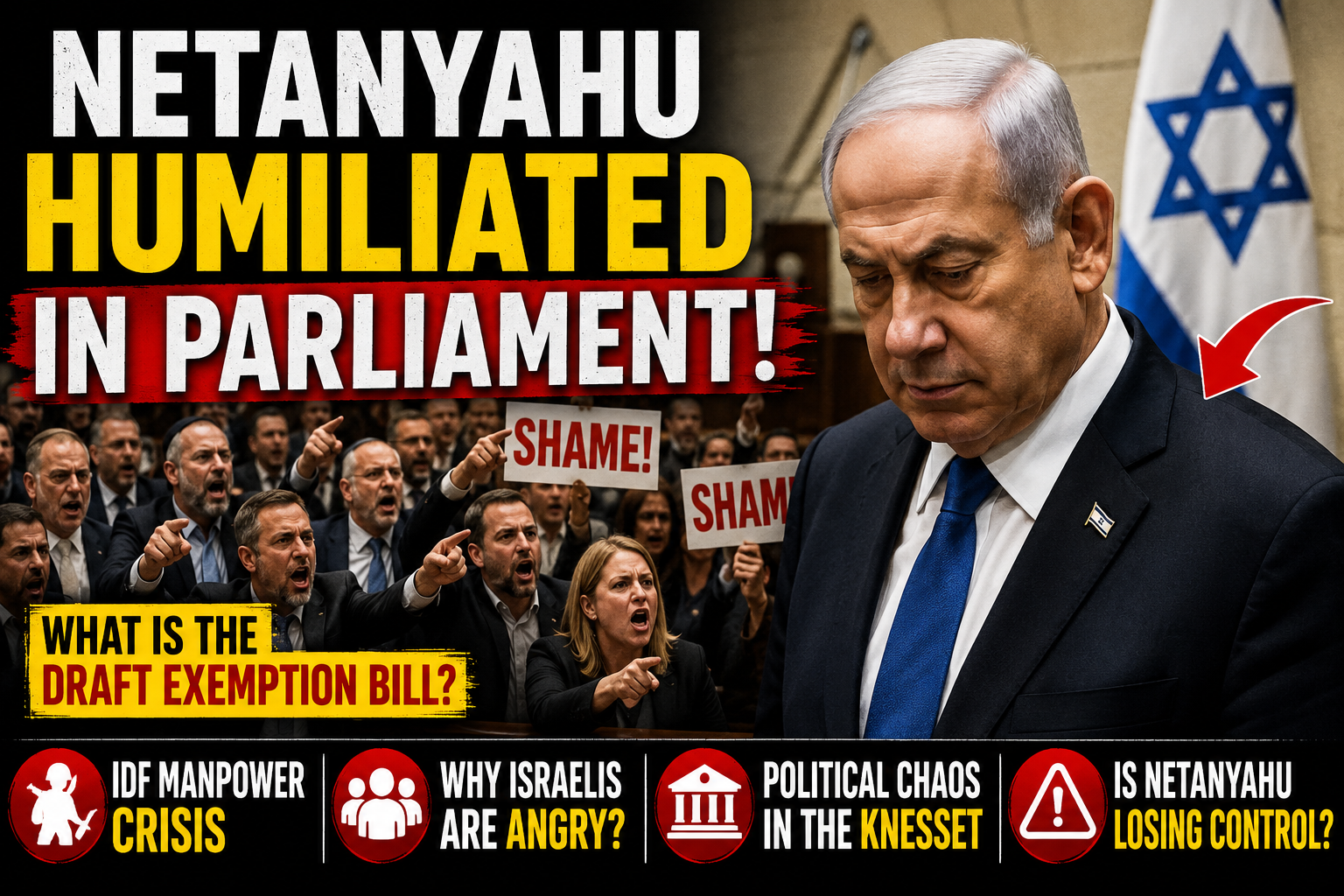
NETANYAHU is HUMILIATED IN ISRAEL'S PARLIAMENT – IS THIS THE BEGINNING OF THE END OF HIS POLITICAL E
What happens when a country's Prime Minister is greeted not with applause, but with deafening chants of "Shame! Shame!" inside his own Parliament?
What happens when the leader of a nation at war is accused of putting politics ahead of soldiers?
And what if the biggest challenge facing Israel today is not coming from Iran, Hamas, or Hezbollah—but from divisions within Israel itself?
This wasn't just another noisy parliamentary session.
It was one of the most dramatic moments in Israeli politics in recent years.
Israel's Parliament, the Knesset descended into chaos as Prime Minister Benjamin Netanyahu faced fierce opposition, loud chants of "Shame!", and intense criticism over one controversial piece of legislation.
A law that many believe protects thousands of military draft evaders while Israeli soldiers continue serving on multiple fronts.
So what exactly happened?
Why has this bill divided Israel so deeply?
Why are military leaders themselves raising alarm bells?
And is Benjamin Netanyahu leading Israel through one of its most difficult periods—or simply fighting to keep his own government alive?
Let's understand the complete story.
THE CONTROVERSIAL BILL THAT SHOOK ISRAEL
At the center of the controversy is what has become known as the Military Draft Exemption Bill.
To understand why it has created such a political storm, we first need to understand how Israel's military system works.
Unlike many countries, military service in Israel is compulsory for most Jewish citizens.
Most young Jewish men and women are required to serve in the Israel Defense Forces, commonly known as the IDF.
This system exists because Israel has faced continuous security challenges since its establishment. Compulsory military service has long been regarded as one of the pillars of the country's national security.
However, for decades, one section of Israeli society has largely remained exempt.
These are the ultra-Orthodox Jews, also known as the Haredi community.
Traditionally, many young Haredi men dedicate themselves to full-time Torah study in religious seminaries called yeshivas. Successive Israeli governments allowed many of these students to postpone or avoid military service so they could continue their religious education.
When this policy was introduced decades ago, only a relatively small number of people benefited from it.
But over the years, Israel's ultra-Orthodox population has grown rapidly.
Today, tens of thousands of military-age Haredi men receive exemptions from compulsory military service.
What was once a limited religious accommodation has gradually become one of the most contentious political issues in Israel.
WHAT DID PARLIAMENT ACTUALLY PASS?
Many people believe Parliament abolished compulsory military service.
That is not exactly what happened.
The legislation temporarily freezes legal action against thousands of ultra-Orthodox men who have ignored military draft notices.
In simple terms, the law pauses arrests, criminal investigations, and legal enforcement against many individuals who have not reported for military service.
Supporters argue that the issue requires a long-term political solution.
Critics argue that it effectively shields thousands of draft evaders while other Israelis continue risking their lives on the battlefield.
That is why emotions ran so high inside Parliament.
WHY ARE SO MANY ISRAELIS ANGRY?
This debate is no longer just about religion.
It has become a debate about equality.
Imagine two Israeli citizens who both turn eighteen.
One is sent to defend the country.
The other remains in a religious institution and never enters military service.
Many Israelis are asking a straightforward question:
Should the responsibility of defending the nation be shared equally by everyone?
Since the Hamas attacks of October 2023, Israel has faced one of the most demanding periods in its history.
Thousands of reservists have been called back into service repeatedly.
Many have spent months away from their families.
Many have placed their careers and businesses on hold.
Some have made the ultimate sacrifice.
Against this backdrop, many Israelis believe it is unfair for another large section of society to remain exempt from compulsory military service.
That is why opposition lawmakers filled the Knesset with chants of "Shame!"
For them, this is not simply a political disagreement.
It is a question of fairness and shared national responsibility.
WHAT IS THE IDF MANPOWER CRISIS?
One phrase has appeared repeatedly during this debate:
The IDF manpower crisis.
But what does that actually mean?
The IDF, or Israel Defense Forces, is Israel's military.
When military leaders warn about a manpower shortage, they mean the armed forces do not have enough trained personnel to meet increasing operational demands.
Israel currently faces security challenges on several fronts.
There are ongoing military operations in Gaza.
There are continuing tensions with Hezbollah along the Lebanese border.
There are growing concerns regarding Iran and its regional allies.
There are also security operations in the West Bank.
Each of these situations requires trained soldiers.
Military leaders argue that exempting tens of thousands of eligible recruits places additional pressure on the soldiers who are already serving and makes it more difficult for the military to maintain readiness over a prolonged period.
That is why senior military officials have warned that this issue is no longer just political.
It has become a matter of national security.
IF THE BILL IS SO CONTROVERSIAL, WHY IS NETANYAHU SUPPORTING IT?
The answer lies in Israel's political system.
Benjamin Netanyahu does not govern alone.
Israel has a parliamentary coalition system.
That means a Prime Minister remains in office only as long as enough political parties support the government.
Several of Netanyahu's coalition partners represent the ultra-Orthodox community.
For these parties, protecting military exemptions is one of their most important political commitments.
If Netanyahu withdraws his support for these exemptions, he risks losing those coalition partners.
If they leave the coalition, his government could lose its majority in Parliament and potentially collapse.
So Netanyahu finds himself caught between two competing pressures.
If he supports the exemptions, he faces growing public criticism, opposition attacks, and concern from military leaders.
If he withdraws support, he risks bringing down his own government.
This debate has therefore become much more than a disagreement over military service.
It has become a struggle for political survival.
WHY DID PARLIAMENT DESCEND INTO CHAOS?
The chants of "Shame!" were not directed at the bill alone.
They reflected months of growing frustration within Israeli society.
Many Israelis believe the burden of defending the country is no longer being shared equally.
Critics accuse Netanyahu of placing coalition politics ahead of national unity.
Supporters argue that he is protecting religious traditions while preserving political stability during a period of war.
Both sides insist they are acting in Israel's best interests.
But they hold very different visions of what those interests should be.
That is why the atmosphere inside Parliament became so explosive.
IS NETANYAHU LOSING HIS POLITICAL GRIP?
That is perhaps the most important question emerging from this crisis.
The dramatic scenes inside Parliament revealed something much deeper than political disagreement.
They exposed growing divisions within Israeli society.
Military leaders have openly warned that the current situation could weaken the country's armed forces.
Opposition parties accuse Netanyahu of putting coalition politics ahead of national priorities.
Meanwhile, Netanyahu's supporters argue that collapsing the government during a time of war would create even greater uncertainty.
This is no longer simply a debate about military service.
It has become a debate about Israel's political future, its national identity, and the balance between religion, democracy, and security.
CONCLUSION
So, was this merely another stormy day inside Israel's Parliament?
Or did the scenes in the Knesset reveal something far more significant, a nation wrestling with one of the toughest questions any democracy can face?
Should every citizen share the responsibility of defending the country equally?
Or should long-standing religious traditions continue to receive special protection, even during a time of war?
Benjamin Netanyahu now finds himself standing at the crossroads of these two competing realities.
On one side are the coalition partners whose support keeps his government alive.
On the other are military leaders, opposition lawmakers, reservists, and countless Israeli families who believe that the burden of national service must be shared equally.
Every decision he makes now comes with a political cost.
If he changes course, his coalition could collapse.
If he refuses to change, public anger may continue to grow.
This debate is no longer just about military service.
It is about leadership.
It is about equality.
It is about the relationship between faith, democracy, and national security.
And perhaps the biggest question of all is this:
Will Benjamin Netanyahu be remembered as the leader who held his coalition together... or as the leader whose political compromises deepened one of the most divisive debates in modern Israeli history?
Only time will answer that question.