


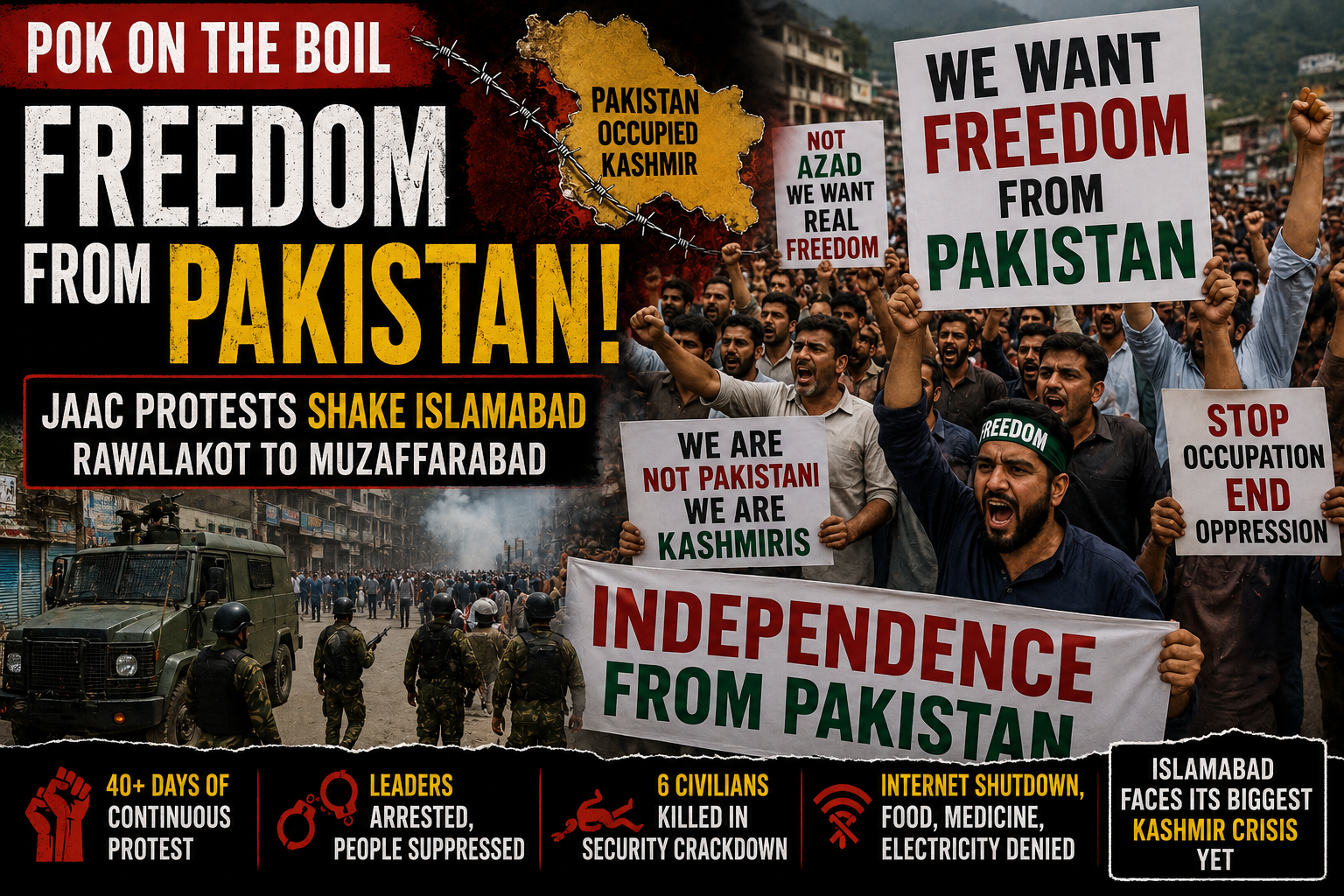
Pakistan-Occupied Kashmir is on the Boil: Is Islamabad Losing Control?
What happens when the people whom a country claims to have "liberated" begin calling themselves "occupied"?
What happens when protests that began over electricity bills transform into a movement questioning political legitimacy itself?
And what happens when a territory that Pakistan has long projected as proof of its Kashmir narrative begins asking a different question:
“If this is freedom, why are we living like prisoners?”
That is exactly what is unfolding today in Pakistan-occupied Jammu and Kashmir, commonly known in India as PoK.
For more than forty days, thousands of people have remained on the streets despite arrests, curfews, internet restrictions and an intense security crackdown. The epicentre of this movement is Rawalakot, and the driving force behind it is the Joint Awami Action Committee, or JAAC. After negotiations with the authorities failed, protest leaders have now announced a Long March to Muzaffarabad.
But this is no ordinary protest. It is no longer just about electricity bills or the rising cost of living. It has become a movement that is questioning Islamabad's control over the region and exposing deep public anger that has been building for decades.
So, who exactly is JAAC?
The Joint Awami Action Committee is not a militant organisation. It is a coalition of traders, lawyers, transport unions, students, civil society groups and ordinary citizens who came together to demand basic rights and better governance.
Initially, the movement focused on everyday issues : affordable electricity, subsidised wheat flour, inflation, unemployment and corruption. But over time, the movement evolved. Today, JAAC is demanding political accountability, genuine representation, restoration of civil liberties and implementation of promises that, according to the protesters, were made by the government but never fulfilled.
To understand why these protests have reached such an unprecedented stage, we need to go back to history.
The story begins in 1947 during the Partition of India.
At that time, the princely state of Jammu and Kashmir had not yet decided whether to join India or Pakistan. In October 1947, tribal militias backed by Pakistan entered Kashmir. Facing the invasion, Maharaja Hari Singh signed the Instrument of Accession with India, following which Indian troops were airlifted into the region.
The first India-Pakistan war followed. When a ceasefire came into effect in 1949, Pakistan remained in control of roughly one-third of the former princely state.
Pakistan refers to this territory as "Azad Jammu and Kashmir," meaning "Free Kashmir."
India, however, considers it Pakistan-occupied Jammu and Kashmir, maintaining that it is Indian territory under illegal occupation.
For nearly eight decades, this dispute has remained one of the world's longest-running geopolitical conflicts.
But beneath the international diplomacy lies another story, a story of the people living there.
For years, many residents have complained that despite being called "Azad," or free, they enjoy very limited political autonomy.
Many important decisions affecting the region are perceived to be taken in Islamabad rather than by elected local representatives.
Economic development has remained slow.
Unemployment continues to be a serious concern.
Ironically, while the region generates significant hydroelectric power through projects like the Mangla Dam, many local residents complain of paying high electricity prices themselves.
Inflation has made essential commodities increasingly expensive.
Healthcare facilities remain inadequate in many areas.
Employment opportunities are limited, forcing many young people to migrate elsewhere.
According to many residents, the problem is no longer only economic. It is about dignity, representation and the feeling that their voices simply do not matter.
Then came the spark that ignited the current crisis.
One of the major triggers was the controversy surrounding twelve reserved assembly seats meant for refugees living outside the territory.
JAAC argued that these seats dilute the political voice of those who actually reside in Pakistan-occupied Kashmir.
When the regional Supreme Court upheld these arrangements, public anger intensified.
Soon afterwards, JAAC was declared unlawful under anti-terror laws.
Its leaders were arrested.
Internet services were restricted.
Roads were blocked.
Security forces were deployed across major towns.
But instead of suppressing the movement, these measures made the protests even stronger.
One important reason why these protests refuse to die is because of broken promises.
Last year, after widespread demonstrations, authorities reportedly agreed to several demands related to electricity pricing, wheat subsidies and governance reforms.
Protesters now argue that those commitments were never properly implemented.
This has created a deep trust deficit.
Today, JAAC is demanding implementation of those earlier agreements before any fresh negotiations can take place.
Rawalakot has now become much more than just another town.
It has become the symbol of resistance.
Following the collapse of talks with the government, protest leaders have announced a Long March to Muzaffarabad.
Their immediate demands are clear.
They want the release of detained JAAC leaders.
They want criminal cases against protesters to be withdrawn.
They demand an end to the security crackdown.
They want internet and communication services restored.
They want uninterrupted access to food, medicines and electricity.
They want previous government commitments to be honoured.
And above all, they want meaningful dialogue instead of force.
Unfortunately, the government's response has been increasingly aggressive.
Large numbers of security personnel have been deployed across the region.
Curfews and roadblocks have disrupted daily life.
Thousands have reportedly been detained.
Several human rights organisations have expressed concern over allegations of excessive force, communication blackouts and restrictions affecting ordinary civilians.
Reports from the ground indicate that clashes between protesters and security personnel have resulted in multiple casualties. Several civilians have reportedly lost their lives, while many others have been injured.
The security crackdown has only strengthened public anger, with many residents now accusing Islamabad of trying to silence legitimate democratic voices.
Perhaps the most politically significant moment came when one of JAAC's key leaders, Sardar Aman Khan, openly challenged Pakistan's long-standing narrative.
He questioned Islamabad's position on the region and argued that the people themselves must have the right to determine their political future.
For Pakistan, such statements are deeply uncomfortable.
For decades, Islamabad has projected itself internationally as the defender of Kashmiri aspirations.
But when voices from within Pakistan-administered Kashmir begin questioning Islamabad itself, that narrative comes under serious pressure.
Some protesters have even begun speaking about greater autonomy and, in some cases, independence from Islamabad.
Whether these views represent the entire population or only a section of the movement remains debated.
However, the very fact that such conversations are now taking place publicly reflects the depth of frustration among many residents.
India, meanwhile, has maintained its long-standing position that the entire region of Jammu and Kashmir, including Pakistan-occupied territories, is an integral part of India.
New Delhi has repeatedly raised concerns about governance, democratic rights and human rights conditions in Pakistan-administered areas.
The current unrest is therefore being closely watched in India because it highlights growing internal dissatisfaction within territory controlled by Pakistan.
So what does all of this mean for Pakistan?
Islamabad today faces an extremely difficult challenge.
If it agrees to all the protesters' demands, it risks encouraging further political mobilisation and stronger calls for autonomy.
If it continues relying primarily on arrests and force, public resentment may deepen even further.
Every additional day that these protests continue raises uncomfortable questions about governance, legitimacy and public trust.
This is no longer merely an economic protest.
It is a crisis of confidence.
It is a crisis of governance.
It is a crisis of political legitimacy.
History teaches us that governments rarely lose control because people ask for cheaper electricity.
They lose control when citizens stop believing that their voices matter.
So the real question today is no longer,
Can Pakistan stop this protest?
The real question is,
Can Islamabad rebuild the trust it has lost over decades or has Rawalakot become the beginning of a much larger political awakening that could permanently reshape the future of Pakistan-occupied Kashmir?**
Only time will answer that question. But one thing is certain—the flames rising from Rawalakot today are no longer just about economics. They have become a battle over identity, dignity and the future of an entire region.