


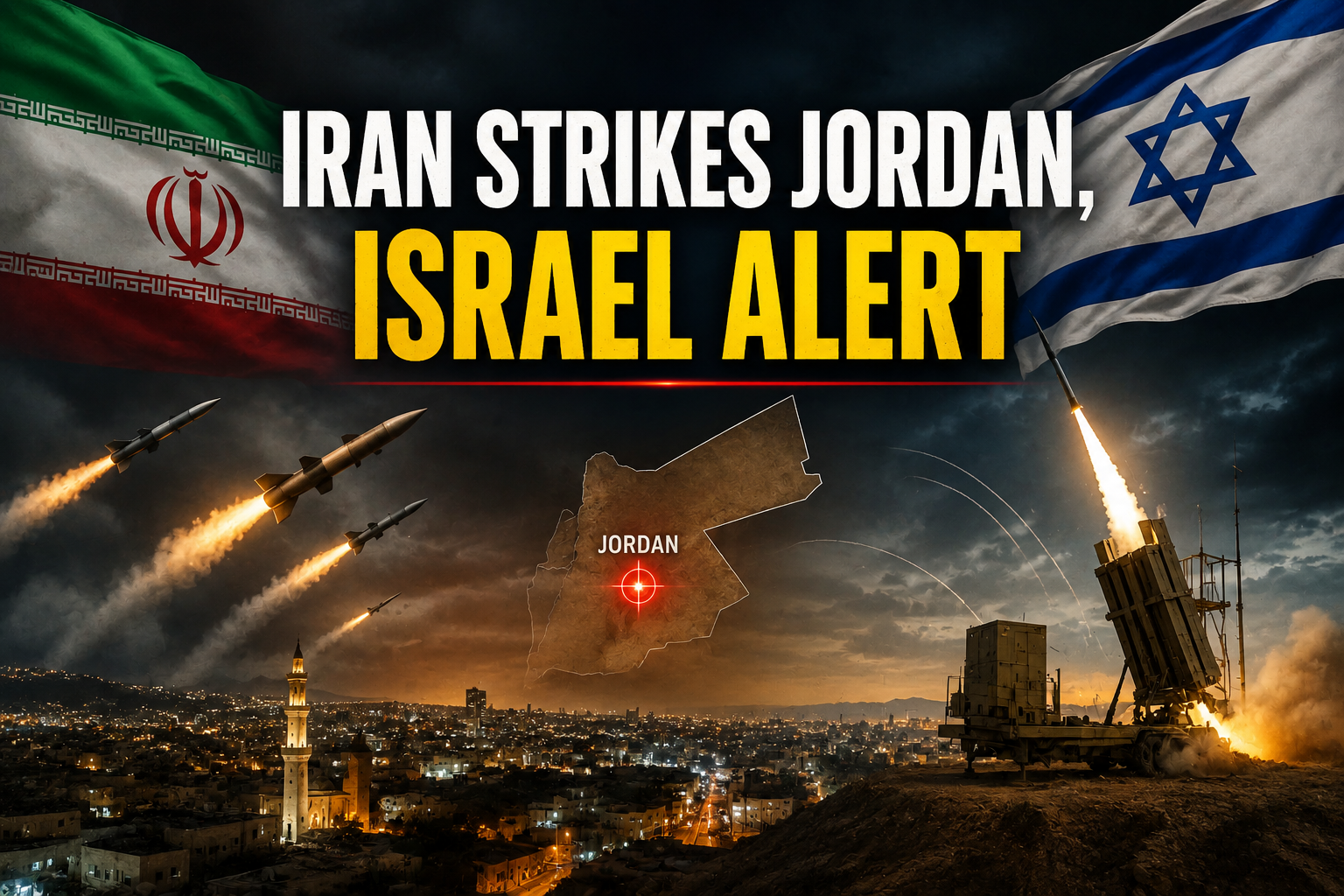
Iran Attacks Jordan, Israel Launches Interceptors Near Eilat | Strategic Analysis
What if the biggest danger in a war isn't the missile that hits its target, but the one that never does?
A missile fired at one country... intercepted over another... with debris landing near a third. Is this how regional wars begin? Or are we witnessing the Middle East entering an era where no country's borders can truly shield it from conflict?
A recent incident in the Middle East has once again demonstrated how modern warfare no longer respects national borders.
Iran launched missiles toward Jordan, prompting Jordanian air defenses to intercept the incoming projectiles.
But what happened next is what has caught the attention of military analysts around the world.
Israel also launched interceptor missiles not because the missiles were aimed directly at Israel, but because falling missile fragments and interceptor debris posed a potential threat to its southern city of Eilat. The Israeli military later confirmed that debris from one interceptor landed in an open area near Eilat. Fortunately, no injuries or damage were reported.
Now the obvious question is, why would Israel intercept missiles that were heading toward Jordan?
The answer lies in geography.
Eilat is located at Israel's southern tip, just across the border from Jordan's port city of Aqaba. When a ballistic missile is intercepted high in the atmosphere, it does not simply disappear. Large pieces of the missile and even parts of the interceptor continue falling back to the ground at extremely high speeds. These fragments, known as shrapnel or missile debris, can still cause significant damage and loss of life.
In other words, Israel was not intercepting an attack on Eilat. It was trying to prevent deadly debris from falling on its own territory.
This is an important distinction because it suggests that, in this particular incident, Iran was not directly targeting Israel. Instead, Israel's military response was a precaution against the unintended consequences of a conflict unfolding just across its border.
But this raises a much bigger strategic question.
If missiles fired at one country can threaten another simply because of where they are intercepted, then every military exchange now carries the risk of pulling additional nations into the conflict.
Jordan has long acted as a geographical buffer in the region. But as missile ranges increase and air defense systems become more interconnected, even countries that are not the primary target can suddenly find themselves at the center of a military crisis.
This incident also highlights the changing nature of modern warfare.
Today's conflicts are no longer confined to the battlefield. Airspace has become shared, missile trajectories cross multiple countries within minutes, and even a successful interception can create new risks instead of eliminating them completely.
The concern, therefore, is not just about one missile or one interception.
The real concern is whether repeated incidents like these could increase the chances of a wider regional escalation, not necessarily through deliberate attacks, but through accidental spillovers, miscalculations, or the pressure to respond whenever national territory is threatened.
The Middle East today is witnessing a security environment where even defensive actions can have cross-border consequences.
And perhaps that is the biggest lesson from this incident.
In modern warfare, danger is no longer defined only by where a missile is aimed but also by where its debris falls.