


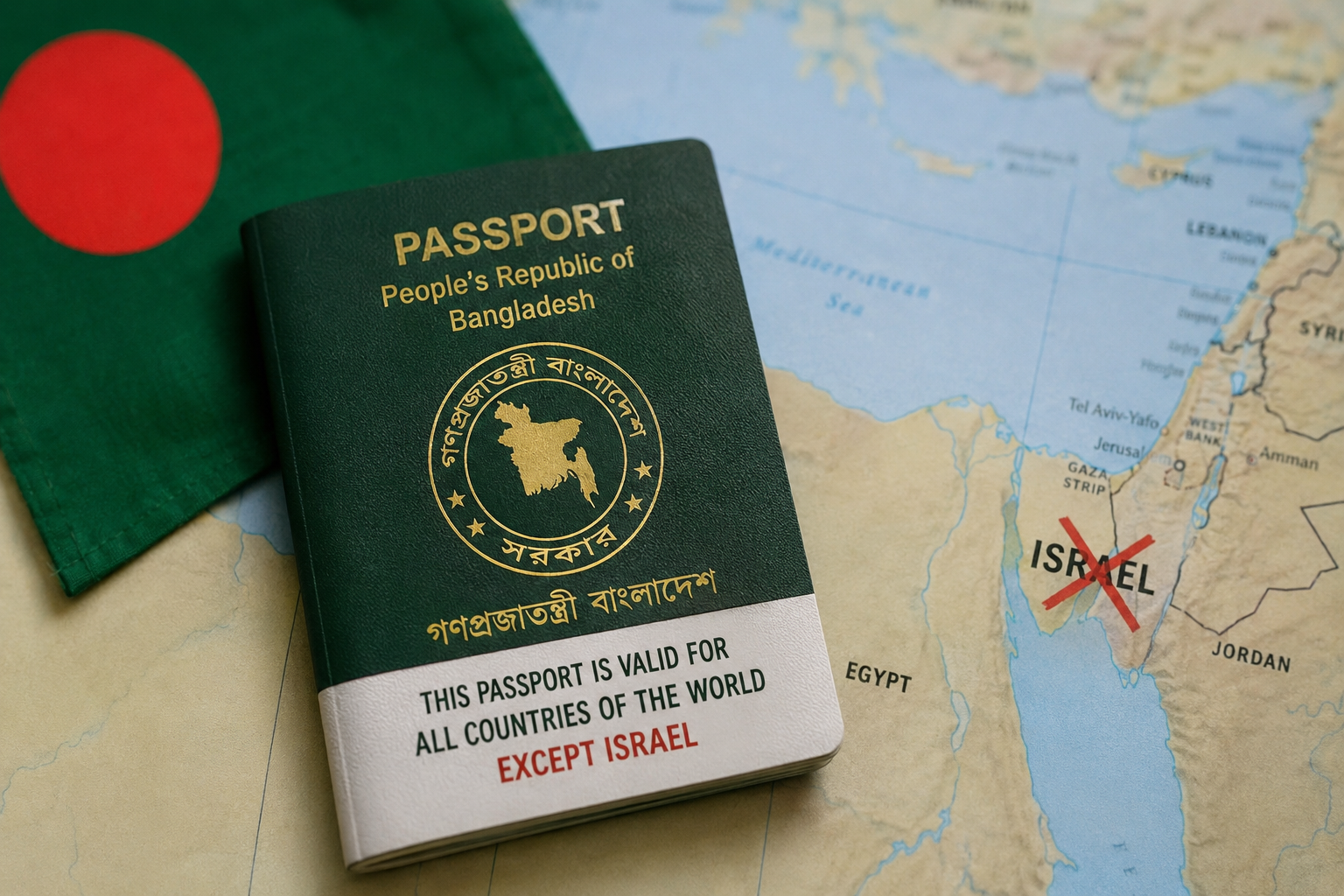
BANGLADESH RESTORES
Can two words printed on a passport change the course of geopolitics?
Bangladesh has decided to restore the words "This passport is valid for all countries of the world except Israel." At first glance, it may seem like a routine administrative decision. But in reality, it reflects decades of foreign policy, domestic politics, national identity, support for Palestine, and the changing political landscape after the fall of Sheikh Hasina's government.
The question is not just why these two words have returned.
The bigger question is what message Bangladesh is sending and to whom.
What does "Except Israel" actually mean?
The phrase printed on Bangladeshi passports is not directed at Israel's immigration authorities. It is a declaration of Bangladesh's own foreign policy that its passport should not be used for travel to Israel because Bangladesh does not recognize the State of Israel and has never established diplomatic relations with it.
Even after the wording was removed from passports during Sheikh Hasina's government, Bangladesh's official policy toward Israel never changed. The country still did not recognize Israel, and travel restrictions remained in place.
In simple terms: It is a diplomatic and political statement.
It reflects Bangladesh's foreign policy.
It does not create or end diplomatic relations by itself.
The Historical Background
To understand this decision, we must go back to 1971, when Bangladesh emerged as an independent nation.
After independence, Bangladesh aligned itself with many Muslim-majority nations and firmly supported the Palestinian cause.
As a result:
Bangladesh never recognized Israel.
Diplomatic relations were never established.
Bangladeshi passports carried the phrase "Valid for all countries except Israel" for decades.
That sentence eventually became more than a travel restriction; it became a symbol of Bangladesh's foreign policy.
Why did Sheikh Hasina remove the phrase?
Around 2020–2021, during Sheikh Hasina's government, the words "Except Israel" were quietly removed from newly issued e-passports.
However, this did not mean Bangladesh recognized Israel.
The government maintained that:
The change was made to align Bangladeshi passports with international passport standards.
Bangladesh's foreign policy remained unchanged.
The country continued to support the Palestinian cause.
Diplomatic relations with Israel were still absent.
In other words, the passport changed, but the policy did not.
Why has the clause been restored now?
The current government has directed immigration authorities to restore the phrase.
The decision reflects:
Bangladesh's traditional foreign policy,
continued support for Palestine,
strong domestic public sentiment,
and a desire to restore a long-standing national position.
The timing is also significant.
It comes at a time when the Israel-Gaza conflict has intensified global emotions and many Muslim-majority countries have publicly reiterated their support for Palestine.
Is this only about Palestine?
Not entirely.
There are three important dimensions behind the decision.
First: Foreign Policy
Bangladesh is reaffirming that its long-standing position on Israel has never changed.
Second: Domestic Politics
After Sheikh Hasina's removal from power, several decisions associated with her government are being revisited.
Restoring the passport clause is also a symbolic reversal of one of those decisions.
Third: Public Sentiment
Support for Palestine remains widespread across Bangladesh.
Restoring the clause sends a clear message that the government stands with the Palestinian cause.
Has Israel's Intelligence Agency Entered Bangladesh?
Another question often raised whenever Bangladesh and Israel are discussed is whether Mossad, Israel's foreign intelligence agency, has had any involvement in Bangladesh.
To answer this, it is important to separate verified facts from allegations.
Over the years, several incidents have fueled speculation, but none establish that the current passport decision is linked to Israeli intelligence operations.
Some notable incidents include:
2016
Sheikh Hasina's government alleged that leaders of the opposition Bangladesh Nationalist Party, or BNP, had links with Mossad after BNP leader Aslam Chowdhury met Israeli-born political activist Mendi N. Safadi during a visit to India.
The government described the meeting as suspicious and alleged it was part of a conspiracy against Bangladesh.
The BNP rejected the allegations, and no conclusive public evidence established any Mossad-backed coup plot.
2021–2023
Investigative reports, including those by international media, alleged that Bangladeshi security agencies indirectly acquired Israeli-made surveillance technology through third countries and that some Bangladeshi officials had received training from individuals associated with Israeli firms outside Bangladesh.
Bangladeshi authorities denied any direct procurement from Israel and rejected allegations of official intelligence cooperation.
These reports generated international discussion but did not establish formal diplomatic or intelligence ties between Bangladesh and Israel.
Does the passport decision indicate an Israeli threat?
There is nothing to suggest that Bangladesh restored the "Except Israel" clause because of any immediate Israeli security threat.
The restoration is better understood as:
reaffirming Bangladesh's traditional foreign policy,
reinforcing support for Palestine,
and reversing a symbolic decision made during Sheikh Hasina's tenure.
It is a diplomatic message rather than a security response.
Analytical Perspective
This development should not be viewed simply as a passport policy.
It is an example of identity diplomacy.
Bangladesh is communicating three important messages simultaneously.
To its own citizens, it is reaffirming a long-held national position.
To the Muslim world, it is reinforcing solidarity with the Palestinian cause.
To the international community, it is signaling that despite political transitions at home, Bangladesh's official position on Israel remains unchanged.
Sometimes, symbolism in diplomacy can be just as powerful as formal treaties.
What does this mean for India?
For India, the decision does not create an immediate diplomatic challenge.
India follows a very different foreign policy model.
New Delhi has strong strategic relations with Israel in defence, agriculture, cybersecurity, innovation and technology, while simultaneously supporting a negotiated two-state solution and maintaining long-standing ties with the Palestinian people.
Bangladesh's move therefore highlights two different diplomatic approaches.
Bangladesh continues to emphasize historical and ideological solidarity with Palestine.
India continues to pursue strategic multi-alignment by engaging with both Israel and the Palestinian leadership.
Importantly, this passport decision is unlikely to affect India-Bangladesh bilateral relations, which are driven primarily by trade, connectivity, border management, water sharing and regional security.
What does this mean for the world?
For Israel, the practical impact is limited because Bangladesh still does not recognize it and has never established diplomatic relations.
For Palestine, however, the symbolic value is significant.
Bangladesh has publicly reaffirmed a position that aligns with the broader support for Palestinian statehood across much of the Muslim world.
More broadly, this decision demonstrates that in international diplomacy, symbolism still matters.
A passport is more than a travel document.
It reflects national identity, diplomatic recognition, foreign policy priorities and political messaging.
Conclusion
This is not a dramatic shift in Bangladesh's foreign policy.
Rather, it is the restoration of a long-standing diplomatic symbol.
It reaffirms Bangladesh's support for Palestine, reverses a symbolic change introduced during Sheikh Hasina's government, and sends a message to domestic, regional and international audiences about where Bangladesh stands.
Sometimes, history is not rewritten through wars or treaties; it is rewritten through a single sentence printed on a passport.
And Bangladesh's decision reminds us that in geopolitics, even four words “Except Israel” can carry the weight of an entire foreign policy.