


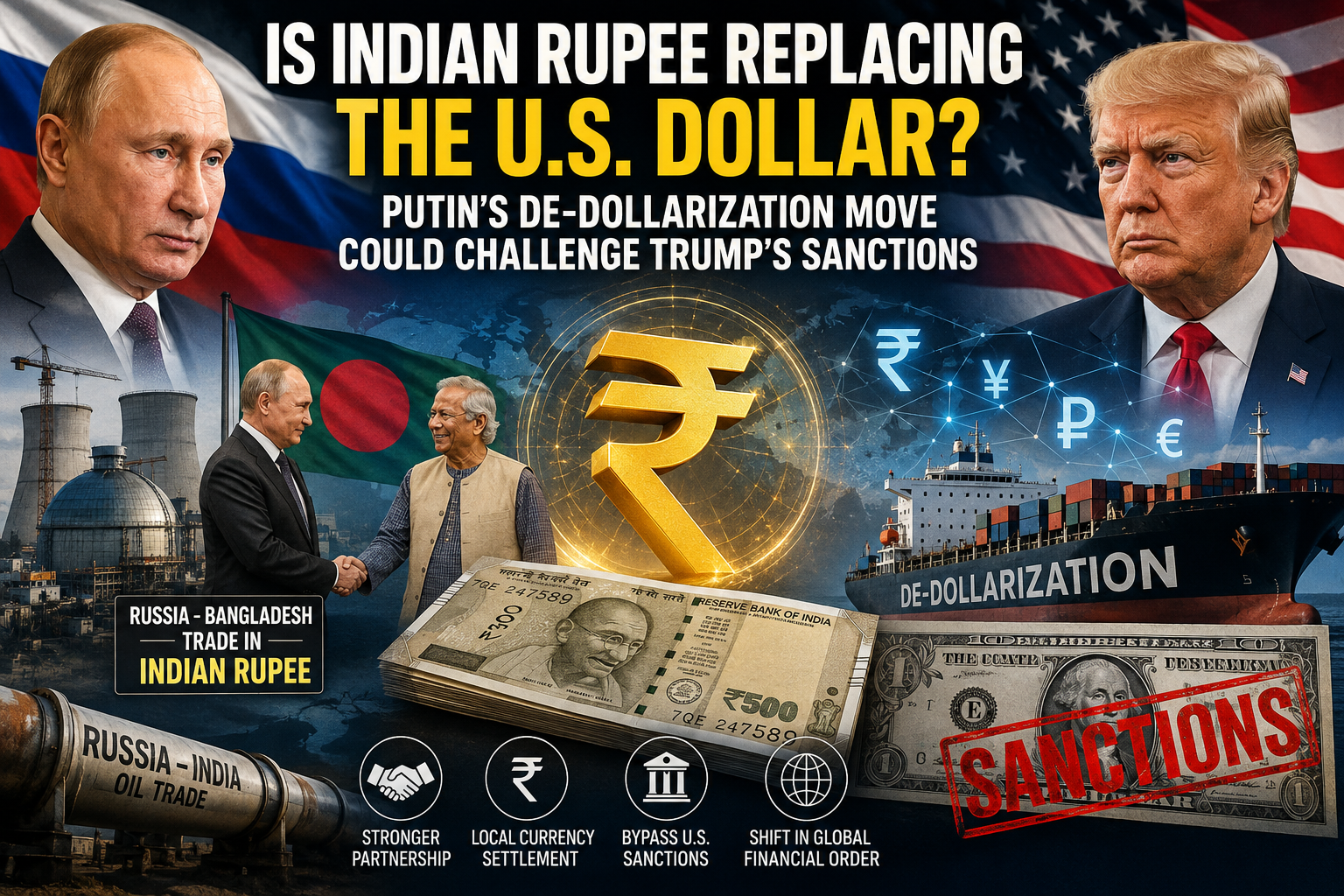
Is the Indian Rupee Replacing the U.S. Dollar?
Could Putin's New De-dollarization Strategy Challenge America's Financial Power?
Is the Indian rupee replacing the U.S. dollar?
It may sound like a bold question, but it is one that is increasingly being asked as the global financial order begins to shift.
For decades, the U.S. dollar has been the world's dominant currency. It has powered global trade, strengthened American influence, and enabled Washington to impose powerful economic sanctions on countries around the world.
But what happens when countries start finding ways to trade without using the dollar?
Russia and Bangladesh are reportedly exploring a new payment mechanism using the Indian rupee to settle transactions linked to Russia's nuclear power project in Bangladesh. If implemented, this move could help bypass the financial complications created by U.S. sanctions on Russian banks.
At first glance, this may appear to be a technical financial arrangement. But in reality, it could represent another chapter in the growing global movement toward de-dollarization.
So, what exactly is happening? Why is Russia turning to the Indian rupee? Why is Bangladesh involved? What does this mean for India? And could this eventually weaken America's ability to use economic sanctions as a geopolitical weapon?
Let's understand.
Why Is Russia Looking Beyond the Dollar?
To understand this story, we need to go back to 2022.
Following the Russia-Ukraine war, the United States and its Western allies imposed some of the toughest financial sanctions ever placed on a major economy.
Several Russian banks were removed from the SWIFT international payment system.
Dollar-based transactions became increasingly difficult.
Russian financial institutions faced severe restrictions.
Foreign reserves worth hundreds of billions of dollars were frozen.
For Moscow, these sanctions sent one clear message.
As long as the world depends on the U.S. dollar, Washington possesses enormous economic leverage.
And so, Russia accelerated a strategy it had already begun years earlier reducing its dependence on the dollar.
Since then, Russia has expanded trade in local currencies with several countries, using the Russian ruble, the Chinese yuan, and other alternative payment systems.
Now, the Indian rupee is emerging as another possible option.
Why Is Bangladesh Involved?
Many people may wonder why Bangladesh is suddenly becoming part of this geopolitical story.
The answer lies in one of South Asia's largest infrastructure projects, the Rooppur Nuclear Power Plant.
This is Bangladesh's first nuclear power station, being built by Russia's state-owned nuclear energy corporation, Rosatom.
The project is valued at nearly 13 billion dollars, with Russia financing most of the construction through long-term loans.
As the project progresses, Bangladesh has to make payments to Russia.
But because of sanctions on Russian banks, making those payments through the traditional dollar-based banking system has become increasingly complicated.
This created a financial problem.
How can Bangladesh pay Russia if the normal payment channels are blocked?
That is where alternative currencies come into the picture.
What Happened to the Chinese Yuan?
Initially, there were attempts to use the Chinese yuan for some of these payments.
The idea seemed practical because China has been actively promoting the yuan in international trade.
However, reports suggest that the yuan-based arrangement did not fully resolve all the financial and operational challenges.
As a result, Russia is now reportedly exploring another possibility, the Indian rupee.
This is important because it shows that Russia is not looking for one single replacement for the dollar.
Instead, Moscow is trying to build multiple payment channels using different currencies so that sanctions become less effective over time.
Why the Indian Rupee?
There are several strategic reasons.
First, India maintains strong diplomatic and economic relations with both Russia and Western countries.
Unlike many nations, India has managed to preserve its strategic autonomy.
It continues purchasing Russian oil while simultaneously strengthening partnerships with the United States, Europe, Japan, and other major economies.
This unique position makes India an important financial bridge.
Second, trade between India and Russia has expanded significantly over the past few years.
India has become one of the largest buyers of Russian crude oil.
As trade grows, both countries naturally have an interest in reducing transaction costs and minimizing dependence on the dollar wherever possible.
Third, India has been steadily encouraging the international use of the rupee.
The Reserve Bank of India has introduced mechanisms allowing international trade settlements in Indian rupees.
Although the rupee is still far from becoming a global reserve currency, its role in regional trade is slowly expanding.
Every international transaction settled in rupees instead of dollars represents another small step toward greater financial diversification.
What Does This Mean for Donald Trump and the United States?
Whether Donald Trump is in the White House or another administration takes office, America's global sanctions strategy depends heavily on one critical factor.
The world must continue using the U.S. dollar.
Why?
Because the dollar is deeply embedded in global finance.
Most international trade is invoiced in dollars.
Most central banks hold dollar reserves.
Many international payments pass through American financial institutions.
This gives Washington extraordinary influence.
If a country is sanctioned, access to the dollar system can be restricted.
That is precisely what happened to Russia.
But if countries increasingly develop alternative payment systems using local currencies, America's financial leverage could gradually decline.
That does not mean U.S. sanctions suddenly become ineffective.
However, it does mean that sanctioned countries gain additional options.
And every additional option reduces dependence on the dollar.
This is exactly why developments like these attract global attention.
Could This Crush U.S. Sanctions?
Not immediately.
The U.S. dollar remains the world's most important currency by a significant margin.
It dominates international reserves, global trade, foreign exchange markets, and cross-border payments.
Replacing it will not happen overnight.
However, this story is not really about replacing the dollar.
It is about reducing dependence on it.
That is what de-dollarization truly means.
Every successful local currency transaction makes the global financial system slightly more diversified.
One transaction may not change much.
But thousands of such transactions across dozens of countries could gradually reshape global finance.
That is the long-term significance.
What Does India Stand to Gain?
If more countries begin accepting the Indian rupee for international trade, India could gain several strategic advantages.
The rupee's global credibility could increase.
India's financial influence could grow.
Businesses may face lower currency conversion costs in certain trade relationships.
India's role in global commerce could become more prominent.
At the same time, this also brings responsibility.
A currency gains international acceptance only when global markets have confidence in the country's economy, financial institutions, and policy stability.
India has made important progress, but becoming a major international currency remains a long-term journey.
Is This Really De-dollarization?
Yes.
But perhaps not in the dramatic way many headlines suggest.
De-dollarization does not mean the dollar is disappearing.
It means countries are gradually reducing their dependence on a single currency.
Russia is doing it.
China has been promoting it.
Several BRICS nations have discussed expanding trade in local currencies.
Now, even regional projects like the Rooppur Nuclear Power Plant are becoming part of that broader transformation.
Instead of one global currency dominating everything, the world may slowly be moving toward a system where multiple currencies coexist.
Now what is The Bigger Picture?
This story is not simply about Russia.
It is not just about Bangladesh.
And it is not only about India.
It is about the future of global finance.
It is about whether countries can create alternative payment systems outside the traditional Western financial architecture.
It is about economic sovereignty.
It is about geopolitical influence.
And it is about who will shape the rules of international trade in the decades ahead.
Conclusion
So, let me leave you with a few questions.
Is the Indian rupee replacing the U.S. dollar?
Not yet.
Is Russia trying to reduce its dependence on the dollar?
Absolutely.
Could more countries begin trading in local currencies in the coming years?
That possibility is becoming increasingly real.
And perhaps the biggest question of all is this—
Will the next global power struggle be fought not only with armies, missiles, and tariffs... but with currencies, payment systems, and financial networks?
Because history has shown us that those who control global finance often shape global politics.
And if the world is indeed moving toward a multipolar financial order, then this may not be just another payment arrangement.
It could be the beginning of a much larger transformation, one that may redefine the future of international trade, challenge the long-standing dominance of the U.S. dollar, and reshape the global balance of economic power.
#geopolitics #dedollarisation