


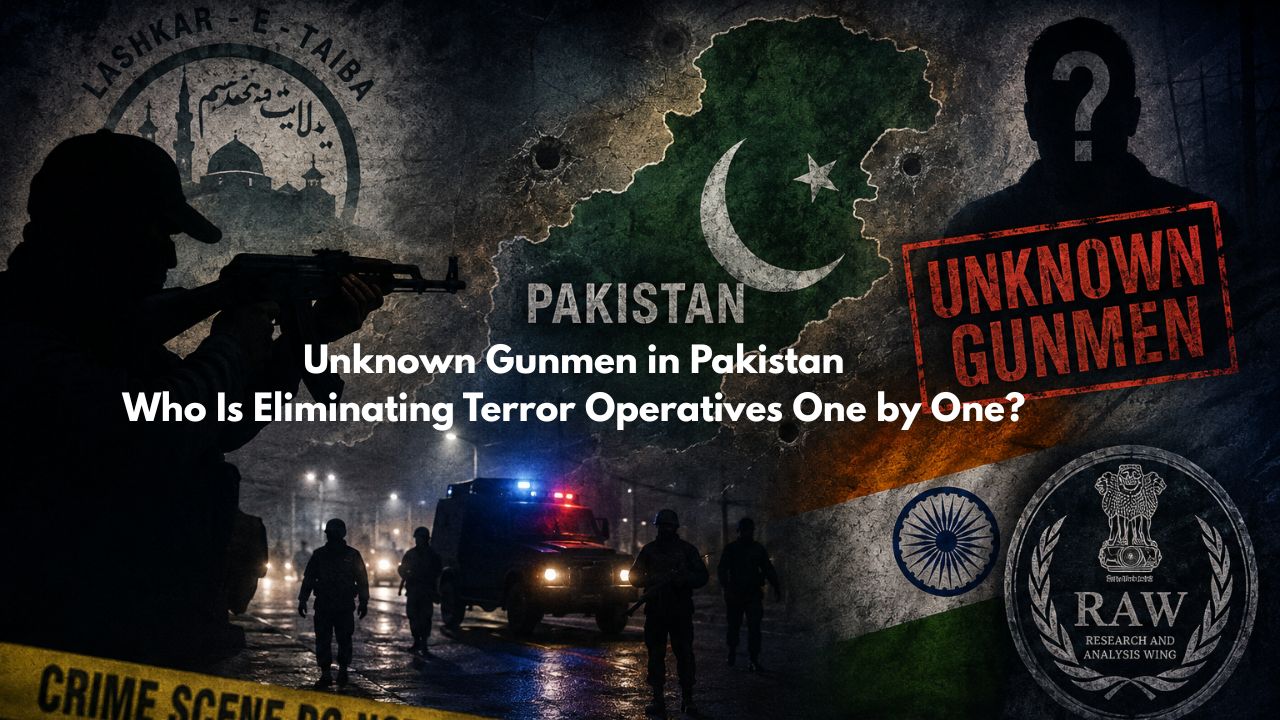
Unknown Gunmen in Pakistan: Who Is Hunting the Hunters? |
What if some of Pakistan's most wanted terrorists are being eliminated one by one... but nobody knows by whom?
No responsibility. No official claim. No clear evidence. Just another headline that reads: "Unknown gunmen strike again."
But who exactly are these "unknown gunmen"? Are they ordinary criminals? Intelligence operatives? Rival terror groups? Or is there a much bigger shadow war unfolding inside Pakistan?
Let's decode one of South Asia's most mysterious security stories.
According to recent reports, a Lashkar-e-Taiba operative has claimed that more than 30 members of the banned terrorist organization have been killed by unknown gunmen across Pakistan over the last three to four years.
The group has alleged that Indian intelligence agencies are behind these killings. India has consistently rejected such allegations, maintaining that Pakistan has repeatedly attempted to shift responsibility without presenting credible evidence.
So, what is really happening?
Let's first understand the phrase "unknown gunmen."
The term does not refer to any specific organization. It is commonly used by journalists and security agencies when armed attackers carry out a targeted killing, escape the scene, and their identities remain unconfirmed.
In Pakistan, the phrase has become almost synonymous with mysterious assassinations. Whenever a militant, separatist leader, intelligence-linked figure, or extremist is shot dead by unidentified attackers, the incident is often reported as an attack by "unknown gunmen."
In simple words, it means the attackers are unidentified, not necessarily unknowable, but officially unconfirmed.
Why has this issue attracted so much attention?
Because many of those reportedly killed were linked to organizations that India has long accused Pakistan of sheltering.
Groups such as Lashkar-e-Taiba and Jaish-e-Mohammed have been designated as terrorist organizations internationally. India has repeatedly maintained that Pakistan has allowed such groups to operate from its soil, an allegation Pakistan has denied or contested over the years.
Now, as these operatives are being killed one after another, several theories have emerged.
Possibility One: Internal Rivalries
Terrorist organizations are rarely united. Disputes over money, leadership, ideology, recruitment, or control of networks often turn violent. Internal purges have occurred in militant organizations around the world.
Possibility Two: Sectarian or Criminal Violence
Pakistan is facing increasing levels of militancy, organized crime, and sectarian conflict. Some attacks may have no international dimension at all and could instead be linked to local rivalries or criminal networks.
Possibility Three: Foreign Intelligence Operations
This is perhaps the most debated theory.
Some analysts speculate that foreign intelligence agencies may be targeting individuals accused of planning attacks beyond Pakistan's borders.
However, there is no publicly available conclusive evidence proving that Indian intelligence agencies are responsible for these killings. India has neither accepted these allegations nor has any official investigation established such involvement.
Therefore, any claim attributing responsibility remains speculative.
A question many viewers ask is:
Are Indian intelligence agents operating inside Pakistan?
Like every major country, India has intelligence agencies tasked with protecting national security. Countries around the world gather intelligence abroad through various legal and covert means.
However, the existence, scale, or operational activities of intelligence personnel inside another country are almost never officially acknowledged. Governments generally neither confirm nor deny such operations.
So, while intelligence gathering between rival nations is a reality of international relations, specific allegations require evidence, not assumptions.
Another interesting comparison has surfaced online.
Many social media users have started linking these mysterious killings with the movie "Dhurandhar."
Why?
Because the film reportedly revolves around covert missions, secret operations, and eliminating threats beyond conventional battlefields. The mysterious nature of the real incidents has reminded some viewers of the film's storyline.
But this comparison should be treated carefully.
A movie is fiction inspired by themes of espionage and national security. There is no verified evidence that the real-world incidents are connected to, or resemble, any actual covert operation depicted in cinema. The comparison largely comes from public speculation and online discussions rather than established facts.
Pakistan views these incidents as evidence of external interference and has repeatedly raised concerns over alleged foreign involvement.
India, on the other hand, rejects these accusations and maintains that Pakistan must first address the continued presence of internationally designated terrorist organizations operating from its territory.
Meanwhile, independent observers note that Pakistan itself is witnessing rising violence from multiple actors including militant factions, separatist groups, and extremist organizations making it difficult to attribute every attack to a single source.
That is precisely why many of these cases remain unsolved.
So, who are the "unknown gunmen"?
Are they the product of internal power struggles?
Are they part of Pakistan's growing security crisis?
Or are they a shadow that governments will never officially acknowledge?
Until credible evidence emerges, the truth remains hidden behind speculation, intelligence claims, and unanswered questions.
One thing, however, is certain: the phrase "unknown gunmen" has become one of the most intriguing and controversial expressions in South Asian security discourse.