


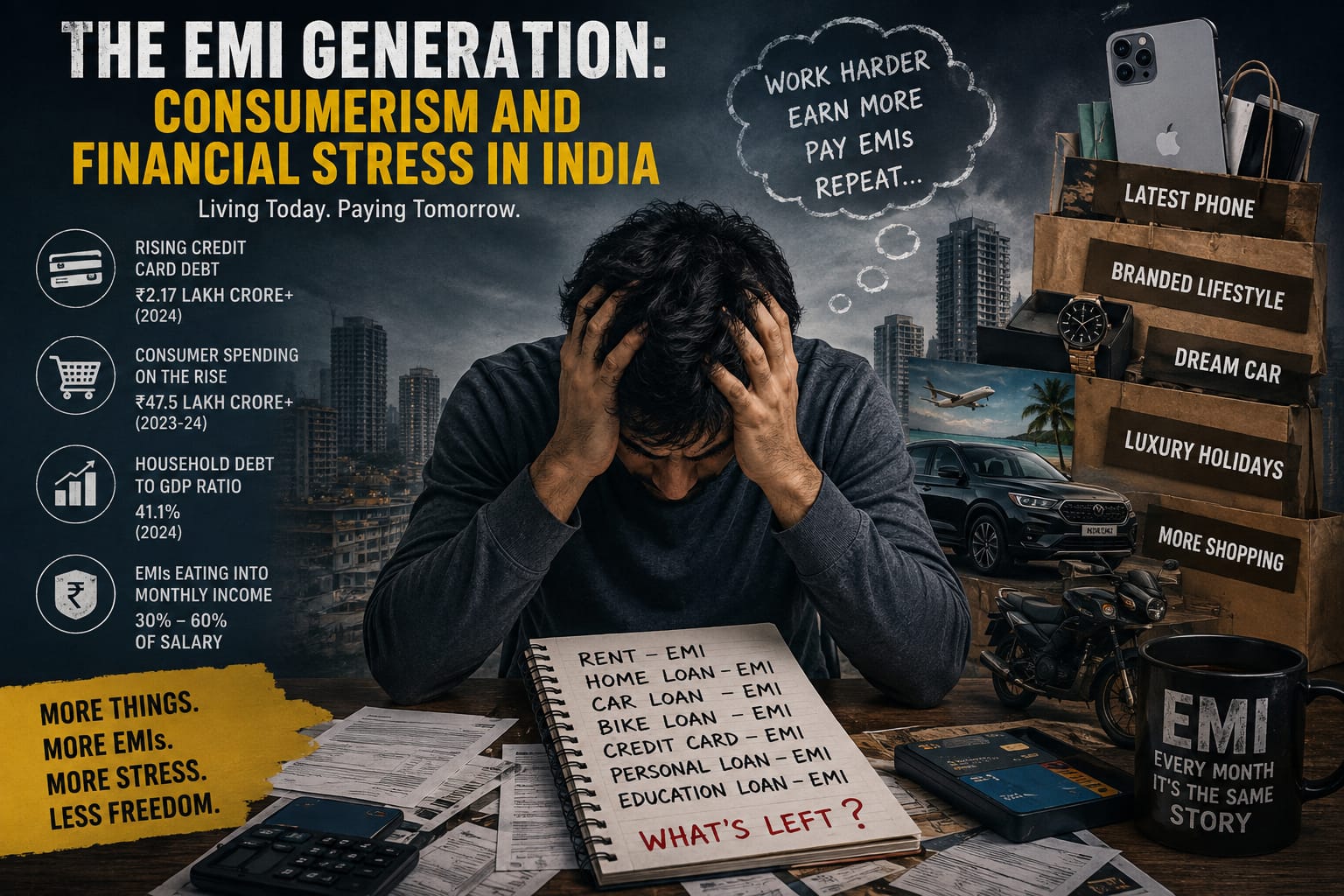
The EMI Generation: Consumerism and Financial Stress in India
Not long ago, Indians were known as cautious savers. Families postponed purchases until they had accumulated enough funds.Debt was largely used for buying a home, funding education and business, or meeting emergencies. Today, that financial culture is undergoing a dramatic transformation.The consumer mindset has evolved from a legacy culture of 'save to spend' to a modern framework of instant, credit-enabled acquisition.
Credit has become so accessible that affordability is no longer measured by the total price of a product but by the size of the monthly installment.The distinction may appear subtle, but its financial consequences are profound.
This is the rise of India’s EMI Generation, a generation that live beyond means.While expanding access to credit has deepened financial inclusion and stimulated consumption, it has also raised crucial questions about household debt, financial resilience, and the sustainability of India’s consumption-led growth.
India’s Consumption Story
India is one of the world’s fastest-growing consumer markets. Easy access to credit ,instant loans ,rising disposable incomes, rapid urbanisation,digital payments, and a thriving e-commerce ecosystem have reshaped consumer behaviour.
Consumerism today is driven less by necessity and more by aspiration. Social media has blurred the line between wants and needs. Every scroll presents images of luxury lifestyles, premium gadgets, and branded fashion. The fear of missing out encourages individuals to spend not merely for utility but for social acceptance.
The expansion of formal credit has been equally remarkable. According to recent industry data, the share of Indians with access to formal retail credit has increased from 35% in 2017 to nearly 74% by 2026, reflecting a massive expansion in financial inclusion.Millions who were previously excluded from the formal financial system can now access credit and participate in the economy.
However, greater access to credit also demands greater financial responsibility.
Household Debt: A Growing Concern
The Reserve Bank of India (RBI) has repeatedly highlighted the changing nature of household borrowing.Recent RBI data indicate that household debt has continued to rise, touching 45.5% of GDP by September 2025, largely driven by non-housing retail loans such as personal loans, credit cards, and consumer financing.
The concern is not simply the level of debt but its composition.When debt finances depreciating assets rather than wealth creation, financial vulnerability increases.
Easy credit has undoubtedly improved convenience.The danger emerges when unexpected shocks occur.A medical emergency, job loss, salary reduction, or prolonged inflation can quickly convert manageable EMIs into overwhelming liabilities. Families with little emergency savings often respond by taking additional loans or revolving credit card balances, landing into a debt trap.
Financial Stress Is Also a Mental Health Issue
Debt is not only an economic issue but also a psychological one.
Young professionals often enter their careers carrying education loans, car loans, credit card debt, and consumer EMIs. Constant repayment obligations can generate anxiety, sleep disturbances, strained relationships, and declining workplace productivity.
Unfortunately, debt remains a social taboo. Many borrowers hesitate to discuss repayment challenges or seek financial counseling until problems become severe.
Towards Responsible Consumerism
We do not need less but smarter consumption.
Financial literacy must become as important as digital literacy.Consumers, too, must adopt a few simple principles:
- Distinguish needs from lifestyle-driven wants.
- Keep total EMI commitments within manageable limits.
- Build an emergency fund for rainy days and invest consistently.
- Avoid financing rapidly depreciating assets through high-interest debt.
Conclusion
India’s consumer revolution reflects confidence, ambition, and economic progress. Easy credit has democratised opportunity, expanded financial inclusion, and accelerated economic growth. Yet the same forces that have fueled prosperity can also create vulnerability if borrowing outpaces earning.
The defining question for India’s EMI Generation is not whether credit should be embraced or rejected. It is whether credit remains a tool for empowerment or becomes a substitute for income.
A nation that has long celebrated the virtues of saving must now rediscover the balance between aspiration and prudence. Consumption drives growth, but financial discipline sustains it. The true measure of prosperity lies not in the ability to buy everything today but it is the ability to secure tomorrow.
By Mahima Kansal