


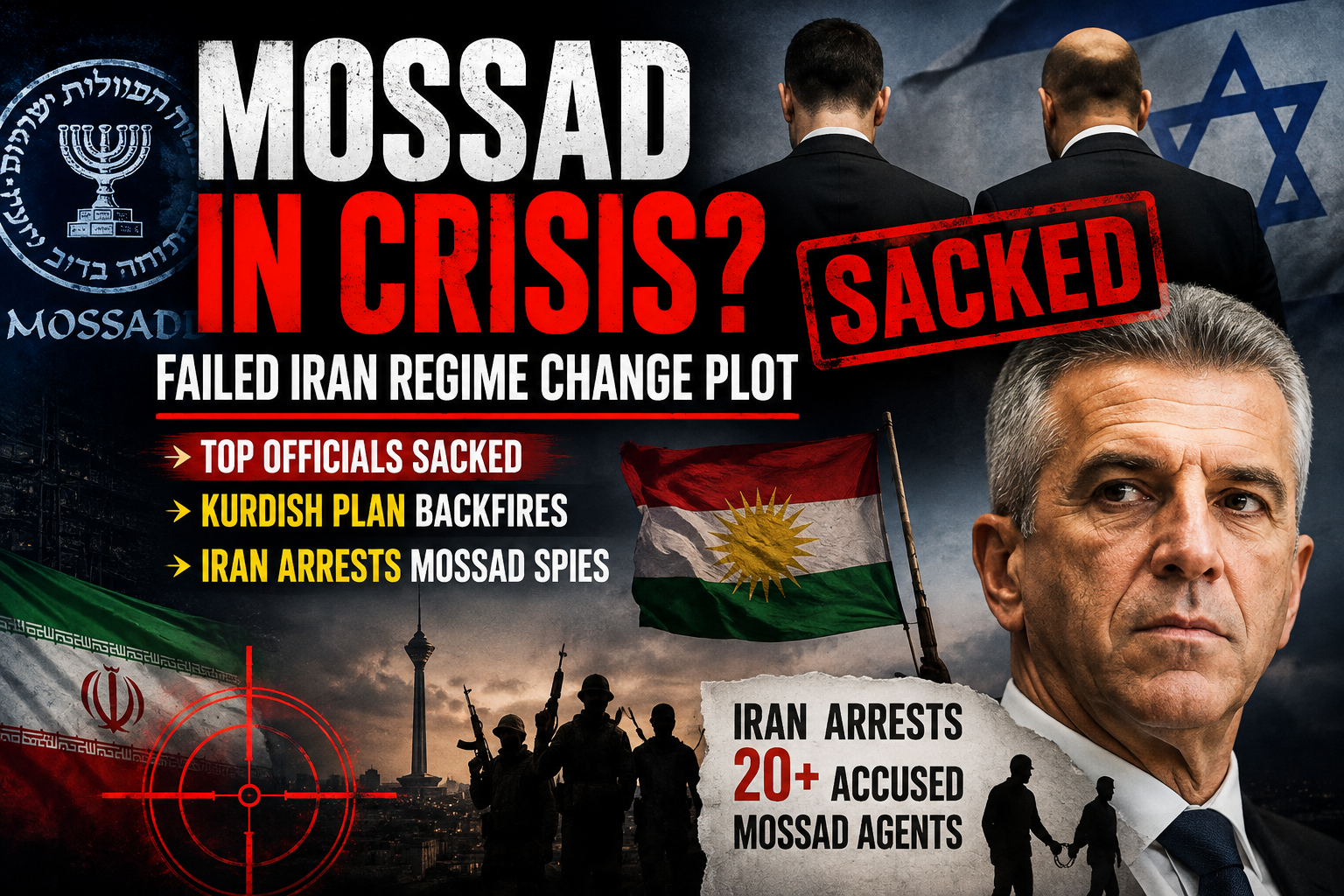
MOSSAD IN CRISIS? THE FAILED IRAN REGIME-CHANGE PLOT
What if Israel’s biggest intelligence gamble in Iran did not fail on the battlefield but inside the shadows of Tehran itself?
A stunning shake-up is now being reported inside Israel’s Mossad after the Iran war, with the agency’s new director, Roman Gofman, reportedly removing two senior officials linked to an ambitious plan to topple Iran’s Islamic Republic.
The bigger question is not simply who was removed.
The real question is: Did Israel miscalculate the possibility of turning Iran’s internal unrest into regime change?
What exactly is Mossad?
Mossad is Israel’s foreign intelligence agency broadly comparable in function to the CIA in the United States or MI6 in Britain. Its responsibilities include intelligence collection abroad, covert operations and countering threats to Israel outside its borders.
And Iran has long been one of Mossad’s most important targets.
For years, Israel and Iran have fought a shadow war involving intelligence networks, cyber operations, sabotage, assassinations and attempts to penetrate each other’s security apparatus.
Mossad does not publicly disclose the details of its networks inside Iran. But Israeli reporting has repeatedly indicated that the agency has cultivated human intelligence and clandestine capabilities there.
That shadow network became particularly visible during the recent conflict, when Israel demonstrated an ability to strike highly sensitive Iranian targets with remarkable intelligence precision.
But intelligence penetration is one thing.
Changing a regime is another.
The regime-change plan
According to Israeli media reports, two senior Mossad officials were deeply involved in developing a written operational concept aimed at bringing down Iran's Islamic Republic.
One was reportedly the head of Mossad’s Intelligence Directorate, while the other headed its Iran division. The plan reportedly envisaged exploiting Iran’s ethnic minorities, reviving mass protests and using Kurdish forces as a potential ground component of a wider campaign against Tehran.
The reported concept was extraordinarily ambitious.
Israeli and American strikes would weaken Iranian security and military positions, particularly around *Iranian Kurdistan.
Kurdish fighters could then move across the border from Iraq.
The expectation, according to reports, was that thousands of Iranian Kurds could join the movement, creating a wider uprising while mass protests inside Iran would simultaneously intensify.
The ultimate objective?
Turn military pressure into political collapse.
Why the Kurds?
This is where the strategy becomes particularly significant.
Iran has a substantial Kurdish population concentrated largely in the northwest, close to the borders with Iraq and Turkey.
There are also Iranian Kurdish opposition organisations, some of which have armed wings and bases or support networks in Iraqi Kurdistan.
Earlier this year, reports indicated that Iranian Kurdish factions were preparing for the possibility of a ground offensive against Tehran’s forces. Axios reported that U.S. and Israeli officials viewed Kurdish forces as a possible component of a broader strategy to pressure the Iranian regime.
But there is a fundamental problem.
Kurdish opposition does not automatically translate into a nationwide Iranian uprising.
Iran's Kurdish population is only one part of a highly complex ethnic and political landscape.
And Kurdish organisations themselves have different agendas.
For Israel, therefore, the calculation appears to have been that a regional insurgency could become the spark for a much larger national revolt.
That calculation appears not to have materialised.
Where did the plan go wrong?
Israeli reporting says Israel and the United States did strike Iranian military and security targets in the northwest during the opening phase of the war, partly in a manner that could have facilitated Kurdish movement.
But according to the reporting, the larger Kurdish ground operation was ultimately abandoned.
Three factors reportedly played a role:
Leaks, Turkish opposition and Kurdish caution.
And this exposes the central weakness of the entire regime-change strategy.
You can destroy military infrastructure from the air.
You can assassinate commanders. You can disrupt communications. You can penetrate intelligence networks.
But you cannot manufacture political legitimacy.
A population may oppose its government and still refuse to become an instrument of a foreign power.
That distinction is critical.
And now comes the Mossad shake-up
Mossad’s new chief, Roman Gofman, took over from David Barnea in June 2026.
According to the latest Israeli reports, Gofman has removed the two senior officials associated with the failed regime-change strategy.
But there is an important nuance.
Israeli security sources cited by The Times of Israel say the departures are being treated as part of a broader organisational restructuring, and that both officials are expected to remain within Mossad in other positions.
So is this really a purge?
Or is Gofman trying to tell Mossad:
“The Iran strategy has changed.”
That may be the more important story.
The Iranian counterstrike inside the spy war
At almost exactly the same time, Iran says it has arrested *21 people allegedly linked to Mossad* in Kerman province, along with four members of armed groups.
These are Iranian government claims and cannot independently establish the identities or affiliations of those arrested.
But strategically, the message is unmistakable.
Iran is saying:
"We are not blind. We are hunting the network behind the attacks.”
That means the war may have entered a new phase.
The missiles may have stopped.
The aircraft may have returned.
But the intelligence war continues.
The bigger geopolitical picture
The reported Mossad operation reveals something far more important than an internal reshuffle.
It exposes the enormous difference between *degrading a regime and replacing a regime.
Israel and the United States may possess extraordinary military and intelligence capabilities.
But Iran is not simply a collection of military installations.
It is a state with powerful security institutions, the IRGC, intelligence organisations, ideological networks and a deeply entrenched political structure.
And regime change requires something military power cannot guarantee:
an alternative centre of political authority capable of taking control once the existing system begins to collapse.
That is the missing piece.
Even if protests erupt…
Even if military commanders defect…
Even if Kurdish fighters advance…
Who governs Iran the morning after?
That remains the unanswered question.
And this is where the Mossad shake-up becomes significant. Gofman may now be facing a strategic dilemma.
Does Mossad continue investing heavily in clandestine networks and internal destabilisation?
Or does Israel return to a narrower objective:
intelligence superiority, military containment and preventing Iran from rebuilding its nuclear and missile capabilities?
The answer could shape the next phase of the Israel-Iran confrontation.
Because if the regime-change strategy failed, Israel may have to accept a difficult reality:
Removing the leadership of a state is far easier than replacing the state itself.
So, is Mossad really in crisis?
Or is this the beginning of a strategic reset after an intelligence operation that could not convert military pressure into political revolution?
And perhaps the biggest question of all:
Can an outside power ignite a revolution or does a revolution have to come from within?
Because in Iran, the shadow war may be entering its most dangerous phase yet.
The bombs may have stopped falling.
But the battle for Tehran’s future may only just be beginning.