


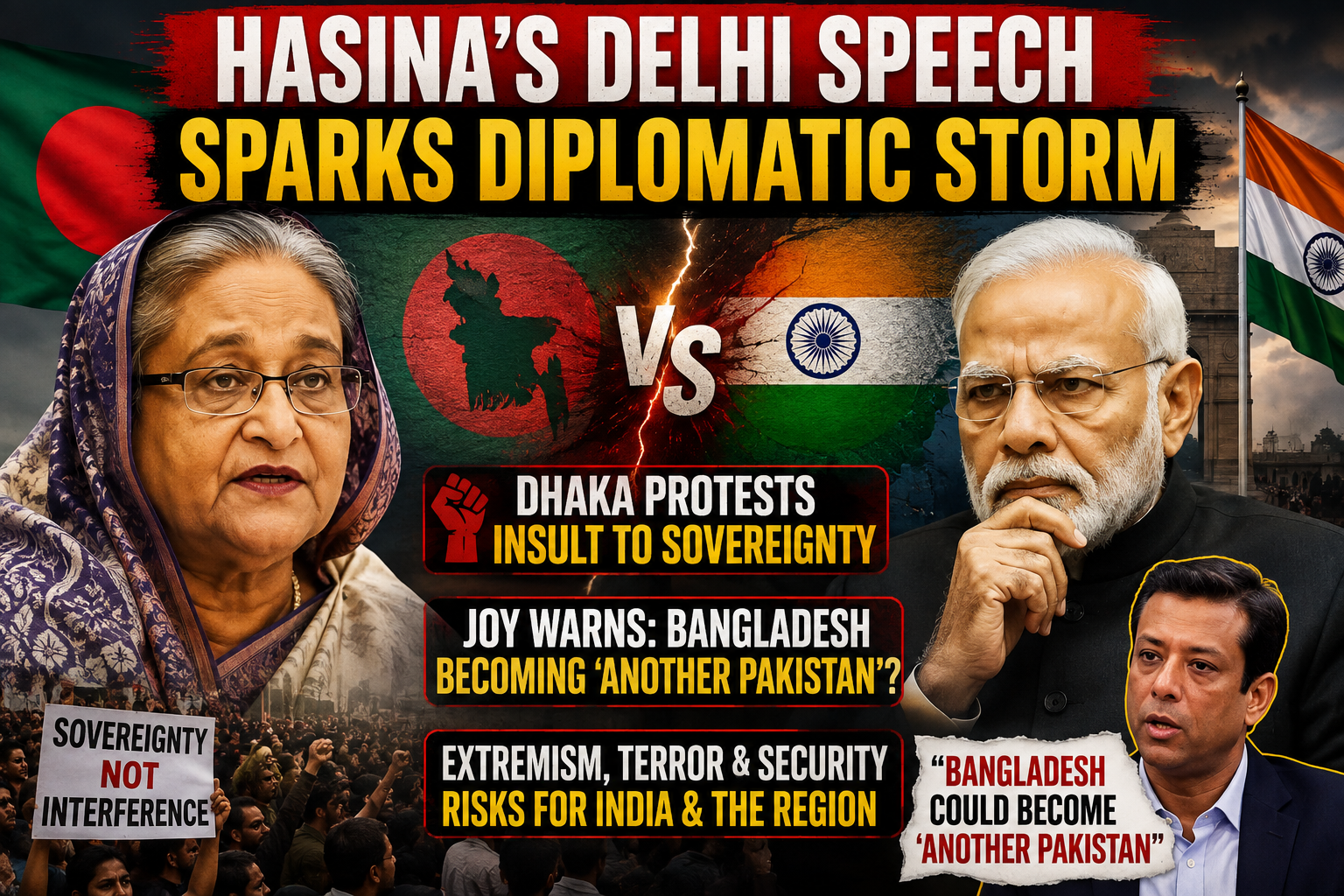
Is Sheikh Hasina turning into the biggest fault line between India and Bangladesh?
What happens when a former Prime Minister, now living in India, publicly challenges the political establishment of her own country and the government in Dhaka responds by accusing India of allowing its soil to be used for an assault on Bangladesh's sovereignty?
And what happens when, at exactly the same time, Sheikh Hasina's son, Sajeeb Wazed Joy, warns that Bangladesh could be moving towards becoming "another Pakistan" because of the growing influence of extremism?
Is this simply another diplomatic disagreement between two neighbours?
Or are we witnessing the beginning of a much deeper geopolitical shift in South Asia?
Because behind the latest diplomatic confrontation lies a much larger question:
*What happens to India-Bangladesh relations when Sheikh Hasina herself becomes the centre of the relationship?*
Let's understand this carefully.
On August 5, former Bangladesh Prime Minister Sheikh Hasina addressed a media interaction from New Delhi.
The event was held virtually with the Foreign Correspondents' Club of South Asia, and it marked one of her most significant public political interventions since she was forced out of power and left Bangladesh for India in August 2024.
And Hasina did not merely speak about the past.
She spoke about the future.
She called for the ban on her Awami League party to be lifted.
And, most importantly, she said she intends to return to Bangladesh in December.
That statement alone has enormous political implications.
Because Sheikh Hasina is not simply a former Prime Minister living in exile.
She remains one of the most polarising political figures in Bangladesh.
To her supporters, she remains the leader who transformed Bangladesh's economy, strengthened its international standing and maintained close strategic relations with India.
To her opponents, she represents authoritarian rule, political repression and responsibility for the violence surrounding the 2024 uprising.
And therefore, when Sheikh Hasina speaks from India, her words do not remain confined to India.
They immediately travel across the border into Bangladesh's political battlefield.
And this time, Dhaka reacted strongly.
The Bangladesh government lodged a protest over her media interaction and described the event as deeply offensive to Bangladesh's sovereignty and to those who lost their lives during the 2024 uprising.
Dhaka also warned that such developments could damage efforts to reset relations between Bangladesh and India.
Now, this is where the story becomes extremely interesting.
Because India and Bangladesh are looking at the same event through two completely different lenses.
For Dhaka, the question is:
Why is a former Prime Minister, facing serious legal and political consequences in Bangladesh, being allowed to publicly address the Bangladeshi people from Indian territory?**
For New Delhi, the argument is very different.
India's Ministry of External Affairs has made it clear that the Indian government neither organised the media interaction nor endorsed Sheikh Hasina's statements.
In other words, New Delhi is drawing a very clear distinction:
*Sheikh Hasina's political statements are Sheikh Hasina's own statements—not statements of the Indian government.*
Legally and diplomatically, that distinction is important.
But geopolitically, perception can be even more important than official explanations.
And that is where the real problem begins.
Because Dhaka may ask:
If India did not endorse the event, why was it allowed to take place from New Delhi?
And India's answer may be:
Because India cannot be expected to censor the political speech of an individual simply because another government objects to it.
So we have two competing principles:
Bangladesh is talking about sovereignty and political sensitivity.
India is talking about non-interference and individual expression.
And somewhere between these two positions lies the future of bilateral relations.
But there is an even deeper layer.
Sheikh Hasina's presence in India has been a sensitive issue since August 2024.
Bangladesh has sought her extradition.
India has said the request is being examined through legal and judicial processes.
And while that issue remains unresolved, Hasina continues to speak publicly from India.
This creates a diplomatic contradiction that is increasingly difficult for both sides to manage.
Dhaka wants Hasina back.
Hasina says she wants to return.
India has not handed her over.
And now Hasina is using her presence in India as a political platform to speak about Bangladesh.
So the question becomes:
Is Sheikh Hasina's exile slowly becoming a permanent diplomatic problem between New Delhi and Dhaka?*
There is another important question.
How are ordinary Indians looking at this?
For many Indians, particularly those who remember the close India-Bangladesh security relationship during Hasina's tenure, there is a perception that her government was an important strategic partner for New Delhi.
During her years in power, India and Bangladesh significantly expanded cooperation on security, connectivity, trade and counter-terrorism.
Her government was also regarded in India as being more willing to cooperate on India's concerns regarding insurgency and security in the Northeast.
So from an Indian strategic perspective, Sheikh Hasina is not merely a former foreign leader.
She represents a period when India enjoyed considerable strategic comfort in its eastern neighbourhood.
But Bangladesh has changed.
Its politics have changed.
Its leadership has changed.
And its public mood has changed.
Therefore, New Delhi now faces an extraordinarily difficult balancing act.
India has to maintain relations with the government currently in Dhaka.
But it also has to manage its relationship with a former leader who is physically present on Indian soil.
And India cannot afford to let either side believe that it has completely abandoned the other.
That is the diplomatic tightrope.
Now look at this from Bangladesh's perspective.
Why is Dhaka so angry?
Because Sheikh Hasina's speech was not simply a historical reflection.
It was political.
She questioned the legitimacy of the political circumstances surrounding her removal.
She demanded political space for the Awami League.
And she announced her intention to return.
Therefore, from the perspective of the current Bangladeshi establishment, her continued political activity from India can be interpreted as an attempt to influence Bangladesh's domestic politics from outside the country.
That is why Dhaka sees the issue as much larger than a press conference.
For Bangladesh, this is about sovereignty.
But for India, it is also about a basic diplomatic principle:
Can one sovereign country dictate what a political figure can or cannot say while physically present in another sovereign country?
And this disagreement could become extremely dangerous if it is not carefully managed.
Because India and Bangladesh are not distant countries.
They share a border of more than four thousand kilometres.
They share rivers.
They share trade routes.
They share security concerns.
They share cultural and historical connections.
India's Northeast depends significantly on connectivity through Bangladesh.
Bangladesh, meanwhile, cannot ignore India's geographic and economic importance.
Therefore, neither country can simply walk away from the relationship.
But relationships between neighbours do not collapse overnight.
They deteriorate gradually.
First comes mistrust.
Then suspicion.
Then diplomatic protests.
Then political rhetoric.
Then public anger.
And finally, every bilateral issue begins to be interpreted through the lens of confrontation.
That is the real danger.
And this brings us to another major development.
Sajeeb Wazed Joy.
Sheikh Hasina's son and political adviser has been warning that Bangladesh could become "another Pakistan."
Joy has expressed concern over what he describes as the growing influence of Islamist and extremist forces in Bangladesh.
He has argued that if extremist groups gain greater political and operational space, the consequences may not remain limited to Bangladesh.
They could create security challenges for India and the wider region.
Now, these are political claims made by Joy.
They should not be treated as independently established facts.
But they deserve strategic attention.
Why?
Because Bangladesh has experienced Islamist militancy before.
The country has seen extremist networks emerge, recruit and carry out terrorist attacks.
And India has its own reasons to be concerned about developments in Bangladesh.
Think about geography.
India's Northeast lies directly next to Bangladesh.
The region has historically faced insurgency and cross-border security challenges.
So if Bangladesh were ever to experience a significant deterioration in internal security, India would inevitably feel the consequences.
The concerns could include radicalisation, extremist recruitment, trafficking, illegal arms movement, terror financing and cross-border militant activity.
That is why Joy's warning has strategic resonance in India.
But there is a major analytical caution here.
*Bangladesh is not Pakistan.*
The comparison is politically powerful, but historically and socially it is much more complicated.
Bangladesh was born out of the 1971 Liberation War against Pakistan.
Its national identity is deeply connected to Bengali language, culture and nationalism.
Its political and social trajectory is different.
Therefore, saying Bangladesh is simply becoming "another Pakistan" would be an oversimplification.
But the question beneath Joy's warning is important.
Could a stronger Islamist political ecosystem gradually alter Bangladesh's internal political balance?
Could it influence foreign policy? Could it affect India's security? Could it create new space for extremist networks?
These are legitimate strategic questions.
And India cannot afford to ignore them.
But India must also be careful not to frame every political development in Bangladesh through the lens of extremism.
Because that could itself become counterproductive.
If Bangladesh's population begins to believe that India views its entire political transformation as an extremist project, anti-India sentiment could intensify.
And that brings us to the most important danger.
The danger of a self-fulfilling prophecy.**
Suppose Bangladesh believes India is still politically aligned with Sheikh Hasina.
Suppose Indian public opinion believes Bangladesh is moving towards Islamist radicalisation.
Suppose Bangladeshi politicians then use anti-India rhetoric to consolidate their support.
Suppose India responds by becoming more security-conscious.
Then Bangladesh interprets that as Indian interference.
Then Dhaka moves closer towards other strategic partners.
And India sees that as confirmation of its original concerns.
This is how geopolitical mistrust becomes self-perpetuating.
And who benefits from that?
Potentially, third countries.
China is already a major economic and strategic player in Bangladesh.
Pakistan has also been seeking to improve relations with Dhaka after years of distance.
Bangladesh does not have to choose one side permanently.
It can balance between India, China, Pakistan and other international partners.
And that is exactly why India needs to be careful.
The danger for New Delhi is not necessarily that Bangladesh suddenly becomes an ally of China or Pakistan.
The greater danger is that India gradually loses strategic influence in a country that is geographically indispensable to India's eastern security.
And there is another dimension.
The Bay of Bengal.
Bangladesh occupies an extremely important position in the maritime geography of South Asia.
The country connects the Indian subcontinent to Southeast Asia.
Its ports, coastline and connectivity corridors have growing strategic importance.
Therefore, India-Bangladesh relations are not just about land borders.
They are about the future security architecture of the Bay of Bengal.
They are about India's Northeast.
They are about trade corridors.
They are about energy.
They are about water.
They are about migration.
They are about counter-terrorism.
And they are about the larger competition for influence in South Asia.
That is why the present crisis deserves much more attention than simply another diplomatic protest.
Now let's look at the international perspective.
The world is watching Bangladesh's political transition through three major questions:
*Democracy.*
Human rights.**
Political accountability.**
The violence surrounding the 2024 uprising remains one of the most controversial chapters in Bangladesh's recent history.
The United Nations has documented serious human-rights violations connected with the crackdown.
At the same time, Bangladesh is now attempting to establish a new political order after the fall of Hasina.
Therefore, the international community has a difficult task.
It must support democratic transition and accountability.
But it must also avoid allowing political vengeance to replace the rule of law.
That distinction is extremely important.
Because if Sheikh Hasina is prosecuted, the world will watch how the process is conducted.
If she is extradited, the world will ask whether due process has been guaranteed.
If she remains in India, Bangladesh will continue to question India's position.
And if she returns to Bangladesh, the question will be whether her return triggers another political confrontation.
Every possible outcome carries risks.
And that is why the December deadline announced by Sheikh Hasina is so important.
She has said she intends to return to Bangladesh in December.
Now imagine the possibilities.
What happens if she actually returns?
Does Bangladesh arrest her?
Does she face trial?
Does the Awami League attempt to reorganise?
Do her supporters mobilise?
Does political violence return?
And what happens to India-Bangladesh relations if New Delhi is forced to make a decision regarding her movement?
These questions do not have easy answers.
But they show why Sheikh Hasina's political future has become inseparable from India's diplomatic calculations.
Now, let's come back to the central question.
Will this latest dispute permanently damage India-Bangladesh relations?
Probably not.
But it can certainly damage trust.
And that may be enough to create long-term problems.
Because India and Bangladesh have too many common interests to completely break relations.
Their geography forces cooperation.
Their economies encourage cooperation.
Their security interests require cooperation.
But cooperation without trust becomes transactional.
And transactional relationships are fragile.
One border incident can create a crisis.
One political statement can trigger retaliation.
One visa decision can become a diplomatic weapon.
One trade decision can be interpreted as punishment.
And gradually, the relationship becomes dominated by suspicion.
That is the scenario both sides should avoid.
For Bangladesh, there is a strategic danger in turning every India-related issue into a sovereignty confrontation.
Bangladesh needs India for trade, connectivity, energy, border security and regional access.
For India, there is an equally serious danger in appearing to treat Sheikh Hasina as its only acceptable political partner.
Bangladesh is a sovereign country.
Its political future will ultimately be decided by Bangladeshis.
India's long-term interest should therefore be in maintaining a relationship with *Bangladesh as a state*, not merely with one political leader or one political party.
That is the difference between short-term political alignment and long-term strategic diplomacy.
And perhaps that is the biggest lesson from this entire episode.
*Sheikh Hasina may have left Bangladesh but the Hasina question has not left India-Bangladesh relations.*
In fact, it may be becoming the defining issue.
Her media interaction from New Delhi has triggered a strong protest from Dhaka.
India has rejected the suggestion that it endorsed her statements.
Sajeeb Wazed Joy is warning about extremism and what he describes as the possibility of Bangladesh becoming "another Pakistan."
And the wider region is watching.
But the most important question is not whether India supports Hasina.
It is not whether Bangladesh opposes Hasina.
The real question is:
Can India and Bangladesh prevent their entire bilateral relationship from becoming hostage to one former Prime Minister?
Because if they cannot, the consequences will extend far beyond Sheikh Hasina.
They will affect the India-Bangladesh border.
They will affect India's Northeast.
They will affect the Bay of Bengal.
They will affect China's strategic calculations.
They will affect Pakistan's regional ambitions.
And ultimately, they could reshape the balance of power in South Asia.
So the question South Asia must now ask is not simply:
Where is Sheikh Hasina?"
She is in India.
The bigger question is:
Where is Bangladesh heading?"
And perhaps the most important question for New Delhi is even more uncomfortable:
*Will India-Bangladesh relations be defined by geography and shared interests—or by the politics of one former leader?*
Because neighbours can change governments.
They can change alliances.
They can change political narratives.
But they cannot change geography.
And the geography of India and Bangladesh demands one thing above all:
Dialogue before confrontation, strategy before emotion, and long-term national interest before short-term political calculations.
The future of this relationship may depend on whether New Delhi and Dhaka understand that before the current fault line becomes a permanent fracture.
And the final question is this:
If Sheikh Hasina's voice continues to echo from India, and Dhaka continues to hear that voice as a challenge to its sovereignty, will New Delhi and Dhaka find a way to separate the Hasina issue from the India-Bangladesh relationship or will one former Prime Minister become the reason two strategically indispensable neighbours drift further apart?