


Beyond the Report Card: The Hidden Burden on Students
Authored By:-Mahima Kansal
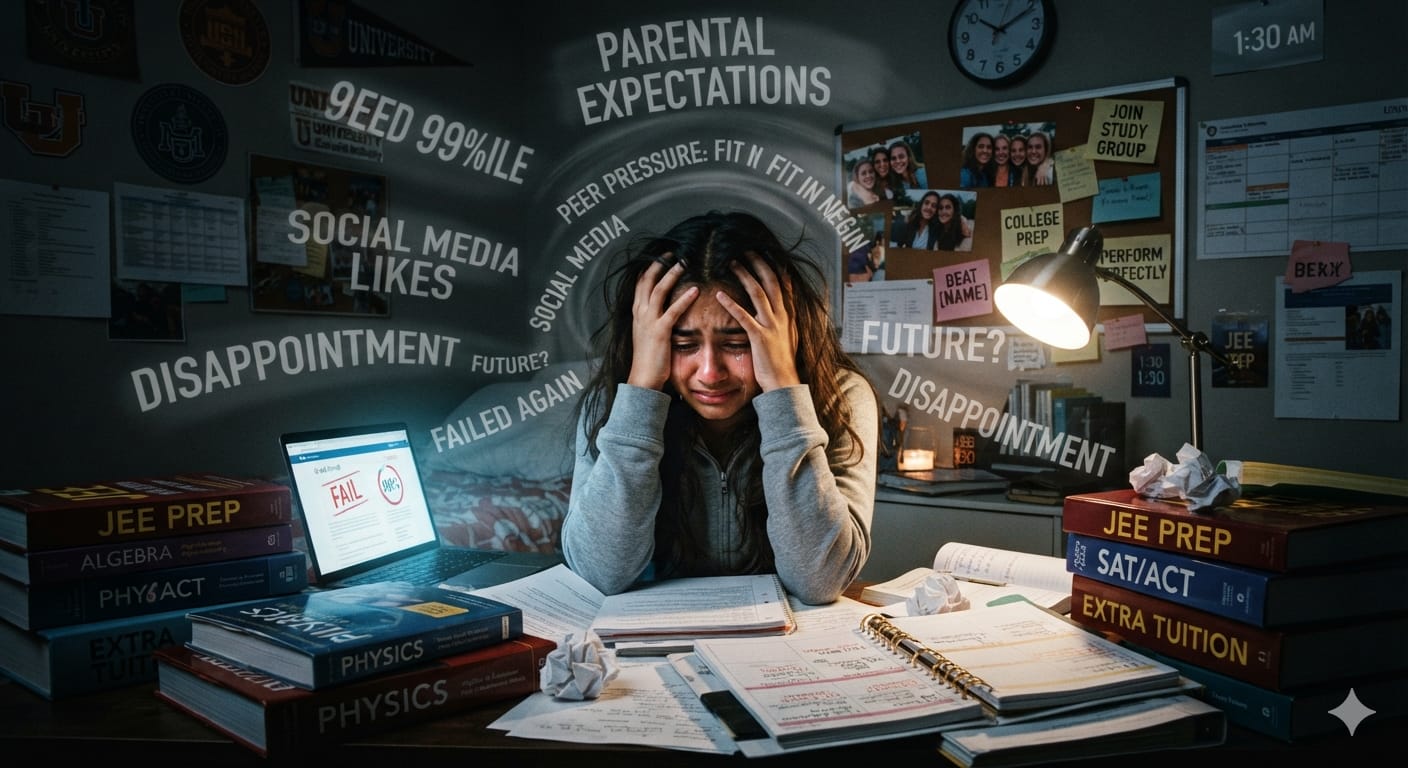
A report card can measure performance. But can it measure pressure, anxiety, sleepless nights, or the fear of disappointing everyone? Unfortunately, it cannot.
A percentage can tell us how a student performed in an examination. A rank can tell us where they stood among their peers. A pass or fail can tell us the outcome. But none of these can tell us,"what it took to get there?" The report card shows the marks. It does not show the burden.
When Exams Become More Than Exams
For many students, examinations are no longer perceived as a way to assess learning . Instead they feel like a judgement on intelligence, ability, career prospects, and even self-worth. The pressure begins early. Who stood first? Why didn't you get more marks? Look at your cousin, he is already preparing for competitive exams. What may be intended as motivation can gradually become comparison. School examinations lead to board examinations. Board examinations lead to entrance tests. Entrance tests lead to college admissions, internships and placements. There always seems to be another competition to enter and another benchmark to cross. The result is a generation that often feels it is running a race without knowing where the finish line is.
Peer Pressure: The Invisible Competition
Peer pressure isn't always obvious. Sometimes, it is simply watching a classmate study for ten hours and thinking: “Am I doing enough?” It is seeing a friend score higher and questioning your own intelligence. And social media has made comparison almost impossible to escape. Students are constantly exposed to toppers, rank holders, scholarship winners, entrepreneurs and carefully curated success stories. What they rarely see are the failed attempts, uncertainty, anxiety and years of struggle behind those achievements.
Someone else's highlight reel can easily become another student's insecurity.
When Marks Become Identity
There is nothing wrong with wanting good marks. Academic achievement matters. It can reflect dedication, understanding and hard work, and it can create opportunities. The problem begins when marks stop being a measure of performance and start becoming a measure of identity. A student scoring 95% may be terrified of falling to 90%. A student scoring 75% may feel they have disappointed everyone. And a student who fails may begin thinking: “I am a failure.” But failing an examination and being a failure are two completely different things. When students begin equating their identity with their results, education become less about learning and more about avoiding failure.
The Silent Face of Exam Stress
Not every stressed student asks for help. Some become withdrawn. Others become irritable, lose interest in activities, struggle with sleep or constantly worry about results. Some continue to smile, attend classes and study while quietly struggling inside. Therefore, a sudden decline in academic performance should not automatically be labelled as laziness or lack of discipline. Sometimes the student is not unwilling to perform. The student is overwhelmed.
According to UNICEF India, an NCERT survey found that 11% of students reported anxiety, 14% experienced extreme emotions and 43% reported mood swings. Globally, the World Health Organization estimates that one in seven adolescents aged 10–19 experiences a mental health condition. These figures cannot be attributed solely to examinations or peer pressure. Mental health is influenced by multiple factors. But they highlight an important reality i.e., the emotional well-being of young people deserves serious attention.
Parents: From Evaluators to Allies
Most parents want their children to succeed. Their expectations often come from love, concern and a desire to give their children a secure future. But sometimes, that love can unintentionally become pressure. A parent may say:“You are capable of much more.” The child may hear: “What I am doing is never enough.” That's why Instead of asking , “How much did you score?” Parents should ask these questions:- “How was the examination for you?” “What did you find difficult?” “Is something worrying you?” “How can I support you?”
A report card should be the beginning of a conversation, not the end of it.
Schools Must Teach More Than Academics
Schools can not ,and should not eradicate healthy competition. But education must also equip students to handle pressure. Counseling, mentoring, emotional-literacy programs, stress-management education and safe spaces for students to speak openly should not be treated as optional extras. They are part of creating a healthier educational environment. Because if we teach students how to solve mathematical equations but never teach them how to manage overwhelming emotions, are we really preparing them for life?
Success Is Bigger Than a Score card
Human potential is multidimensional. A mark sheet can measure academic performance. It cannot measure curiosity, creativity, courage, kindness, leadership, resilience or emotional intelligence. The student who discovers a passion for music or any art form matters. The one who wants to become an artist, athlete, entrepreneur, designer or social worker matters. And so does the student who may not always come first but continues to show up, learn and try again.
A percentage is a number. A person is much more than a number.
Failure Is Not a Verdict
One of the most important lessons we can teach young people is that failure is not final. An examination can be retaken. A subject can be improved. A college rejection can lead to another opportunity. A career path can change. A disappointing result can become a learning experience. What can be far more damaging is the belief that failure makes someone worthless. Students need to understand that academic performance is one chapter of their story, not the entire book.
Beyond the Report Card
Perhaps it is time to change the questions we ask children. Instead of asking only, “How much did you score?” We should ask “How are you feeling?” Instead of ,“Look at what others have achieved.” We should say ,“Let's discover what you are capable of.”
Students do not need a world without expectations. They need a world where expectations are balanced with empathy. They need parents who support rather than compare. Teachers who recognize improvement as well as achievement. Friends who celebrate one another rather than compete over every mark. And schools where asking for help is seen as strength not weakness. Most importantly, they need to hear,“Your marks matter, but you matter more.”
The report card has its place. It can reflect academic progress and identify areas for improvement. But it should remain a record, not a verdict. Because behind every examination, there is a student who may be carrying expectations that no mark sheet can reveal. Education should not produce students who are afraid of failure. It should produce individuals who know how to face it. The real success story may never be written on a report card. Sometimes, it is written in the resilience of a student who struggled, stumbled, learned, and still chose to keep going.